An upcoming Veterans Day ceremony at Columbia High School aims to correct the record by honoring Black WWI veterans not listed on the school’s commemorative plaque that was installed decades ago.
Easily visible to anyone stepping though the main entrance, the WWI commemorative plaque at CHS holds the names of 270 veterans and men and women from the South Orange-Maplewood community who served in the war effort.
However, some local veterans never received recognition. Until now.
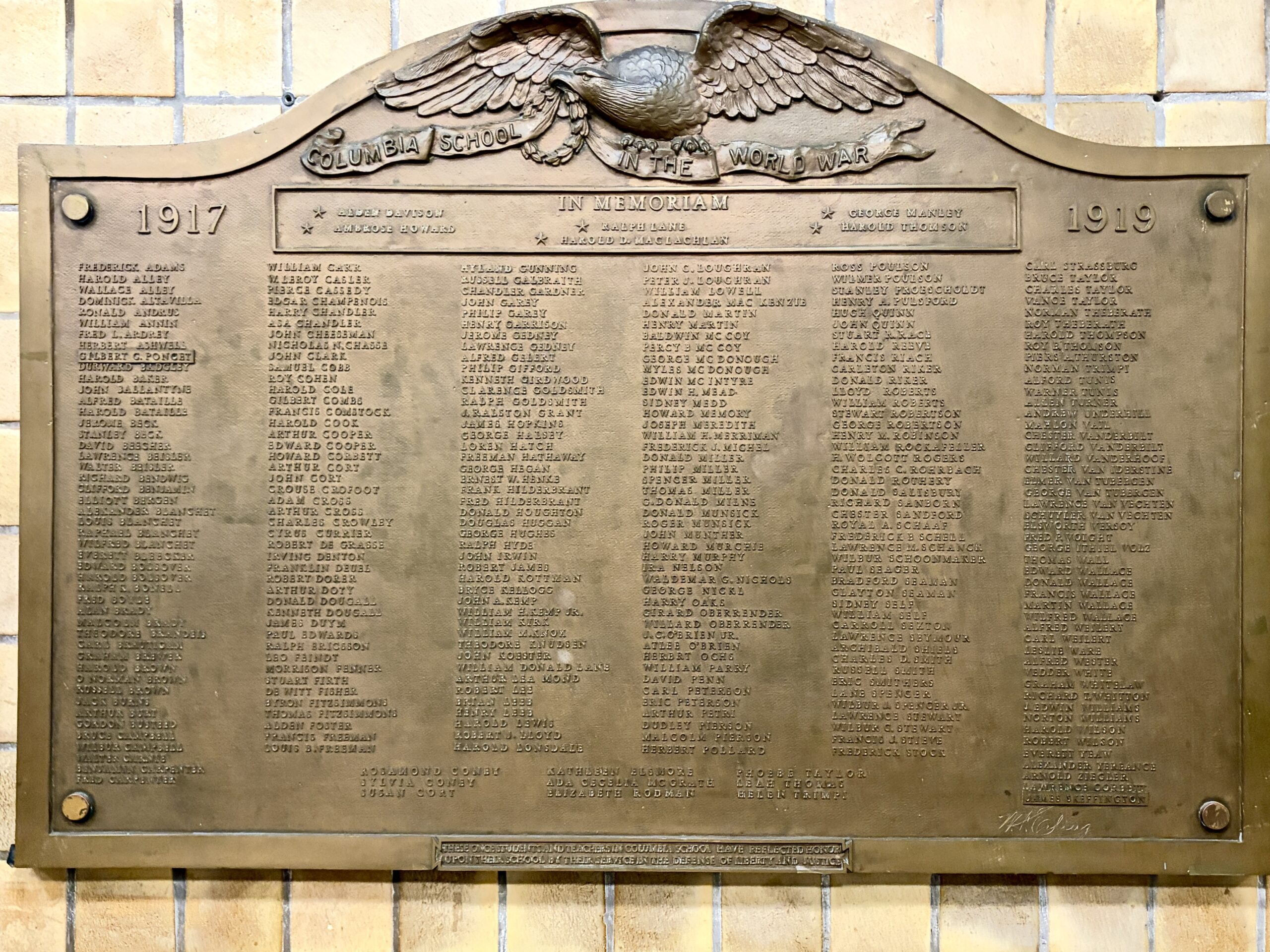
The commemorative plaque in the main hallway of Columbia High School honors those who served in WWI.
Volunteer archivists and former district teachers discovered the first missing vet while looking into a former South Orange High/Columbia High School student, Alice Johnson, the only Black student in her class.
One of those archivists and former teachers, Anne Wessel, recalls what she thought when she first found Alice: “What was it like for her? What was it like to be the only student of color in that class?”
Wessel’s interest was piqued. “I asked a friend to find more, and she found Dudley.”
Wessel was surprised to discover that Dudley was a 1910 graduate of South Orange/Columbia High School and served in WWI, yet his name was not on the plaque.
After further investigations, they found a total of five confirmed WWI veterans whose names had been left off of the original plaque. Besides Dudley Johnson, the others are: William W. Baskerville, John L. Beach, Edmond B. Jackson and Eardley Washington. (See detailed background information on all five at the end of this article.)
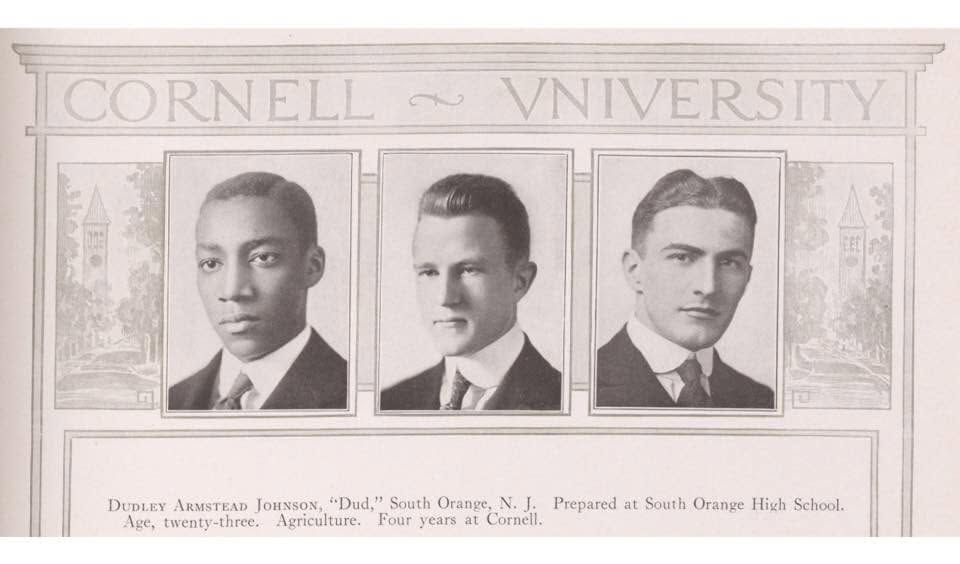
At left is Dudley Johnson, one of five WWI veterans and South Orange High School graduates (later Columbia High School) whose names will be added to the WWI commemorative plaque at CHS on Veterans Day. (Photo taken from the Cornell University Yearbook.)
South Orange Council members Summer Jones and Patricia Canning got involved and helped track down family and helped to officially give the servicemen the recognition they deserve.
“It went from being one person to five people that we found – and we suspect that there are more,” Jones said. “After we found these veterans, we wanted to check all the names. There were 200+ names, teachers, students, nurses, we couldn’t find one Black name. It was something that was of the time.”
The South Orange and Maplewood community has always prided itself on its diversity. However, the stories of Black and brown community members sometimes go untold – and their history in the towns goes back further than many people realize. At this moment, their stories are more relevant than ever, the council members said.
“In August, we also did a summary of businesses that existed in the 1920s in South Orange, [specifically] Black businesses. And there we saw the diversity of South Orange in that time. We saw how these companies thrived during that time,” said Canning. “So that spoke to the opportunity that existed for Black families at that time. And then we skip forward a few years, many years ahead and we wonder about progress and we wonder about the fact that these men were left off.”
Wessel said, “We have so much material going back to 1814 including books of photographs of students and whenever people see those students from the early 1900s they are surprised to see so many children of color in those books. So I don’t think we really have a good sense of our history.”
“Certainly, nationally, there is an initiative to deny history or hide history, and I think it says a lot about our community that we are not interested in participating in that,” Wessel said. “We want to know what things were like and I think it affects your identity when you realize what this community was about for a hundred years.”
Jones described the histories of the veterans: “Edmond Jackson; he was a Harlem Hellfighter… When you look at all of them in their service, being Black in 1917-1918 within the war was very difficult for those soldiers, fighting for a country that didn’t really accept you.”
“The same way they were treated in the military was the same way they were treated… seemingly all of these men survived; some of them would have been around when the plaque was put up,” Jones said. “The thought process of these men not even being posted on there, how they would have felt… it’s really difficult to think about.”
But now, the record is being rectified. And descendants of some of the servicemen – including 10 members of the Baskerville family – will attend the plaque dedication ceremony, Jones said.
“When you ask how the family feels, based on the reaction of those that are attending, I think that they love that this is happening,” she said. “I think it’s really important that they appreciate it.”
Said Canning: “So many people understand the politics around it and so appreciate that it has been uncovered; this is a story that hits not just the family, but a whole community of people who understand what it means to rewrite history.
“There’s stories that were lost,” she said. “And maybe being on that plaque they would have been represented a little bit better.”
Jones said adding the names will be meaningful for students. “I think that for Black and brown students, looking at the veterans plaque and knowing that there were people that should have been on there and knowing that their story doesn’t have to disappear is really key,” she said.
Overall, Jones and Canning emphasized that efforts to recognize and uphold untold stories are a continuing commitment, and that there are still untold stories remaining in the community.
“We’re giving back their voice, their presence – that they were here, and that they served,” Canning said.
According to Wessel, the archives show that the plaque itself was never thought of as containing the definitive record; rather, it was something that was meant to be expanded on over time.
The Superintendent at the time of the plaque’s dedication, Henry Ward Foster, acknowledged that the list was incomplete, even adding a list of seven possible unconfirmed names at the end of his official letter, she said.
“I looked at all the people on his original list,” Wessel said. “All but one are on the plaque.”
Councilwoman Jones said the list may still not be complete.
“We suspect that there are more – more students that were left off,” she said. “There’s stories that are lost, and maybe being on that plaque they would have been represented a little bit better.”
The ceremony will also include students, but there is not room to open it up to the public, since it is inside Columbia High School during the school day, Jones recently told the public at a Village Council meeting last week. But, she said, it will be recorded.
On Tuesday, November 3, CHS Principal Frank Sanchez shared the following background information on the five servicesmen with teachers and administration and The Village Green:
William Baskerville
William Waverly Baskerville was born on November 14, 1898, in Virginia. William’s grandparents were enslaved in what is now Baskerville, Virginia. As a child, William moved with his parents, John and Amanda, to South Orange where they became part of the local community and raised a large family. John was a Deacon at First Baptist Church of South Orange and the Baskerville children were raised at First Baptist. Education and military service were encouraged. Several generations of Baskervilles graduated from Columbia High School.
William’s name first appears in the Columbia School gradebook from 1906 when he entered first grade at age 7. Census records trace William’s life in South Orange for more than two decades. In 1910, he lived with his parents and his siblings on Valley Street. By 1920, the family was living on South Orange Avenue. Eventually, the family settled at 24 Second Street. William left school to go to work, which included jobs at an electric company and as a chauffeur. In 1930, William lived on Wyoming Avenue at the Shifman residence. That 1930 census also identifies him as a World War veteran.
During World War I, William served as a private in Company D of the 337th Labor Battalion, Quartermaster Corps. On June 6, 1918, he departed Newport News, Virginia, aboard the USS Powhatan for France. There, he worked to support the troops, including working as a cook before he returned from France on July 22, 1919. He was honorably discharged shortly after arriving home.
When his employer moved from New Jersey to Arizona, William went with them. William lived in Tucson and worked at the historic Black Elks Club. During segregation, the club was an important center of social life, civic action, music, and community organizing for Tucson’s Black residents. William also served in WW II as a corporal in the 391st Army Aviation Squadron.
William and his wife, Ethel Mae, settled in Tuscan and had three children, including Patricia Baskerville Dilworth. Patricia became a Freedom Rider during the Civil Rights Movement and later served 24 years in the United States Army, retiring as a sergeant major.
William died in Tucson on December 19, 1973. His life connects South Orange to a commitment to military service, Tucson’s Black civic community, and the continuing struggle for freedom and equality carried forward by his daughter.
John Langston Beach
John Langston Beach was born in Farmville, Virginia, in 1889 or 1892. Early Columbia School records show he was enrolled starting in 1900. John’s mother, Louisa, operated a laundry and then a restaurant at 152 South Orange Avenue. John was the youngest of Louisa’s five children, all sons.
John entered the United States Army on November 19, 1917, and reported to Camp Dix, New Jersey. His surviving military records document several assignments, including service connected with Battery A 350 Field Artillery Battalion, the 153rd Depot Brigade, and the 413th Labor Battalion. He completed his military service as a private in Company B of the 413th Labor Battalion.
John’s records do not show overseas deployment or participation in a particular battle. However, his service was still essential. John was a horseman in South Orange, and it was common for Field Artillery soldiers to work with munitions and horses. Depot brigades trained, organized, equipped, and transferred soldiers. Labor battalions performed the difficult physical work required to supply and sustain the Army.
After the war, John returned to New Jersey. He lived at 165 Church Street in South Orange and worked for the Works Progress Administration during the Great Depression. Later, he worked at Weequahic Park in Newark which was famous for trotters and harness racing.
John died in Newark on August 10, 1959. Fellow veterans from Guyton-Callahan American Legion Post Number 152 honored him with American Legion services. He is buried at the Essex County Veterans Memorial at Glendale cemetery in Bloomfield.
Edmond Bond Jackson
Edmond Bond Jackson was born in South Orange on November 7, 1894. He grew up at 152 South Orange Street with his parents, Matthew, who was born in Virginia, and Helen, his older brother Matthew, and his younger sister, Edith.
Edmond and John Beach were classmates at the Columbia School in 1900. In 1907, a newspaper recognized Edmond among the students who had been present every day and had not been tardy, crediting him with three years of attendance. Edmond left school in February of 1909. By 1910, when Edmond was 15, his family had moved to Newark.
In 1917, Edmond enlisted in the 15th Infantry of the New York National Guard. After entering federal service, the regiment became the 369th Infantry, remembered today as the Harlem Hellfighters.
The 369th served in Europe under French command because the segregated United States Army would not permit Black soldiers to fight alongside white American troops. The regiment spent 191 days in frontline trenches, longer than any other American regiment during World War I, and earned international respect for its bravery.
Edmond served overseas from November 11, 1917, until February 12, 1919. His military records trace his service through Companies A, D, and I, as well as Headquarters Company of the 369th Infantry. He was honorably discharged on February 24, 1919.
After the war, Edmond married Zenobia Benford in 1924. On the 1925 state census, his occupation is listed as soldier, and he and Zenobia live near West Point, in a community that included many military families. During the Great Depression, he worked for the WPA at the NYC headquarters for the Federal Art Project and Writer’s Project. Later records connect him to Helen Yancy. By 1940, he was living in New York City with Helen, then his wife, and working as a watchman for the city’s sewer department.
Edmond died on May 11, 1949 and is buried in Linden, NJ. His life connects the South Orange Black community to the distinguished World War I service of the Harlem Hellfighters. His story also reminds us that Black soldiers fought for democracy overseas while facing segregation and discrimination from their own country at home.
Dudley Armstead Johnson
Dudley Armstead Johnson was born in Brooklyn on November 1, 1892, and grew up at 318 Meeker Street in South Orange, a home owned by his parents, William and Alice. Dudley graduated from South Orange High School in 1910. He had one sister, Alice, who, like Dudley, graduated from the high school, although it was commonly referred to as Columbia High School when she graduated in 1915.
As a senior at South Orange High School, Dudley received the Harvey Underwood Prize and took an active role in the graduation ceremony for the class of 1910, which had suffered serious loss due to a typhoid fever outbreak.
In 1916, Dudley graduated from Cornell University’s School of Agriculture. Cornell’s yearbook identifies him as “Dudley Armstead Johnson,” nicknamed “Dud.” While at Cornell, Dudley was inducted into the Alpha Phi Alpha Fraternity. He later became one of the original 14 charter members of Alpha Alpha Lambda Chapter in Newark and served as its sergeant at arms and Social Committee chair.
Dudley entered the United States Army on August 5, 1918. He served overseas with Depot Company 18 from September 20, 1918 to August 4, 1919. In October of 1918 he was promoted to corporal. He had several assignments, including working with the American Expeditionary Forces Quartermaster Corps Depot, which provided the enormous logistical support for combat operations in Europe.
After returning home, Dudley worked as a farmer, landscape agriculturist, and contractor. A Cornell ribbon was found by recent owners of 318 Meeker as well as a written plan for expanding knowledge of farm management to area farmers and students through ten educational initiatives.
Dudley took a leadership role in his fraternity, as well as his church, the Church of the Epiphany in Orange, and the New Jersey Tennis Association.
Dudley’s life represents scholarship, military service, entrepreneurship, fellowship, and leadership in the greater South Orange community.
Eardley Washington
Eardley Washington was born on March 29, 1894, in South Orange, New Jersey. An only child, he lived with his parents, George and Mary Washington, at 1 Montague Place. Like the Baskervilles, Jacksons, and Beaches, the Washington family had roots in Virginia. Eardley started kindergarten in 1900 at age 6.
By 1910, Eardley had moved with his mother who worked as a housekeeper for a family in Mendham, New Jersey. By 1917, Eardley was living in Elizabeth, New Jersey, and working as a chauffeur. On June 30, 1918, he married Madeline Tucker at the home of her parents on South Seventh Street in Elizabeth.
Only a few weeks after his marriage, Eardley entered the United States Army on August 5, 1918. He trained at Camp Upton in New York and served as a private in the 27th Company of the 152nd Depot Brigade. Depot brigades received, trained, equipped, and assigned soldiers during the rapid expansion of the Army in World War I. Eardley was honorably discharged in December 1918.
After returning home, he continued working as a chauffeur, including employment with a factory. He and Madeline built their life together in Elizabeth.
Eardley Washington died in Newark in August 1928. He was only 34 years old. Although his life was brief, his records preserve the story of a young man from South Orange who answered his country’s call, served during World War I, and returned home to his family and community.
Adair Curry is a 12th grade student at Columbia High School who is working with Village Green as a paid student freelancer through a grant from the NJ Civic Information Consortium.
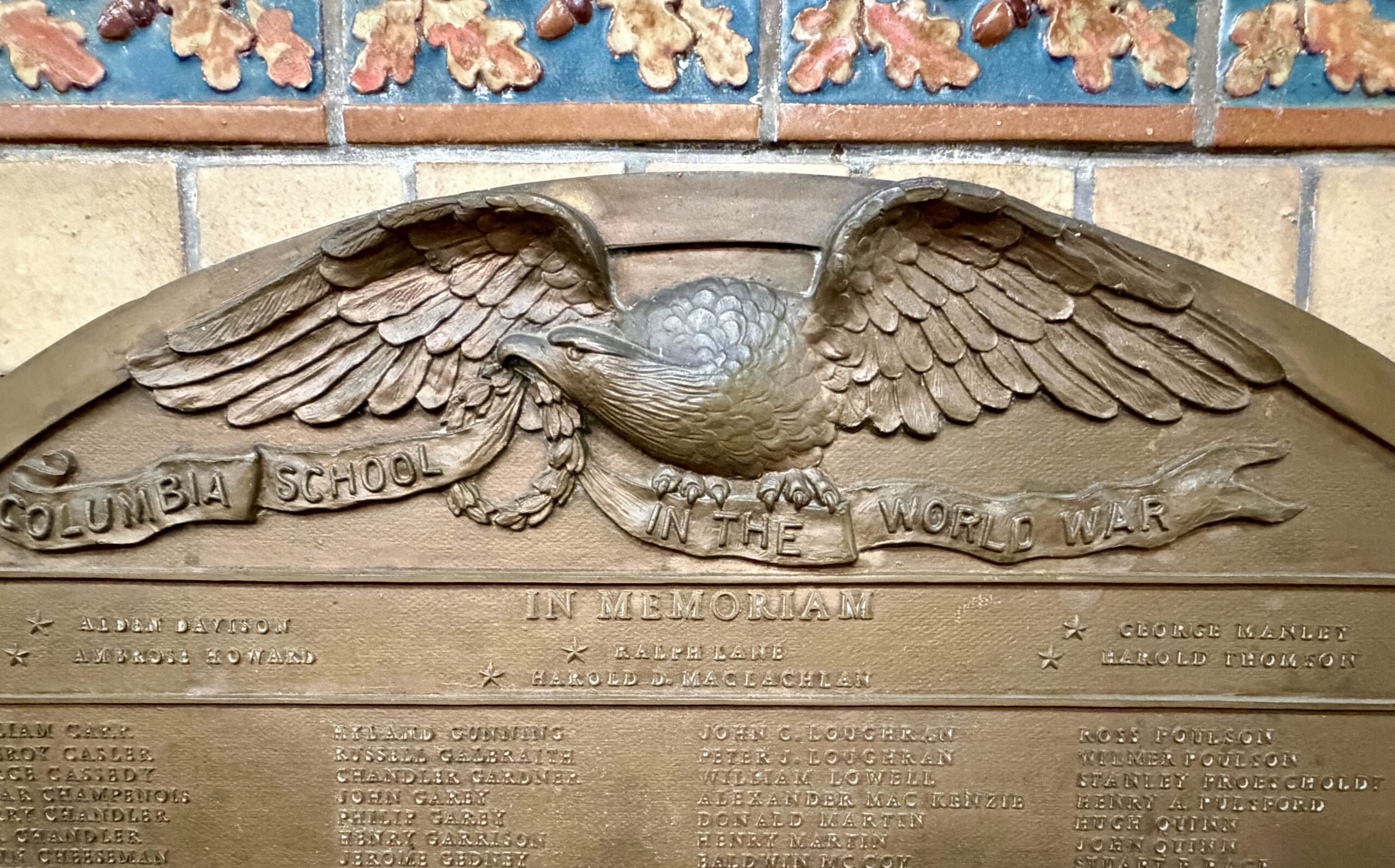
Detail of the top of the plaque at CHS.