This summer on a downtown Maplewood rooftop, six young middle school filmmakers stepped behind cameras while the local band Ouroboros performed a song, “The New Wave,” in a scene inspired by a legendary 1969 rooftop concert by The Beatles in London. The filming gave the young filmmakers an opportunity to plan and produce a music video of their own creation in their community.
The project was part of the inaugural summer program at South Mountain Film Academy (SMFA), a Maplewood-based program founded by cinematographer and director Chris Cassidy. Student filmmakers Jacob Cohan, Levi Farrington, Matilda Baden-Lyga, Roman Boghosian, Izzy Barmus, and Arlo Levi handled filming, chose camera placements and equipment, and helped select the best takes. Cassidy finished the post-production. (Their music video can be seen here.)
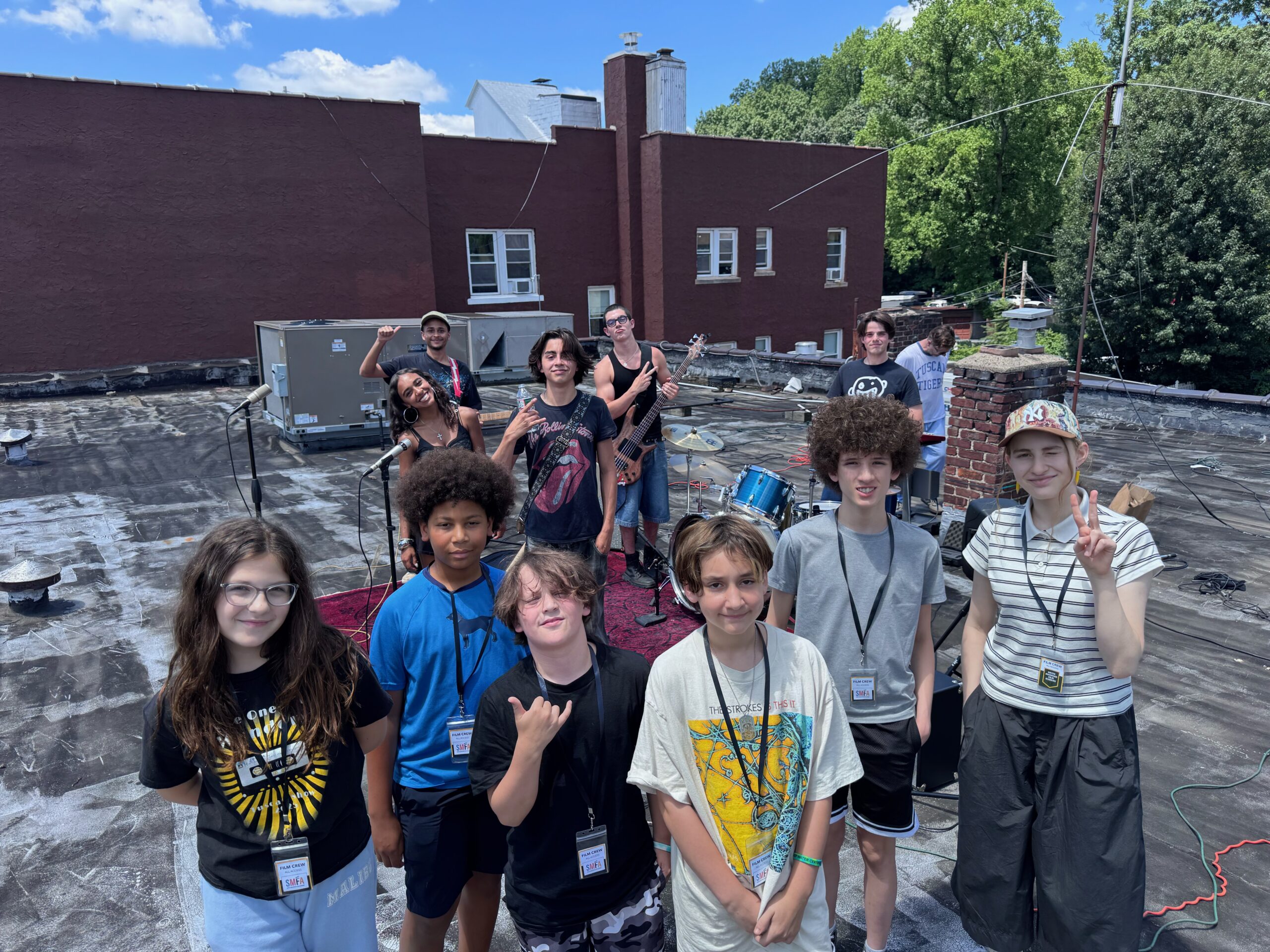
The middle school filmmakers in foreground and the CHS band Ouroboros in the background. (Photo courtesy of Chris Cassidy)
“I was thinking a music video themed camp would be great for the kids, I’ve always loved music videos and had directed a bunch myself,’ Cassidy said. “I thought about some of the more iconic music videos that are out there and the Beatles London rooftop performance came to mind. I knew the kids would be really excited about this idea.Now, we just needed a band to film. While doing some research and with a little help from some local parents, we found Ouroboros, a Columbia High School band.”
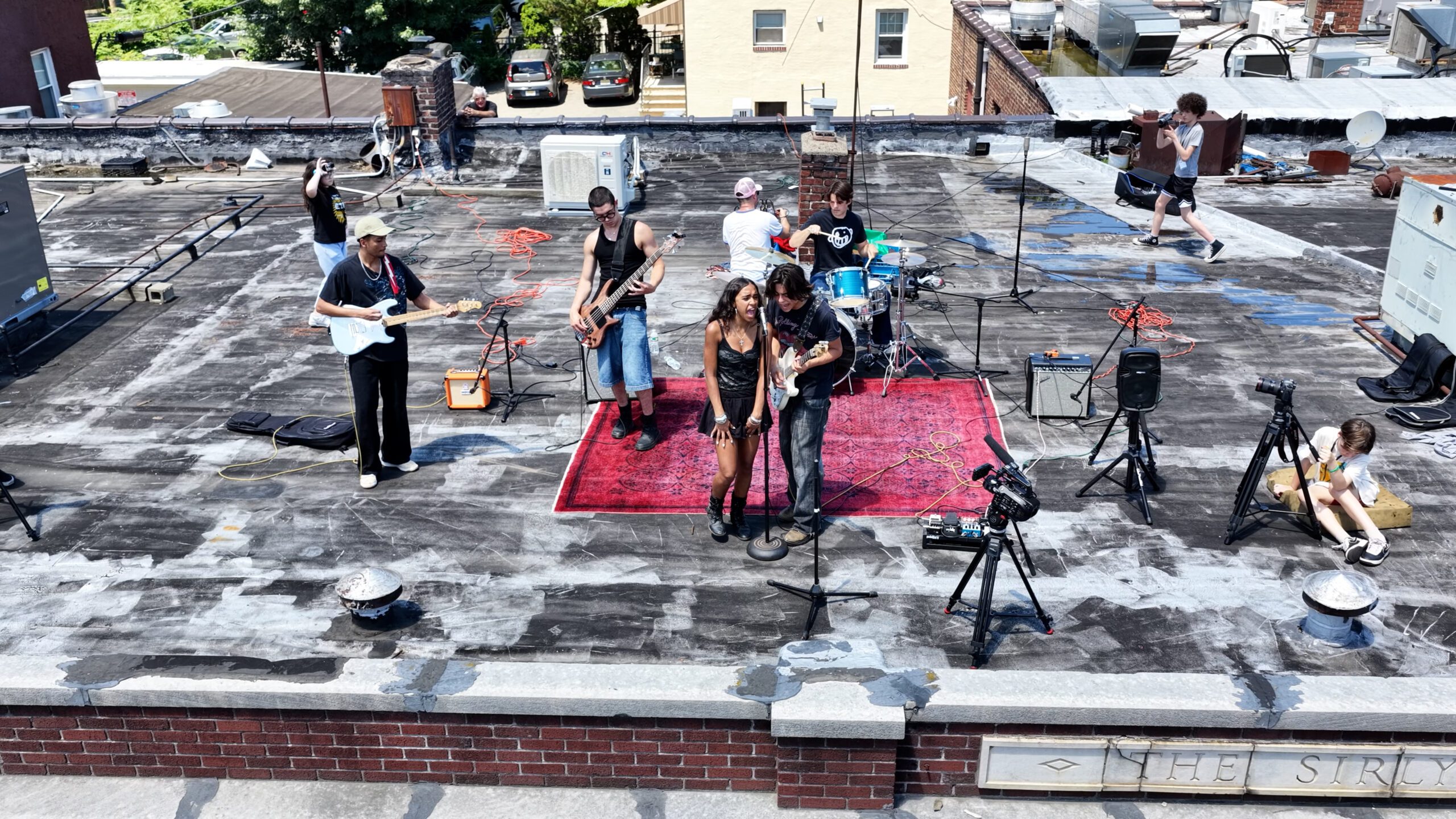
A drone shot of the rooftop rmusic video recording for the bad Ouroboros shows the band and some of the filmmakers. (Photo courtesy of Chris Cassidy)
Cassidy was inspired to create the academy just over a year ago, after volunteering at Tuscan Elementary School, where he formed a 10-student crew to create a behind-the-scenes video for the Tuscan Show. In the process of creating the video, the students learned how to use cameras, conduct interviews, and film B-roll. His observations led him to believe local children need more opportunities to explore filmmaking.
“Aside from learning filmmaking skills, we hope each kid discovers his or her own voice, becomes confident, and learns how to turn their ideas into stories that resonate with others,” Cassidy said.
To make participants feel like members of a professional production company, Cassidy said, he involved them in every step, from preliminary research to decisions about camera placement and the operator. Additionally, the students worked with professional equipment, such as 10 DSLR cameras and lenses, which were generously provided by Getty Images with the help of Getty sportswriter Al Bello, a friend of Cassidy.
“The fact that they had the freedom to choose their own cameras and their own angles to film from gave them a sense of creative ownership,” Cassidy said.
Finding a safe way to bring all the participants, band members, and equipment to the rooftop became the production team’s major logistical challenge. And Cassidy expressed gratitude for the building’s owners and managers for providing access to the rooftop and electrical cables. After all the preparations, the group filmed for an hour and then dismantled the equipment.
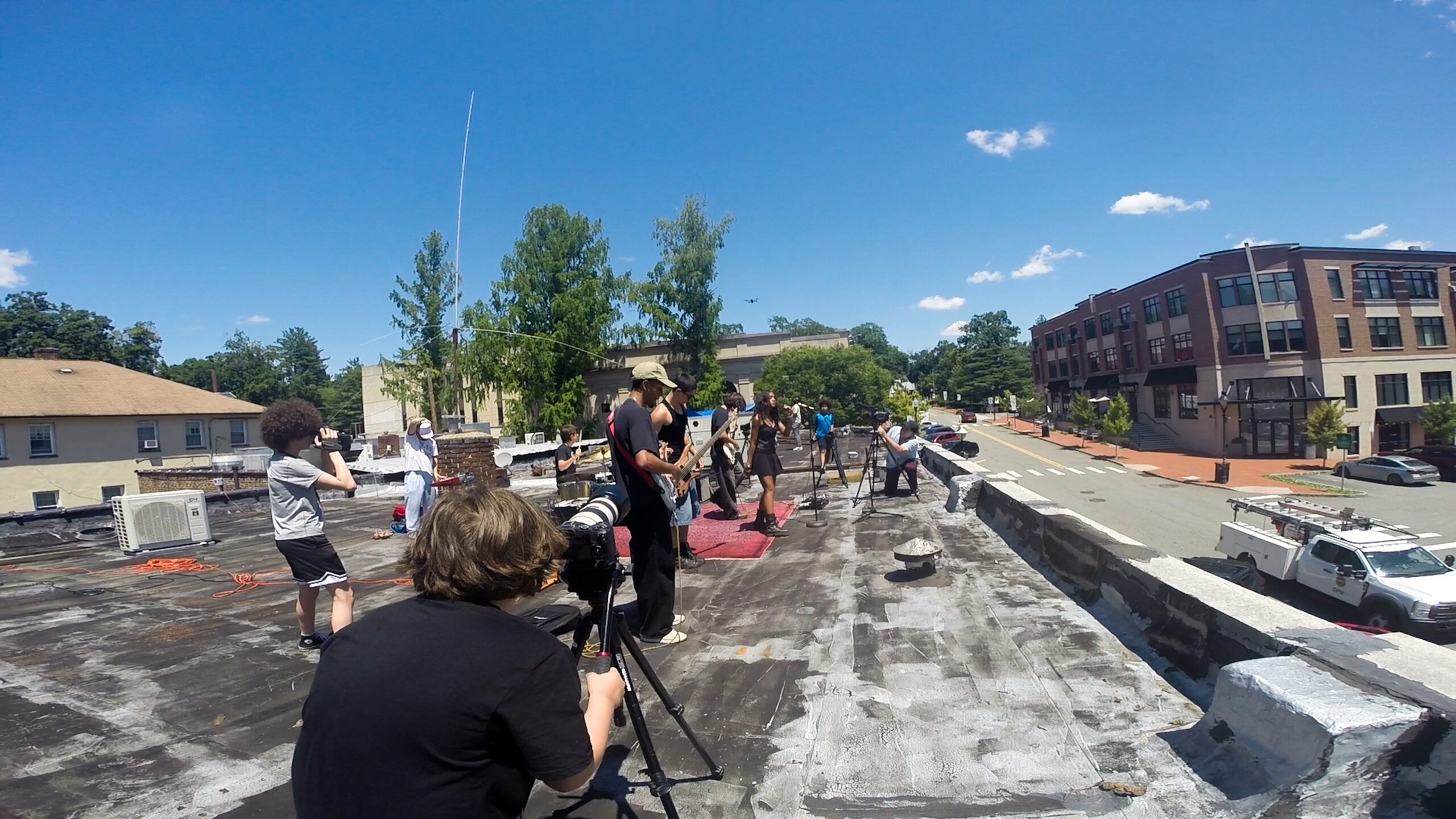
Filming the music video on a rooftop in downtown Maplewood. (Photo courtesy of Chris Cassidy)
The academy is, in part, a response to the growth of the film industry in New Jersey. As reported by the New Jersey Economic Development Authority, 556 productions filmed in New Jersey in 2024. Production spending totaled $833 million, and more than 30,000 crew members were employed. Maplewood became one of the Film Ready Communities of 2025, a designation that aims to help communities to prepare for future film and television productions.And South Orange is working toward becoming certified as film ready.
According to Cassidy, statewide growth is another reason students need to be familiar with all the types of jobs within a production company. “We want the kids to know there are potential career opportunities right here in their backyard,” he said.
To give them this experience, students rotate through writing, directing, acting, editing, camera operation, sound, and other production jobs.
Additionally, the program gives students opportunities to communicate and collaborate with each other. Students come up with their own stories, develop storyboards, plan shoots, and participate in the production process in various roles. “Filmmaking is a collaborative process, and working together helps them become more comfortable expressing themselves and trusting their creative instincts,” Cassidy said.
This fall, SMFA will continue the hands-on experience with Documentary 101, a ten-week course for middle school students in grades six through eight. Students will learn to find a compelling story, develop interview questions, operate camera and sound equipment, film B-roll, and understand the documentary editing process. The class meets Mondays from 6 to 7:15 p.m. from Sept. 14 through Nov. 30, and tuition is $375.
No prior filmmaking knowledge is required. “Just curiosity and willingness to try something new,” Cassidy said.
Students in grades four and five are welcome to participate in SMFA classes, too. This fall, winter, and spring, SMFA will offer various courses for middle school students, and a program for fourth- and fifth-graders. Based on the success of the academy’s first summer camp, Cassidy plans to offer another summer program. All registration and class information is available at southmountainfilm.org.
Last winter’s class of middle schoolers created a short documentary titled “The Maplewood Theater: The Show Must Go On.” On September 23 at 6 p.m. the Maplewood Library and South Mountain Film Academy will premiere the documentary, which explores the history of the Maplewood Theater, including its closing during the COVID-19 pandemic. The doc features interviews with local officials, business owners, and residents about its much-anticipated return. The filmmakers and Cassidy will be on hand afterward for a Q & A.
Francesca Cudrin is a 12th grade student at Columbia High School and is working with Village Green as a paid freelancer through a grant from the NJ Civic Information Consortium.