The new Columbia High School schedule implemented this academic year is negatively affecting students in Advanced Placement classes, while having lunch for all grades simultaneously is already leading to hot, crowded and unsanitary conditions, according to student representatives to the South Orange-Maplewood Board of Education.
“Throughout the course of the year there are fewer overall minutes per course, and that’s especially prevalent and obvious in AP STEM (science, technology, engineering and mathematics) courses, which lose the sixth period of the week, their lab period, and it’s approximated that that equates to roughly six weeks loss of instruction time during the school year,” said Penuel Shapiro, one of two nonvoting student representatives at the board’s September 24 meeting.
The feedback comes as the South Orange-Maplewood School District has looked to address historic inequity in how it has served its students, as well as increase participation of Black high-school students in honors-level courses. In August, the school district shared information on the new, later start and end time at CHS — in part to make transportation more affordable and efficient — and shortened conference period.
Shapiro also said that due to other schedule changes over the past three years, AP STEM classes “have lost 12 weeks total in instruction time over the entire school year, which means a faster-paced curriculum — and even with extended class periods for these STEM classes, a lot of teachers now prioritize lectures and instruction time over using them for hands-on lab activities” in order to maintain high test scores.
Superintendent of Schools Jason Bing said that the biggest issue is “that those AP classes are not serving our neurodivergent and our African American and low-socioeconomic students at all.”
Bing added that white students are overrepresented in those advanced courses. “There’s a reason why we’ve been litigated against multiple times as a district in regard to students not being in AP classes,” he said.
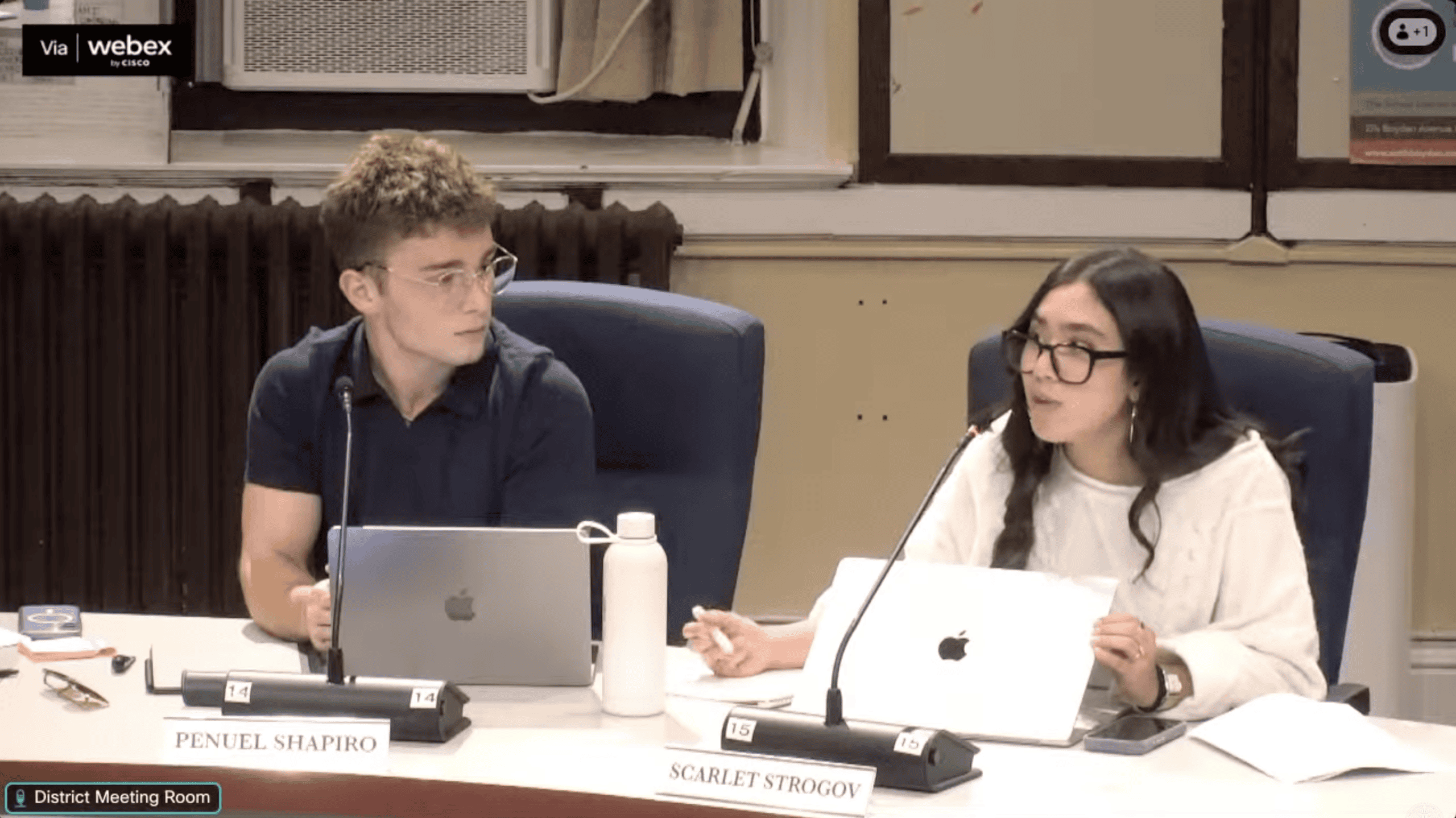
Penuel Shapiro and Scarlet Strogov, student representatives to the South Orange-Maplewood Boad of Education, speak at the September 24, 2026, meeting.
“I can give you my numbers right now from just our AP statistics: 68 percent white, 13 percent African American,” Bing added. “Let’s drop down to the middle school level. Students who take Algebra 1: 65 percent white, 13 percent African American. Let’s go to students who take geometry: 70 percent white, 7 percent African American.”
“We have huge gaps in this district that we have to address — huge,” Bing said. “And AP is at the core of those. We are not addressing the needs of our low socioeconomic kids, especially our African American kids, and also our neurodivergent kids, with those courses. We are not.”
In 2014, SOMSD faced a federal lawsuit over racial disparities in its disciplinary policies and academic tracking standards, later settling the complaint with oversight from the U.S. Department of Education Office of Civil Rights. The school district also settled a separate lawsuit by the Black Parents Workshop in 2020 that sought to address the inequitable treatment of Black students.
Board member Deirdre Brown suggested the school district look at possibly swapping lab time for physical education classes. “Equity is about meeting each child where they’re at — and that includes all children, even children that have more skills in a certain area,” she said.
Bing replied that high-achieving students are “overrepresented” in Advanced Placement courses. “The students that are underrepresented are neurodivergent, are our special education students, are our multilingual students, and are African American students and low socioeconomic,” he said. “There is a big disparity between overrepresentation and underrepresentation.”
Defining academic rigor
Bing said there exists a misconception among middle-school students that AP courses involve “10 times the amount” of schoolwork — an idea that educators can do a better job at countering.
“Rigor isn’t, ‘I’m adding more homework. I’m adding more projects.’ Rigor is: You’re going more in depth into critical thinking, and the assignments you’re giving are dependent on that critical thinking. You’re doing more group work, more collaborative work, and AP pushes that.”
Board member Shayna Sackett-Gable said that the BOE’s Curriculum and Instruction Committee touched upon this topic and that teachers were partnering with educators in the Randolph school district to look at how they make time for AP labs.
Surveys of AP students showed that they wanted fewer topics and more time for discussion, Bing said. That makes it critical that teachers make choices about what topics to delve deeper into, which is challenging due to the state-mandated education standards.
“If we were to teach every New Jersey standard, kids would be going into 14th grade,” he said. “That’s the only way to teach all the standards New Jersey has.”
Shapiro noted that AP courses aren’t SOMSD-specific and follow the College Board guidelines. “Especially as we do more outreach and bring in more students from various socioeconomic backgrounds and demographics and neurodivergent status, reducing the number of topics in order to have more in-depth conversations about those topics does not equal better performance on AP tests.”
Bing acknowledged a gap between the purpose of an AP curriculum and students’ expectations. “You know that every student I’ve talked to, it’s about the test and passing that test,” he said. “That is not what AP was created for. AP was created to go in depth into deep subjects, similar to the international bachelor’s curriculum.”
An emphasis on critical thinking skills
Board member Jeff Bennett argued that critical-thinking skills come from expertise in a subject.
“Yes, a lot of people in the education world praise critical thinking, but to me it’s not a transferable skill,” he said. “It’s actually something that comes as a result of actually knowing a lot about a subject — and for things we do think of as skills like lab work, various kinds of math, writing, research.”
Bing disagreed.
“I can put critical thinking in teaching the alphabet,” he said. “It makes no difference what the content is. There is not one employer out there that, when you interview with them or you write an essay for them, is going to ask you the name when Washington defeated the British. Not one.”
State Department of Education data shows that employers want to hire people who can think critically, Bing said. “They want people who can lead. They want people who are organized, and those skills are transferable, doesn’t matter the content.”
Bing said that students are being educated for jobs that “haven’t been invented yet.”
“However, there are core skills that to be successful at those jobs, kids need to be fluent at, and that’s really what all the research is showing, is that when we do write curriculum, it should be less of the focus on content and more of a focus on really developing these skills that are going to make them successful if they choose to go to college or make them successful if they choose to go to a career,” he said.
Challenges at lunch
Scarlet Strogov, a student representative to the BOE, spoke about the lunch experience at Columbia High School.
“Overall, it’s a little bit crowded,” she said. “It gets really hot in the cafeteria. Lunch lines are definitely an issue. It’s taking longer, and the school is in general relying on a lot of students leaving the school for lunch, which is really expensive for everybody, and I just don’t know that it’s sustainable.”
Students have expressed concern about going off-campus for lunch during inclement weather.
Freshmen students this year have been assigned to eat lunch in the school gymnasium, which has raised another set of issues.
“I’ve heard that it’s really a mess in there, and it’s unsanitary for the classes after lunch and the clubs sometimes who meet in the building the same day,” she said. “It’s not good. There’s food everywhere. The cleanup isn’t fast enough, and it isn’t thorough enough for students to be meeting in those rooms after lunch.”
Board member Brown said she shared the students’ concerns about the school’s capacity at lunch as winter approaches. “I am concerned that the district is basically relying on a huge chunk of the student body to go out for lunch because there is not enough capacity in that school for everyone to have lunch at once,” she said. Brown added that students should have tables if they want to do homework during lunch.
Board member Bimal Kapadia said, “Kids should have a table if they want to eat lunch. Seems like a basic student right.”
Board member Liz Callahan asked if the custodial arrangements needed shifting to allow for proper cleanup. “Maybe those are just things that could be tightened up,” she said.
Bing replied that extra items could be added to the custodial contract to address issues that were being neglected at all the schools. “That’s something we ought to look at as well,” he said.
The full discussion begins at 1:18:56 in the online video.