On June 25, the South Orange-Maplewood Board of Education voted 8-0, with one abstention, to switch its third party vendor for paraprofessional services and award the services for 2026-2027 to Delta-T Group North Jersey Inc. through the Mercer County Special Services School District Cooperative Pricing System contract.
The decision came after lengthy public comment from the parents of special education students and discussion by Board members about potentially going out to bid again — an idea that was ultimately rejected when Superintendent of Schools Jason Bing said there was neither the time nor the budget to seek another contract before September.
It was a decision that appeared to please no one.
“I don’t like having to take this vote right now because there is no good option,” said Board President Will Meyer, noting his day job representing the parents of special needs students in New York City.
The District will pay Delta-T Group North Jersey, Inc. a fixed rate of $28.56 per hour through an annual contract estimated at $5.8M. Paraprofessionals would see reduced pay and benefits — but, according to Supt. Jason Bing, not as much as has had been reported by their union. Bing said that the district was also looking to rehire existing paras through the new vendor, hoping to maintain some continuity in relationships and care.
Members of the South Orange-Maplewood Board of Education said they were unhappy with the process and communication of the contract award — with all of them saying they did not realize they had approved the contract on June 11 through Resolution 4984B. However, the contract had not been signed in the interim and the Board voted on an amended Resolution 4989AV on June 25. [Editor’s note: Board member Bimal Kapadia made the motion to sever the resolution for a separate discussion and vote.]
“I’m really struggling with the way this all happened, and the timing and the lack of engagement with the community and the Board in general,” said Board 2nd Vice President Malini Nayar. “This feels like we’re stuck and we have to make a decision because not moving forward has potentially equally or worse consequences in some other way. I really would like to avoid a situation like this going forward where we have erroneously voted on something and then now we have to amend it because we’re too late to do anything else. It feels like a very difficult choice. And we’re not talking about small programs, we’re talking about vulnerable children who need services.”
“This is a really hard decision, I think for everyone here,” said Board member Deirdre Brown, who said she agreed with other board members who suggested “monitoring this to ensure that there isn’t negative impact.”
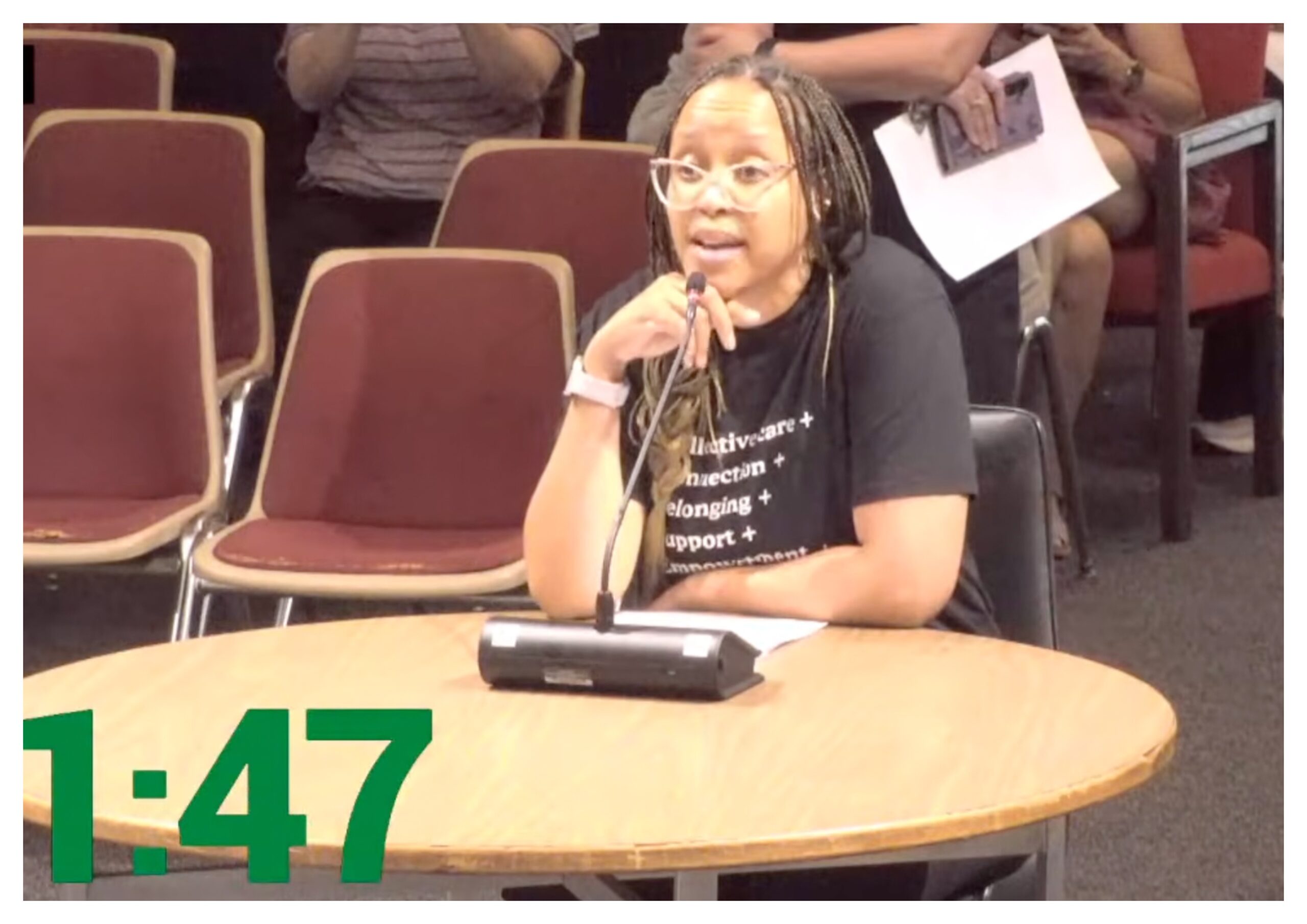
Board members also questioned whether the award to Delta-T would erode special education services — as did many members of the Special Education Parents Advisory Committee [SEPAC] who expressed outrage at the process and the award during public comments at the June 25 Board of Education meeting.
Watch the parents’ comments here:
“We have watched Superintendent [Jason] Bing hold town halls around numerous budgetary changes,” said parent Meg Davis, reading from a open letter along with other parents (see the full letter below). “That this change was made with no public engagement with special education families, with SEPAC, or with the educators serving our children is deplorable. Special education families, SEPAC, and our broader community deserve the same level of communication, collaboration, and transparency Superintendent Bing demonstrates in his work with other community stakeholders — courtesy bussing families, arts advocates, athletics advocates, and others. The consistent exclusion of our community from that standard of engagement is a pattern, not an oversight, and it must end now.”
Jessica Mingus, founder of the SOMA Parent Support and Advocacy Network for IEP Families, contacted Village Green ahead of the June 25 meeting to note that a Special Services working group that Bing had committed to in February 2025 — and that Village Green covered in the story, “Why Are We Looking to Save Money by Eliminating Services to Our Most Vulnerable Population?”, had “never materialized” despite her best efforts.
Jessica Mingus, founder of the SOMA Parent Support and Advocacy Network for IEP Families
“Last week, without a single conversation with SEPAC, special education families, or the teachers running our self-contained programs, the district switched paraprofessional vendors — firing all ESS paras district-wide and returning to Delta-T Group, a vendor the district previously discontinued due to harm caused by undertrained, low-wage staff,” wrote Mingus. “The compensation drop is stark: from $22–26/hour under ESS to $16–18/hour under Delta-T. The consequences are significant: deeply committed, skilled, and longstanding paraprofessionals are being pushed out of our classrooms; the safety and wellbeing of special education students is jeopardized; our already-strained teachers face even greater demands; and our district absorbs inevitable financial damage at the very inflection point Mr. Bing has repeatedly described as a ‘fiscal cliff.'”
Mingus noted that beyond SEPAC, other groups represented at the June 25 BOE public comments included SOMA Parent Support and Advocacy Network for IEP Families, Together We Bloom, and Care Lab Collective, of which she is also a founder.
Supt. Bing defended the move.
“We went through a cooperative this year. Mercer County Special Services School District Cooperative. … There are about 27 schools in that cooperative, including, I believe, West Orange, Westfield [Bing later listed Clinton, Newark, Springfield, Verona, and more]. It’s just not Mercer Counter Schools. It’s across from the state. Districts do that to secure lower volume based pricing. We also do that to reduce administrative bidding costs that come with the bidding process.” Bing noted that the district had rebid many of its contracts in a move to reduce costs in light of a budgeting “fiscal cliff.”
“We probably spoke to over 70 schools around our area and outside our county in regards to what they were doing and who they were utilizing,” said Bing.
“We landed on Delta-T for our paraprofessionals. They have been in the district previously. They’re in many districts across the state. We currently utilize Delta-T to fill other positions in the district that we do not have.”
Bing continued, “We did meet with their account manager, their local staffing coordinator, their recruiting team, their operations team, and their 24/7 on-call team to discuss the following, what day-to-day communication protocol’s going to look like moving forward, staffing coordination and service delivery, issue resolution and escalation management, performance monitoring and reporting designation of backup contacts, confirm staffing, scope schedules and service expectations, and establishing escalation protocols and response timelines. We aligned on reporting formats and meeting cadence, meeting outcomes, documented and shared weekly meetings schedule development.”
After public comments, Bing took a more conciliatory tone, and also said that hourly rates quoted by Local 68 were inaccurate.
“I did want to clarify… I do want to thank everybody who advocated tonight. Your words were heard and we appreciate it,” said Bing. “I did put that in many of my correspondence that we are continuing to explore in-house self-contained paraprofessionals. If it’s fiscally feasible, the board will move forward on it. We’re looking at it in various forms, contractual carve out. We’re looking at different scenarios. I do want to point out that, I believe one of the speakers requested a guide analysis. We did do that guide analysis my first two months in this job, [Asst. Superintendent for Special Services] Kathy [Gesumaria] and I, and we presented it to SEPAC. … We did provide that analysis.”
“I do want to clarify also the Delta rate. … Our co-op rate is $18 to $22. I think as Kathleen [Gesumaria] put in some of her emails, we’ll be pushing Delta to make that $20 to $22. That is something we will have discussions with them. Currently, it is $18 to $22. That is the co-op number, and that is what we are approving. … I also want to clarify that Delta was never terminated from South Orange Maplewood School District. I also want to point out that Delta will be offering positions to current ESS paras. That’s part of the recruiting.” Bing also said that in talking to other districts, the terms they used regarding Delta-T were “quality, professional, and great customer service.”
Bing noted later that the district has had many vendors in the recent years, and that there are current issues with ESS, the current contractor.
BOE member Paul Stephan also called out the process: “That does not sit right with me because I try to take my role very seriously…. I think it’s also a missed opportunity, how late it was put on the agenda on the 11th, because the community didn’t have an opportunity to look at it and to comment.”
Stefan said he also had concerns about service quality. “Some people have great experiences with their paras. Other people have less good experiences. ESS was not perfect. Delta-T is not gonna be perfect. But that concern about quality remains. And unfortunately, because we contract out our paras, there is limited ability for the district to ensure quality in the way that we could try to ensure quality if it was our own staff. I appreciate what Mr. Bing just said about bringing paras in house. I know that’s something that’s been discussed, in the Special Services committee led by Board member [Liz] Callahan. I know when we talked about it a couple months ago, it was cost prohibitive, but we’re continuing to look at it, even it’s for a subset of paras. And I really encourage those continued discussions.”
Bing concurred with Stephan: “As you noted, with any third party vendor, there’s high turnover, and there’s also quality issues as well. I believe this would be our fourth third party vendor in over the last seven years, eight years. … Our focus right now is that transition to make sure it’s as smooth as possible and to make sure that, especially for our kids that are most vulnerable, Delta knows them by name and knows what they need. And our powers will be ready to go be on the floor when they come in.”
Board 1st Vice President and Special Services Committee Chair Liz Callahan said that the district should form the requested working group.
“I would say that I think given the state of of things right now, that the suggestion to have potentially a working group, I think we’ve seen how effective that can be for our transportation families, how effective that can be in spotting and analyzing issues as they come up and being responsive and reflective to them,” said Callahan. “So I think I would really like to see the district make a commitment to doing that as we go through this transitional period, to really hear from those families most impacted, whether it is that we end up with Delta-T or we’re affective in getting our paras to come in-house. I think having those voices in those conversations on a more regular basis beyond just SEPAC will be important.”
“The large number of parents and students and paraprofessionals who came out to speak on this, their points have to be so very much validated,” said Board President Meyer, “because the quality of those people who are sitting in their kids’ classroom and helping to facilitate their progress and be that familiar face, there’s no way to understate it.”
Meyer continued, “These rates are very, very low compared to a lot of other professions for the very important work that they do, and at the same time as a board member and as a someone who has a responsibility to maintain the district’s physical health, you see what’s happened in districts around, you see districts that ignored signs of financial struggle and all of a sudden imploded, had to lay off scores of teachers, had to close down buildings, and there’s an obligation that we have to all of the families in our community, including the special education families, to not let our district implode.”
“This is not something I think where we are asking the special education community to take this burden on their back,” said Meyer. “There’s a lot of areas where we’re having to cut and where we know we’ve been promised that next year it’s going to be worse. Next year we’re going to have the harder cuts. And so to agree right now to spend more money for the same level of paraprofessional service as far as the number of people coming in, is really tough.”
“This is not going to be our forever plan,” said Meyer. “So that’s why I am planning to vote yes and I’m doing it knowing that it is a very difficult compromise that we are asking some of our families to potentially have to endure, knowing that the alternative is potentially so much worse.”
Voting yes: Jeff Bennett, Deirdre Brown, Liz Callahan, Bimal Kapadia, Will Meyer, Malini Nayar, Shayna Sackett-Gable, and Paul Stephan. Abstaining: Meredith Higgins.