South Orange is known and celebrated for its diversity. But just how far back does the story go, and how much of that history is known to locals?
South Orange Village leaders are working to fill that gap.
Village Councilwoman Summer Jones returned to South Orange in 2015 because of her appreciation for its diversity and community feel; however, after reading about the town’s history, she felt that the perspective of Black people was frequently excluded.
With the help of Councilwoman Patricia Canning, Jones is now working to preserve Black history overall by putting up signs across downtown South Orange honoring Black businesses that existed over a century ago.
They met with Dr. James Amemasor, a Research Specialist at the New Jersey Historical Society in Newark, who provided them with an Essex County directory of Black businesses in the 1920s. To Jones, the directory served a similar purpose to The Green Book, a list of safe places for Black people to eat, sleep, and shop during the Jim Crow era.
Using the directory and old censuses, Jones and Canning identified numerous Black-owned businesses that existed in the 1920s, ranging from hair salons, laundresses, auto repair services, furniture shops and restaurants that surrounded the First Baptist Church on Valley Street. They created a website to expand upon the details of the businesses, the lives of the owners, and how this research was conducted. They also created a sign (see below) that will be posted in windows throughout South Orange Downtown; most of the signs are expected to be posted by Sunday evening, August 16.
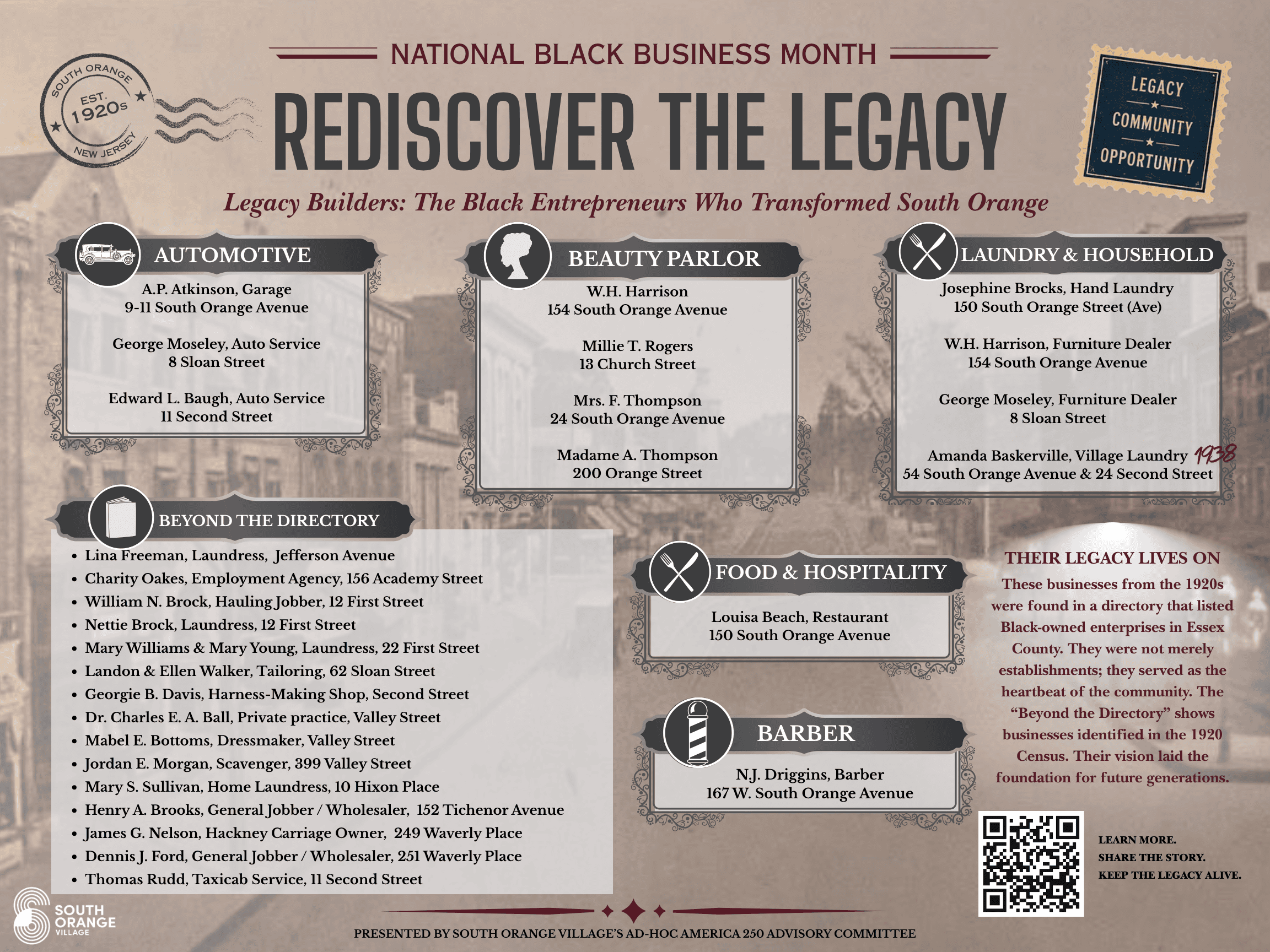
While August marks National Black Business Month, to Jones and Canning, the importance of this project extends far beyond just that.
“It’s interesting that in (America’s) 250 years we don’t know much about the contributions of Black families (here in South Orange),” Canning said. “This was our way of making sure people know something happened in a place where we are officials.”
Jones had previously heard that South Orange did have Black businesses in the 1920s, but that they weren’t documented.
“Depending on who you spoke to in South Orange, sometimes the narrative was that Black people who lived here in the late 1800s and early 1900s were servants and butlers,” she said. The directory helped prove that that was not in fact the case.
“Naturally, when we came upon the list of Black businesses, it made sense to make something out of it because you don’t often hear about businesses being owned and operated in the 1920s by Black families,” Canning said.
These signs are “just another opportunity for people who care about diversity, integration, and equity to really get good information and have access to a different story that includes all,” Jones said.
Melissa Hodge, South Orange’s Executive Director, loves that the stories of Black entrepreneurship in South Orange are being told in an accessible way.
“Those who came before helped set the foundation,” she said. ”I hope that as people learn about their stories and become more familiar with our current Black-owned businesses, it leaves them feeling inspired to dream big and take a chance on starting their own business.”
Jones and Canning are continuously working to find people connected to these businesses. “We have other stories to uncover and share,” Canning said. “This is just a starting point.”
To visit the website, click here:
https://www.southorange.org/1065/Black-Businesses-in-the-1920s
To visit the directory, click here:
https://dn710703.ca.archive.org/0/items/classifieddirect00bure/classifieddirect00bure.pdf