Columbia High School’s new drop-block schedule is now in full swing. Functioning on a four-day rotating basis, students’ days now consist of six periods a day, rather than the eight periods in which they are enrolled; Two periods each day drop, while two others extend as 71-minute periods rather than the traditional 46 minutes.
The one constant each day is lunch.
Though this new schedule is a substantial shift for students academically, it also changes another part of their routine. Now, when the 11:11 a.m. bell rings, nearly the entire school heads for lunch.
With almost 2,000 students sharing a single, 45-minute lunch period – the shortest period of the day – the common lunch is divided within the school, with each grade level eating in different locations, from the cafeteria to the gym to the Alumni Commons. At times, in some places, students can be found sitting on the floor.
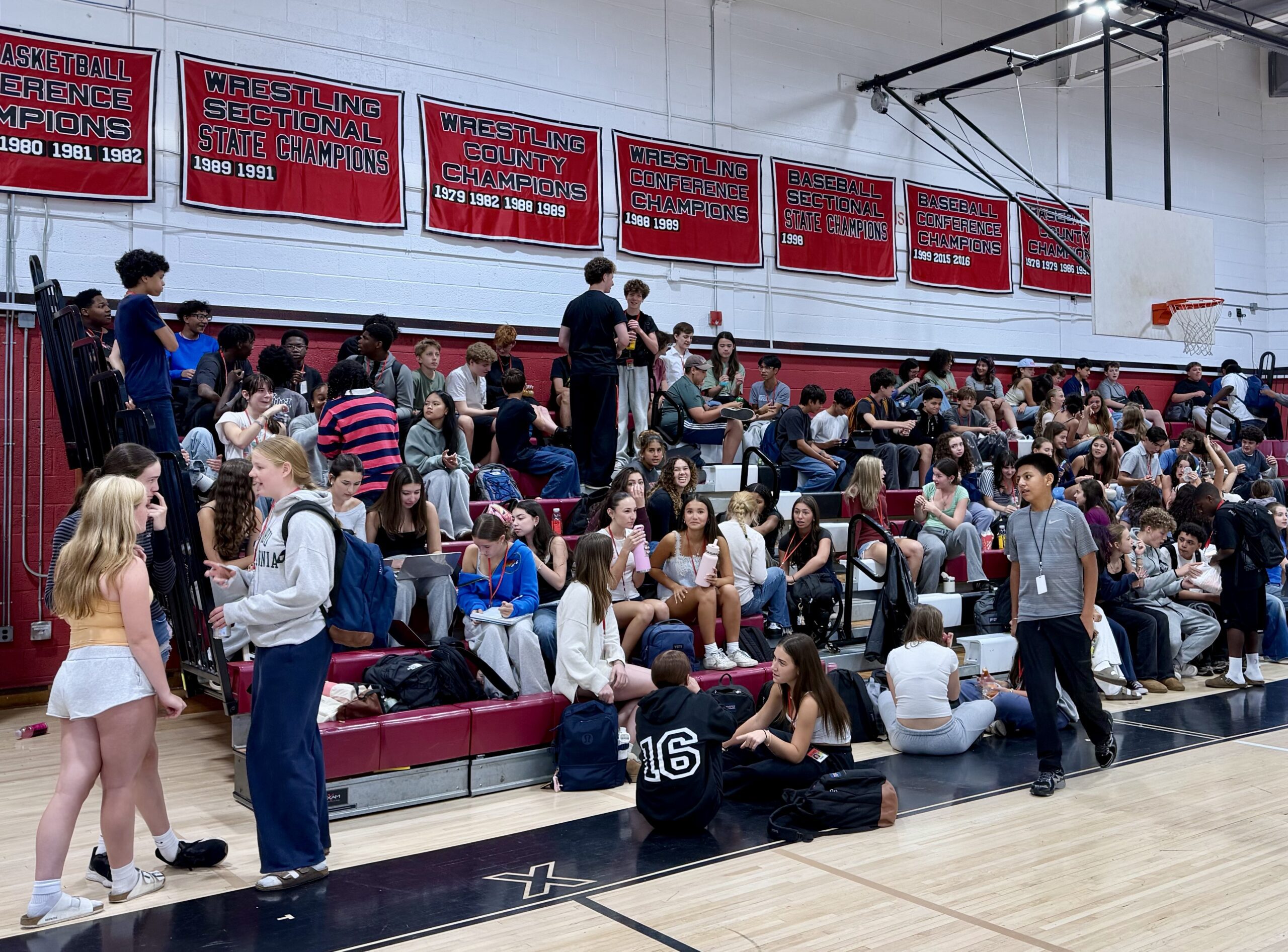
The freshman class eats lunch in the gym. (Photo courtesy of CHS Principal Frank Sanchez)
The freshman class is required to eat lunch in the gymnasium, while sophomores have access to the cafeteria. For upperclassmen (in addition to the cafe), juniors and seniors are allowed to leave the school for lunch and utilize the commons, which now has a smaller cafe-like setup where students can also purchase their lunch.
The change is introducing many new logistical and social considerations for students.
For many years prior, CHS has organized lunch into three distinct periods, with various grade levels having lunch during each period. Though this traditional lunch division meant less congestion across the school grounds during lunchtime, administrators and some students say it also resulted in less than ideal social situations.
Considering this social shift, Sanai Edwards, a 12th grade student, said that the new single period “gets rid of the exclusion lunch has had for many years,” arguing that “when kids aren’t with their friends and split up into multiple periods, it’s harder to connect.” Other students share a similar sentiment.
However, the social benefits also come with logistical complications.
“I like getting to sit with all of my friends, however, I think it is easier to manage when there are different periods for everyone,” said Esme Krais, also a 12th grader. Krais added that in her experience, “the lunch period is very hectic,” suggesting that “it would be better organized if there were longer periods of time.”
Many seniors shared concerns with The Village Green about the ability to leave campus in their cars and get back in time within the period, arguing that in many ways it is a necessity to leave campus due to the lack of space in many other areas within the school, such as the commons and the cafeteria.
“Everybody really goes to town, there’s no way to stay at school for lunch,” said 12th grader Felix Rotberg, speaking of seniors.
Columbia High School Principal Frank Sanchez said he is confident about the efficiency of the schedule and the logistics of the single period; however, he has recognized students’ concerns about the length of the period, especially from seniors, and is taking that into account.
Though pleased with the organization within the school grounds, Sanchez said that he is “hoping to add another 5 minutes to lunch” as he understands that “seniors are all leaving at once and coming at once.”
Though appreciating the principal’s sentiment, Scarlet Strogov, one of two CHS Board of Education student representatives, says that the single lunch doesn’t make sense “because it relies on too many students going out.”
Regardless, Sanchez, acknowledging that this is an issue he previously did not consider, is confident that he will find a way to remedy the situation with the possible addition of 5 minutes to the period.
At the September 24 District Board of Education meeting, Strogov and Student Rep Penuel Shapiro told the board about the issues surrounding lunch, and Board Member Deirdre Brown said she shared their concerns about the school’s capacity at lunch as winter approaches.
“I am concerned that the district is basically relying on a huge chunk of the student body to go out for lunch because there is not enough capacity in that school for everyone to have lunch at once,” Brown said.
One of the biggest changes to the lunch structure is that all freshmen are now required to eat in the gymnasium.
“The lunch period is run pretty well by staff,” Freshman Julia Pohl said, adding, however, that “it is also very dirty at the end (of the period) regardless,” because of the large number of students eating in the gym at the same time.
The gym, Pohl said, is “very crowded and doesn’t have enough space for everyone,” frequently resulting in students having to “eat on the floor outside the gym in the hallways.”
“Kids should have a table if they want to eat lunch. Seems like a basic student right,” Board Member Bimal Kapadia said at the September 24 meeting.
Regardless of crowding and congestion in the gym, Principal Sanchez said that the lines in the cafeteria are “down after 10-15 minutes every day” in part due to the fact that the school has “three new lines that we have increased this year.”
Despite the crowded situation, Strogov said, “there is something to say about the fact that students can have lunch with their friends and not worry about a whole different period,” mirroring the sentiments of many students.
Although working to remedy issues with the new structure, Sanchez says he wants students and families to understand that “the common lunch is part of the schedule” and is essential to the drop-block system in order for it to remain stable and consistent.
He also highlighted a benefit for those students who have a study hall in their schedule before or after lunch, especially for juniors and seniors who can leave campus for lunch.
“When the study hall touches lunch, isn’t that the greatest thing in the world?” he said.
Norah Pharaon is a 12th grade student at Columbia High School and is working with Village Green as part of a grant from the New Jersey Civic Information Consortium.