Leaders in the South Orange-Maplewood School District are acknowledging that a decision to rebid its paraprofessional contract and transition to a new third-party vendor—a move made, in part, to save $1.8M during a budget crisis—has created “uncertainty and distress” for parents and the paraprofessionals.
But the Board of Education and school administrators say they are working with parents and Delta-T, the new vendor, to address concerns.
That was the message on Thursday, August 27, from Board of Education 1st Vice President Liz Callahan, Board President Will Meyer and Supt. Jason Bing, after numerous letters and public comments pointed out issues with the new paraprofessional vendor.
Nonetheless many parents of special needs students said that the district had relied too much on parents and advocates to identify issues and that they remained concerned that, once school starts, problems will arise with the many new paras that have been hired (only about 20% of former paras had signed on with Delta-T by August 27).
Paraprofessionals are teachers’ aides who work with special needs students in classroom setting. Some paras work with multiple special needs students; other paras work one on one with students, depending on the student’s level of need.
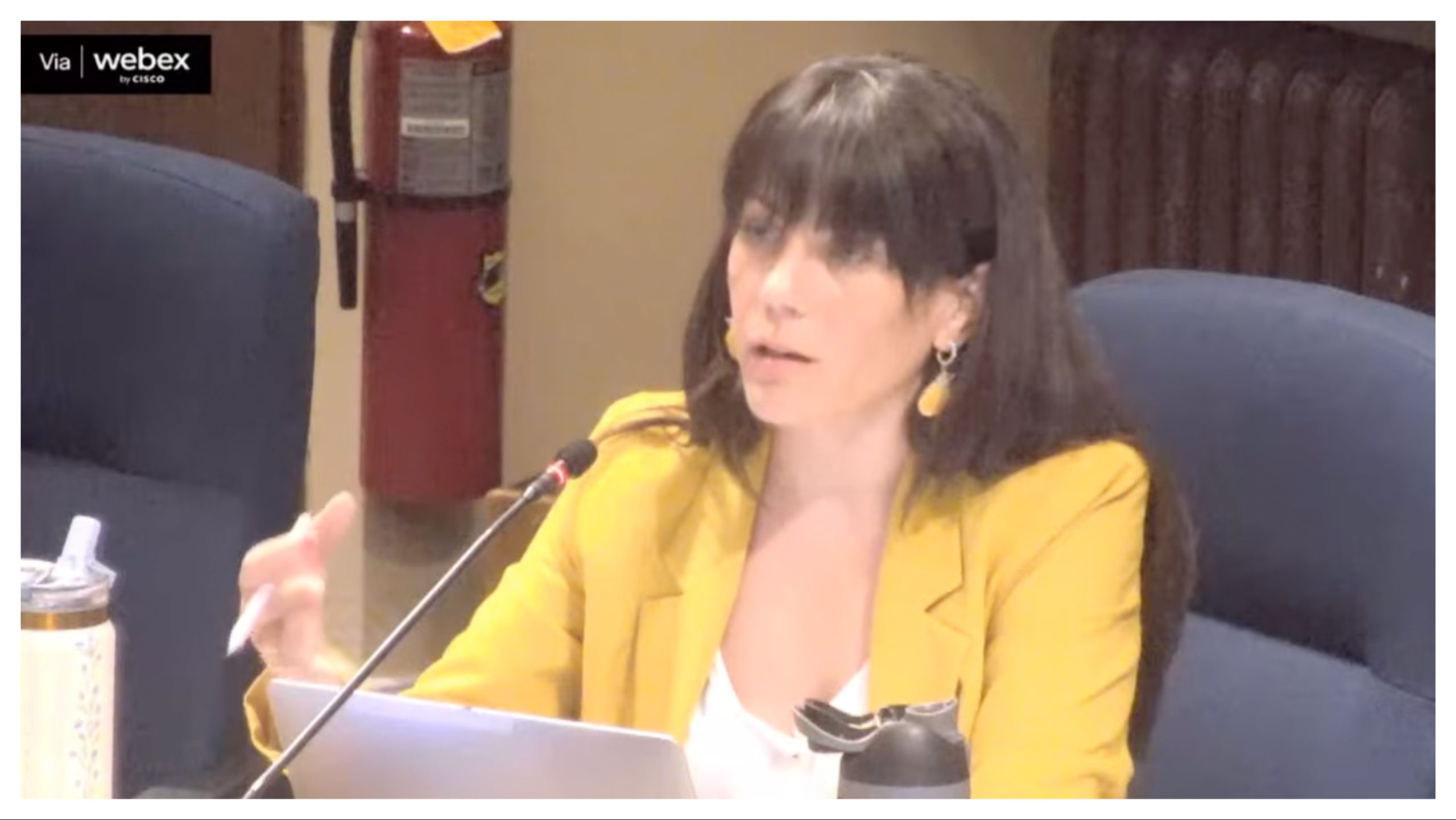
South Orange-Maplewood Board of Education 1st Vice President Liz Callahan
“As an educator, someone who started my career as a paraprofessional myself, I do understand these are not simply staffing positions on a spreadsheet,” said Callahan during her Special Education Committee report late in the August 27 BOE meeting. “They are trusted adults in our students’ lives. They know students’ communications, their regulation needs, strengths, triggers, routines, and all the small things that really do make a difference in the day-to-day. And so for that reason, those changes in adults supporting kids can be consequential. I understand that not just as an educator, but carry that understanding into my board responsibilities….”
“I recognize the transition has created, as we have talked about throughout the summer, really intense uncertainty and distress for many families,” said Callahan. “And I hear the concerns about disruption, safety, continuity, communication, and trust. And I do not take those concerns lightly.”
“I want to recognize, and I think this is important to say, that the families and caregivers who have organized, asked difficult questions, shared their experiences and advocated so persistently, you’re doing exactly what we want families to do. And the advocacy is not an obstacle to the work, but a benefit to the work. It’s essential as part of our responsibility to our students. So thank you.”
Callahan referenced Board President Meyer and Superintendent Bing’s updates earlier in the meeting.
She noted that Bing had committed to quarterly check-ins with a caregiver working group during the upcoming school year.
A major change that the district had just recently brokered with Delta-T — based on community advocacy including an article in NJ.com — was changing the employment structure for paras from 1099 independent contractors to W-2 employees for the upcoming school year. Many former paras had not signed on with Delta-T because they said they could not afford to be independent contractors.
Callahan noted that 218 paras had been hired for 184 positions and that the district was working to ensure they had the “requisite training that they need.”
“There are also concrete steps to ensure that important information, including IEP [Individualized Education Program/Plan] at a glance and All About Me are disseminated, so that kids are known to their paraprofessionals ahead of time and appreciate the work and responsiveness that went into making sure those measures are in place.”
Callahan also reported that the Special Services department “has formalized the paraprofessional transition as one of the department goals for 26/27. And the committee has also developed an oversight dashboard with input from the community that will be monitored throughout the year. It’ll track staffing and student outcomes, including attendance, restraint and seclusion, safety incidents, HIB [Harassment, Intimidation and Bullying] and discipline, mental health and behavioral indicators, staffing stability and coverage, as well as the results of a monthly family survey that the district has committed to administering. Those measures will be reviewed monthly to look at patterns, recurring concerns or gaps in service to determine where follow-up or corrective action may be needed. In addition, supervisors have committed to weekly check-ins with teachers and administrators once the school year begins to assess placements, to ensure that they’re working effectively.”
“Ultimately our shared goal is straightforward,” said Callahan. “We are trying to ensure that our special education classrooms are safe and joyful places where all students can learn and thrive. I am committed to doing my part as a board member to make sure that happens and appreciate the partnership of our families and our district as we move forward with this transition.”
Callahan also outlined changes that would be made to communication with the Special Education Parents Advisory Committee, or SEPAC.
Watch Callahan’s comments and the ensuring discussion here:
More About Training
After parents reported that only 14 paras showed up for voluntary training earlier in the week, Board 2nd Vice President Malini Nayar asked, “Can we get confirmation on the status of the training? It sounds like we attempted to hold some sessions, but is everyone fully trained as of now?” Nayar also asked, “What is our plan if things don’t go well? So like day one, day two, day three, day four. I know we have a broader framework around the dashboard and monitoring, but we need to have a plan in place if across the board there are lots of students that are facing issues first day, second day, third, day fourth, day, fifth day, week two, week three, what is the district’s plan?”
Bing responded that staff, led by Special Services Director Kathleen Gesumaria, “have been working very hard over the last month and a half since we started this with Delta-T to ensure that, one, we have enough powers, [and] two, that we have a system in place to make sure every para knows their students, and, three, providing opportunities for our current teachers to meet their new powers and also providing opportunities for our parents to meet new powers. We’re going to be working on an opportunity during back to school night for parents and a few other opportunities that we’ll be announcing over the next few weeks. So a lot of hours have been put into making sure that we make this as smooth as possible with a student-centered focus.”
Board President Meyer added, “It’s my understanding that Delta-T does right now have a surplus of paras for our use. So in the event that there is a para that is not a good fit, there is a pretty easy ability to swap someone out. Is that accurate?”
Bing responded yes and said, “This is the first time in seven years that all of our paraprofessional spots will be filled and that we actually have a surplus of paraprofessionals. I can speak only for myself that over the last couple of years, we had work stoppage threats at the start of each of the two years I’ve been in district and also for ESS [the former paraprofessional vendor] that we had to come up with a plan B, working with Essex County and working with [Essex County Schools Superintendent] John Ferraro. This is the first year since I’ve been here that we have not received that threat and that we are planning to have normal work attendance in our schools.”
Board member Paul Stephan asked if the Senior Leadership Team [SLT] would be in the buildings and classrooms, watching the implementation closely. Bing assured him that they would.
Board member Meredith Higgins noted, “I recognize that some of these questions are micromanaging, but they are very important to the families and they’ve come every week to share what they’re going through. I think it would be helpful to hear when will teachers meet their new paras, because my understanding is that the paras show up on Tuesday, teachers are in the building on the 31st.”
Bing said that the district had offered compensation to paras to meet with teachers on August 27 and 31 (school starts on Sept. 1). “We can’t mandate,” said Bing. “So we’ve given those two days that are compensated.”
Attracting Former Paras
Callahan asked Bing if the district was working to reach out to former paras who had previously decided not to sign on as 1099 contractors.
Bing said, “We’ve been pretty clear with Delta-T and, and Delta’s on the same page that for those paras that wish to return that our principals and teachers identified, they will be bumping any of the new paras, and those new paras would be surplus. At this point, we just had the conversation earlier this morning, all the paras have been reached out to in regard to the transition. So their expectation is that we should be seeing some more returning paras over the next day or two. They have priority. They also have priority in regards to making the top of the scale, which is $22 as well for our returning paras.”
Parents Express Thanks—and Frustration
Seth Boyden parent and Special Education Parent Advisory Committee (SEPAC) member Scott Ingalls thanked the board “for the listening that you’ve done throughout the summer on the paraprofessional transition. We were very relieved to hear the news this week that Delta-T is reclassifying paras as W-2 employees instead of 1099s.”
However, he noted, that “doesn’t change their wages or benefits, but it does provide a little bit of extra legal protection, which will materially benefit hundreds of paras. We particularly want to thank Kathy Gesumaria and [Supervisor of Special Services] Christina Punturieri for their hard work and open ears. With only two business days until school starts, we do still have some outstanding concerns regarding training and retention, which we would like the board to address to address.”
Ingalls said the first concern was that “Mr. Bing guaranteed that under the Delta-T contract, all paras would be certified in Handle With Care, verbal deescalation and safe restraint techniques. There were three days of training scheduled and only 14 paras attended on day one. Can anybody confirm if the remaining 204 paras were present at yesterday’s and today’s training? And for the ones who have not been certified, are they able to report to work on day one? If so, what is the plan to hold Delta T accountable for getting them trained as soon as possible? This is a safety issue, not only for special ed students, but for everyone, students and staff alike in self-contained and inclusion classrooms.”
Second, Ingalls asked about efforts to bring back former paras with the reclassification as W-2 employees.
Ingalls closed with “the other slice of the compliment sandwich and extend our sincere thanks to BOE policy and special ed committees for hearing our concerns about the revised restraint and seclusion policy and incorporating the changes that we suggested. Thank you for making us feel heard and for working to keep our students safe. My ears also perked up at the mention of the neuro-affirming bias framework and better communication with out of district families just a few minutes ago. SEPAC is standing by to work with you on that. We are here to help.”
Other parents who spoke where not as conciliatory.
Lindsay Stone, a 7-year member of SEPAC, told the Board, “I have spent this entire summer alongside other special education parents anxious, angry, and honestly heartbroken. ” She noted that her son’s one-on-one para had chosen to leave the district after 16 years in SOMSD.
“I’m here tonight to recognize someone most of you have never met, but who has quietly shaped my son’s entire elementary school experience,” said Stone. “Her name is Ms. Gloria Cunningham and she has dedicated 16 years to this district as a paraprofessional. My son is autistic and visually impaired, and Ms. Cunningham was assigned as his one-to-one para in 2020 when he was starting virtual kindergarten during the pandemic. She stayed with him every year all the way through fifth grade. Over the years, we’ve experienced high turnover with service providers and teachers, and my son struggles with inconsistency.”
Stone continued, “However, she was his one steady source of consistent support. She knew him better than anyone else in the building. Because of her, he wasn’t just present in an inclusion classroom, he belonged there. That kind of relationship does not come from a job description. It comes from years of showing up, being patient, and building trust. This June, my son graduated elementary school at South Mountain alongside his peers and everyone in the auditorium cheered for him. That same day, I learned about the change in paraprofessional vendor, not from the administration, but from Ms. Cunningham herself…. To be clear, we always knew we would be saying goodbye to Ms. Cunningham and assigned a new para for middle school. But sadly, a new student will not benefit from her support. She’s made the decision to leave for West Orange, a district facing its own budget crisis and outsourcing of paraprofessionals because she could not afford the pay cut and loss of benefits offered by Delta-T.”
Marie-Paule Florestal of Local 68, which represents the paras of ESS, told the Board that there were remaining concerns, despite the announcement that paraprofessionals are no longer classified as independent contractors, but will instead be employees of Delta-T.
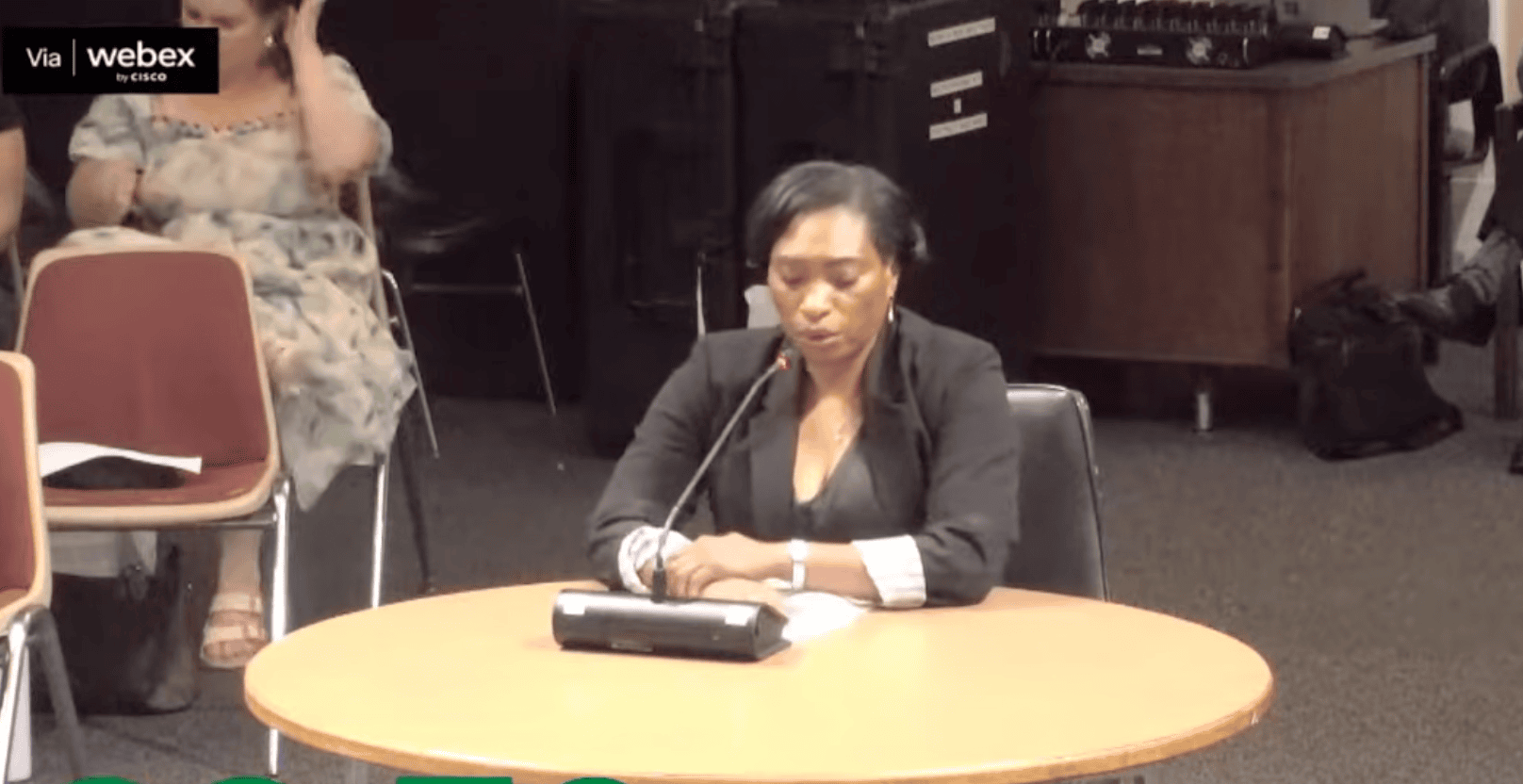
Marie-Paule Florestal of Local 68
“However, the rate of pay remains unchanged at 20 to $22 per hour,” said Florestal.” This wage is not competitive enough to attract or retain qualified paraprofessionals, particularly those who have worked in the district for years and developed strong relationship with their students. After taxes and mandatory payroll deduction such as New Jersey state taxes, state unemployment insurance, temporary disability insurance, family leave insurance, federal income taxes, social security and Medicare, paraprofessionals’ take home pay will be less than the state hourly rates, which will be, as I mentioned before, $16 per hour. The minimum wage in New Jersey is $15.92.”
She continued, “In today’s economy, these wages combined with no health insurance, pension, contribution, and pay during school holidays, winter and spring breaks make these positions difficult for a paraprofessional to return to South Orange-Maplewood School District. … The district has stated that this arrangement will save approximately $1.8 million annually. However, any projected saving must be weighted against the cost of disruption, turnover, and the loss of experienced paraprofessionals. Now, 80% of the paraprofessionals who worked in the district for years are not coming back…. Students will be forced to adjust to new staff. Teachers will have to spend additional time training and supporting inexperienced paraprofessionals and instructional time may be lost. The union’s position remains clear. Students deserve qualified, experienced paraprofessionals, and those professionals deserve fair wages and benefits. Cost of savings should never come at the expense of students learning or qualified educational services.”
Watch the public comments here:
Close Oversight
Board President Will Meyer shared this message about the paraprofessionals in his Board President’s report earlier in the meeting:
“As we have discussed at length recently, our transition between paraprofessional agencies has caused anxiety and even panic in the families that rely on this critical support staff. And we can discuss the nuts and bolts of the rationale behind this move and what the district has been doing to shore things up, but I want to pause and acknowledge, to these parents and caregivers who tend to our students with the most intensive needs, the fears that have been invoked surrounding this move, and acknowledge what you have been going through.
“Please know that, under the board’s close oversight, district leadership has been working around the clock with our external vendors and with our returning and incoming paraprofessionals to address challenges, ensure proper coverage, and establish a strong, supportive environment for every learner. Not all that work has been visible, or can be visible, but I assure you it has been ongoing. We appreciate the advocacy efforts that parent and community leaders have invested in, and the time they have given to us in meetings addressing concerns and discussing solutions.
“Our focus right now is to have a successful student-centered experience on day one of the school year on Tuesday – and when problems crop us, which inevitably they will, that on Day Two they’ll be getting fixed. Without question, the board will closely monitor these support services and ensure we deliver the quality care our students deserve.”