Some Columbia High School parents, teachers — and students — are pushing back on aspects of the new block schedule that was unveiled last week and that will be implemented this fall.
The new schedule includes a single, school-wide lunch period, as well as changes to instructional time — most notably for AP Science courses — and the introduction/expansion of career pathways (Aviation & Aerospace, Auto Technician, Early Education, Music Technology, and Health Sciences).
Members of the CHS Music Parents Association are questioning access for freshmen to the Music Technology Career Pathway, while other parents are concerned about the loss of instruction time in AP courses ahead of the AP exams in May. Additionally parents questioned how 2,000 students would be able to access and eat lunch all within a single 45-minute lunch period each day.
At a special virtual town hall on June 8, Dr. Jennifer Antoni, Director of Counseling, acknowledged the “feelings of anxiety” that change can bring and said that she and CHS Principal Frank Sanchez had broken submitted questions from families into four “big buckets.”
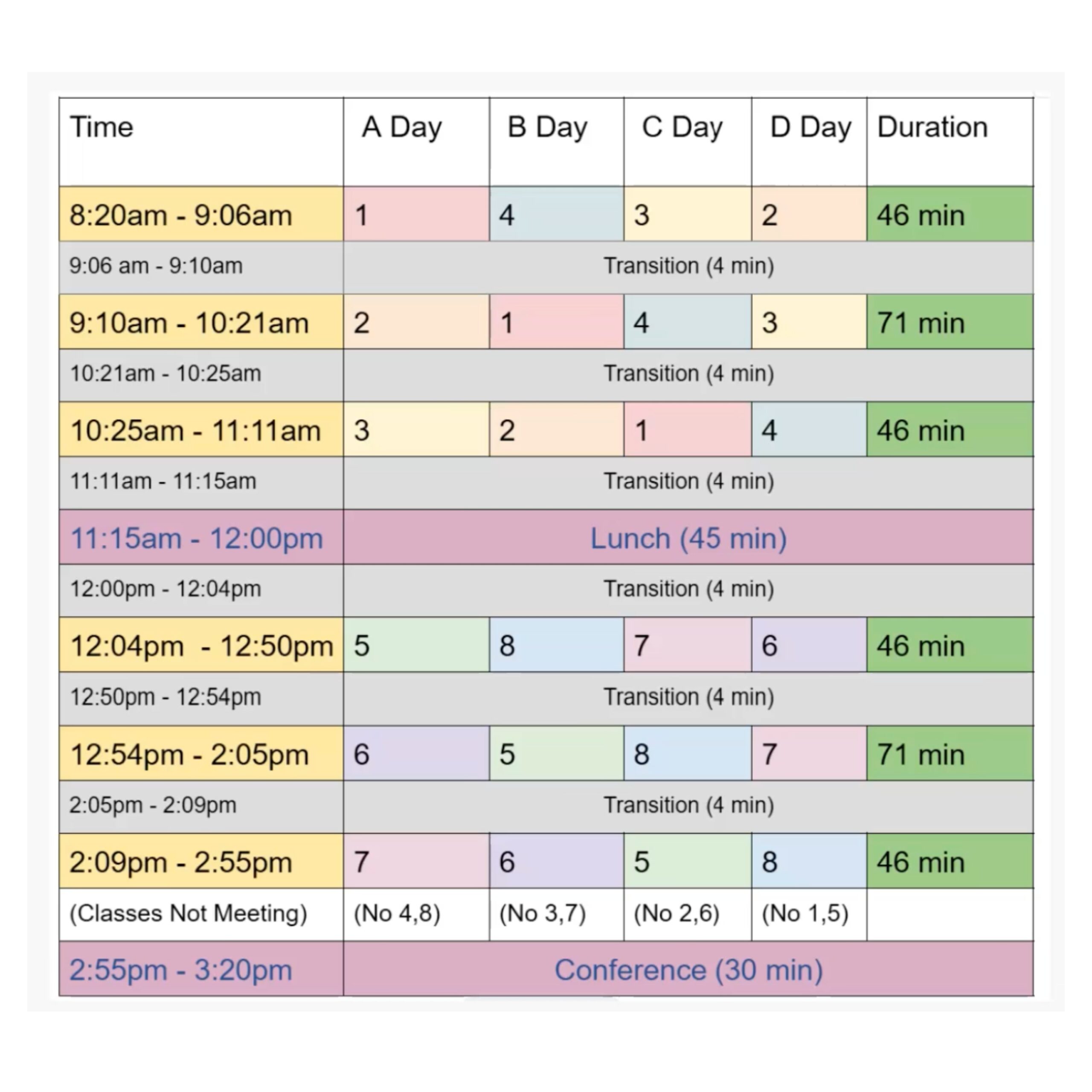
Block schedule table provided by SOMSD at June 8 virtual meeting.
“One was our brand new unit lunch. The next was how our brand new testing center at Columbia High School will serve student needs,” said Antoni. “A third very, very important bucket in terms of the questions that we received are the instructional minutes, and we’ll talk through a couple different ways to look at that. And last but not least, student wellness, which is really kind of where this idea for the new schedule was born.”
Antoni said that the new schedule was guided by data and stakeholder input, including surveys of both grade 11 and grade 12 students about their AP classroom experiences. “We also had a wonderful committee, Columbia High School Teacher Committee, informing some of our work on the new bell schedule. And then, as [Mr. Sanchez] mentioned, we did research of some of our peer districts.”
Sanchez said that the new schedule was something that had been talked about since before he started at CHS six years ago.
“I do want to just stress a couple of pain points that we had previously. Just so you know, the only science classes that had AP that had labs for our students was just the AP. We didn’t have lab science labs in our college prep courses or what we call academic classes here at Columbia High School. And we didn’t even have labs for honors classes, which is really unheard of in districts like ours. So what we wanted to do was to ensure that our students can have lab classes.”
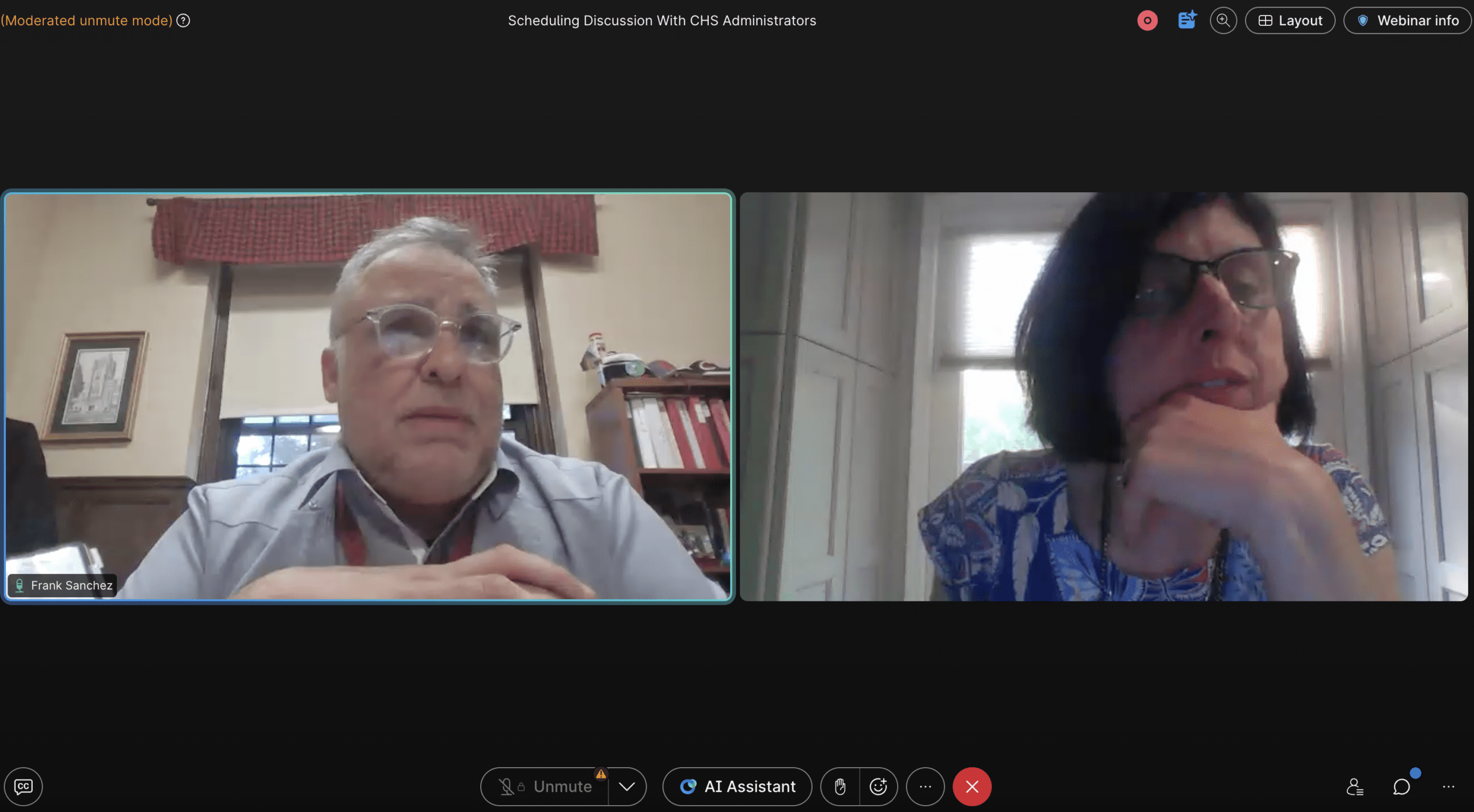
CHS Principal Frank Sanchez and Director of Counseling Dr. Jen Antoni at a June 8 virtual meeting.
“The other pain point, I think was our current schedule basically has seven classes, seven periods plus lunch, which would be eight periods. And that conference period, that ninth period, over two thirds of our students utilized it as the time to talk with teachers,” said Sanchez.
“But we had almost a third of our students using that to demonstrate to colleges that they were taking this extra class,” he added. “Well, that’s not really fair because those students couldn’t talk to their teachers after school. In addition to that, students who had perhaps a 504 or an IEP who wanted to have that extra course, couldn’t take it because they had to have conference time or conference period to be used in that way.”
“So what we wanted to do was to, again, alleviate this idea of not having labs for college prep and honors classes, but also to allow all students, regardless of who you were, to have the option of having eight classes,” said Sanchez. “That’s what this schedule does. It alleviates two huge pain points.”
“Basically, all of our students were offered eight periods: four in what we like to call the AM wheel and four after a block lunch during the PM wheel,” he explained. “Now, if we’re gonna offer eight classes to our students, we wanted to make sure that still our students were able to manage that well. And to put mental health as a primary focus…. Some of our students are dealing with four, five AP classes, which I think is just incredible. So how do you balance all of that?”
Antoni added, “I think the another important idea behind this is that …whatever class they have first period, for example, or second period, the idea is they’re not going to encounter that first period during the first block each and every day, day in and day out.”
“It rotates that pain,” said Sanchez.
One 45-Minute Lunch Period
Many parents questioned how students would be able to get lunch in the new 45-minute school-wide lunch period.
Sanchez said that the new Student Commons has a cafeteria grab-and-go section built into it. “This is part of our plan for several years, as well as our gym area. And we’re also planning for extra grab-and-go sections on the back of the building, back of the cafeteria.” Later in the meeting, Antoni reported, “We are absolutely going to be expanding our seating for unit lunch. This is something that Mr. Sanchez and I are steadily working on.”
Sanchez noted that many students already use food delivery apps like GrubHub or DoorDash. In the comments, many parents questioned how students would be able to utilize food delivery apps when they did not have access to their phones. Sanchez acknowledged that freshmen and sophomores would not have access to their phones, but that juniors and seniors would. “We trust our juniors,” said Sanchez. “It’s unlocked so students will be able to go into their phone and order their foods. Yes, that is something they’re able to do, and able to take with them. So I hope that alleviates some concern.”
Said Sanchez, “Freshmen and sophomores will have their phones locked. Seniors will have no phone pouches. Next year, juniors will have an unlocked pouch.”
Sanchez said that the district’s food vendor also works in other districts with a unit lunch, and that it works. In addition, said Sanchez, “What is different, I think from our school versus other schools, we have such a downtown that is so close by [and] students can walk to, whether it’s Stop ‘n’ Shop or the pizza places. And so we don’t see an issue with that at all. That is something that we’re kind of happy about and we’ll be able to maintain.”
“The other piece about the common lunch or the unit lunch is that we do believe it is going to foster student belonging,” said Antoni. “There are times when students may not be able to eat lunch with students, they would like to eat lunch with, given the schedule constraints. …It’s also an opportunity for students to have some time together across grade levels, across groups, let’s say. So it can really foster a deeper sense of belonging in a positive school climate.”
Sanchez said it would be the perfect time for someone to open a food truck outside CHS.
Music Technology and Other Arts
The Columbia High School Music Parents Association sent an open letter to the Board of Education this week, noting that rising 9th graders have been blocked from enrolling in Music Technology 1 and Intro to Music Theory at CHS.
CHSMPA wrote to Village Green: “Because the pathway starts in 9th grade, entry enrollment has dropped sharply — from the high 60s–70s to 31 — and sections are being cut for low numbers, even as the District has invested in a larger lab and new equipment and just featured Music Technology on its budget slides as one of five signature Career Pathways.”
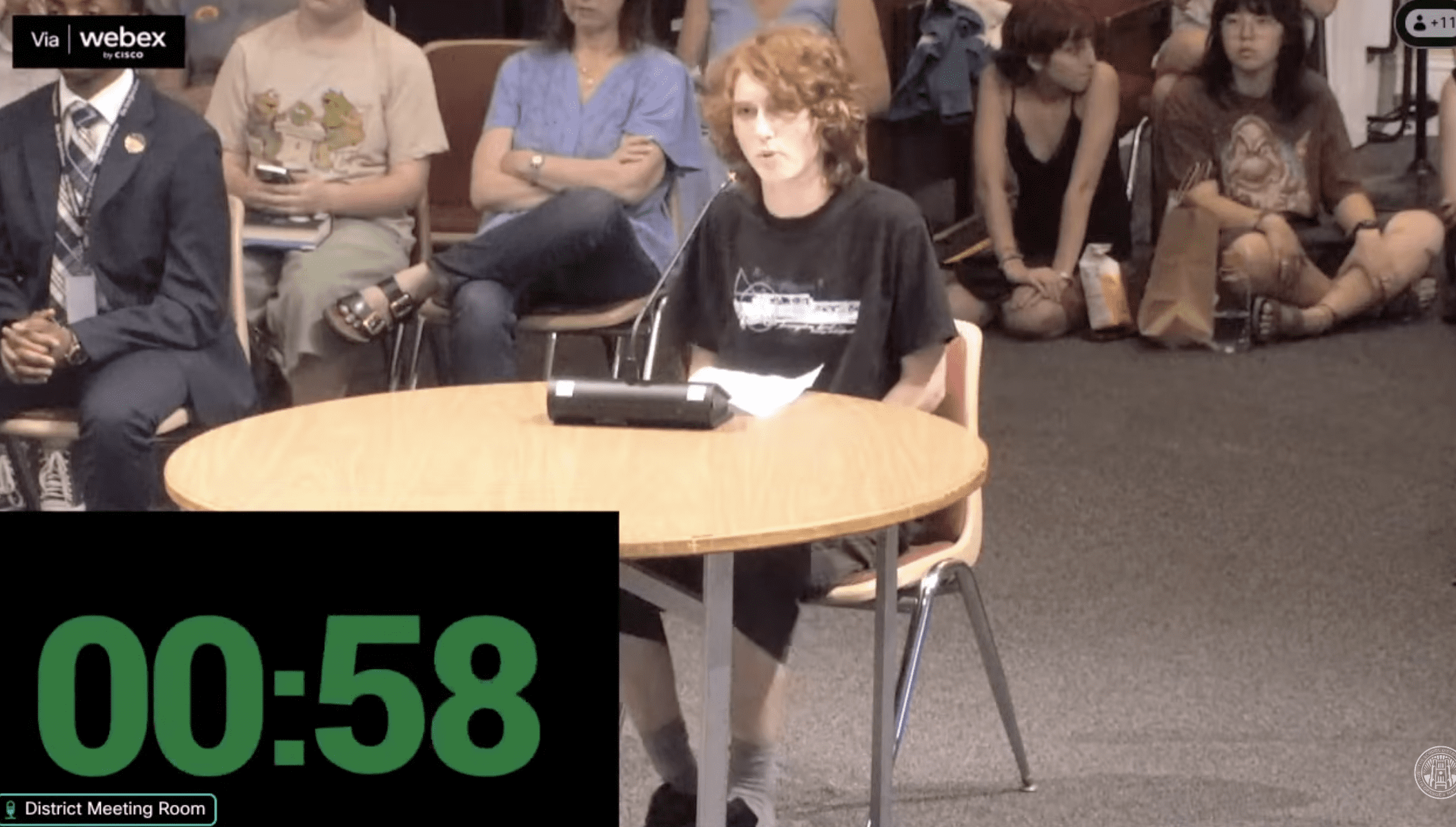
CHS student Mateo Martinez at the June 11 South Orange-Maplewood Board of Education meeting.
“I’m advocating for the arts this evening,” said rising senior Mateo Martinez at the June 11 Board of Education meeting. “My friend and I run the Music Industry Club with Columbia High School. We put on events like BeatFest…. I find that in this world full of the rise of AI, it’s very important to not cut the arts or not reallocate the arts, as humans are obviously very important. It’s a very important outlet for creativity where people can fully express themselves. The arts are incredibly important to CHS, and the arts usually attract many minority and underrepresented communities, which other than the arts, do not receive much of a voice.”
[BeatFest is a student-run event featuring dozens of students releasing their own self-produced albums, with teacher/adviser Emily Vite, who is a current quarterfinalist for the Recording Academy and GRAMMY Museum’s Music Educator Award.]
Martinez said the “change in how the ninth grade are perceiving the arts where they’re no longer allowed to take specific classes is, in my opinion, ludicrous as it’s the point where students are most impressionable and where their brains are most developing and defining what they’re interested in.”
“My name is Sam Cooper,” said another student. “I’m a junior at CHS. I’m a musician going to college for Music Production. My first exposure to this field was taking Music Tech 1, in my freshman year with Ms. Vite. After that class, I started making my own songs. After that, I realized that I really loved it and I wanted to make a living off of it. So from that point on, I started to dedicate my personal time to develop these skills. And in that regard, being able to start my freshman year was very significant.”
Cooper concluded, “I think the district should reevaluate the classes that they are not allowing freshmen to take because, if they are going to pick these fields, this is automatically a year of self-guided time that you could be using to develop their careers that is being taken away from them.”
One parent told Village Green that they feared that the inability for freshmen to register for certain arts classes was a way for the district to erode enrollment and then later justify cutting the classes and teachers in a budget crunch.
It’s a point that CHS student Z Hunt, who will studying Fine Arts at the Pratt Institute in the fall, made during public comments on June 11.
“It saddens me to hear that Mrs. [Alexandra] Paholke will no longer be teaching AP Art,” said Hunt. “She was an instrumental part of your team and now there’s a vacancy supposedly to be filled by Mr. [Richard] Cutrona and Dr. [Kandice] Stewart, who is already teaching three classes. I don’t see how this could be a comfortable transition for them to make. Mrs. Paholke is being let go due to low enrollment that is a result of freshmen only being able to take Art 1, TV Production, Dance or Music for their elective, meaning that Mrs. Paholke’s drawing class and others, like Ceramics and Photography have had low enrollment this year. It’s frustrating that you are letting someone go partially because of circumstances that you created.”
AP Science and Instructional Time
During the June 8 virtual meeting, parents commented that AP [Advanced Placement] Science instructional time was being cut and feared that it would impact student performance in AP exams.
“AP sciences will have 60 minutes less instructional time every week,” wrote one parent. “You’re losing the equivalent of 6–7 weeks of instructional time,” wrote another.
Sanchez acknowledged the reduction in instruction time for AP Science classes, but said the change was about equity as well as student wellbeing, and that instructional time was still sufficient for students to excel in AP exams.
“There is no doubt that AP Science will lose some time because of this new section. But as I stressed earlier, the biggest pain point we have, we were probably one of a few schools — I don’t know another school — that didn’t have Science labs for the vast majority of their time, whether it was academic or honors. AP Science classes will lose that lab period. Yes, they will have, just like all classes an extended time. They all have the 71 minute period, but they did have a earlier luxury of having even more than that.”
“At this point, we are looking into it,” said Sanchez. “This is our first iteration of this schedule. This has been five years in the planning, or six years in the planning. And we’re not going to wait for perfection to deliver us from good. And we believe this is going to be a really good, good schedule. And if we need to tinker with our schedule the year after, then that’s what we’ll do. But right now, I think everybody, the vast majority of our students will see the benefit.” Sanchez said that as an AP teacher, “we didn’t have AP classroom, AP videos and things like that. Our students do now have that, and they’ll be able to access things, but they are losing quality time with our teachers. I’m not going to say that’s not the case, but this is what will help the majority of our students meet the two pain points that we have.”
Sanchez pointed out an advantage for AP Science students with the new schedule: “I will say this, prior to this year, some students couldn’t double up on AP Science because their labs might have conflicted with gym or their lunch and they couldn’t do it. Now with this new schedule, they can take two science courses, three science classes even, and it wouldn’t conflict. So that is one of those benefits.”
Antoni provided overall numbers: “The 26/27 schedule leads to a total of 1,580 instructional minutes across all the whole day eight courses for a student. This breaks down to a 40-minute increase from the 25/26 bell schedule. I also want to share that it is also a bit more equitable in that, in the current 25/26 bell schedule our non AP Science students were receiving 17% less instructional time in their science classes. So that includes students that were taking honors academic sciences and also includes our students with different needs. For example, behavior, academic needs, language acquisition, linguistic diversity. They were receiving 17% less instructional time.”
CHS Science teacher Amy Biasucci said that teachers support the new rotating schedule, but decried the loss of instructional time.
“The district has encouraged more and more students to enroll in AP Science,” said Biasucci, “but how do we continue to serve those students effectively when we have less time to complete the curriculum and offer the individualized support many students need to succeed. It is exactly that individualized support that I offer to students in class, in conference that sustains their success. The district already removed labs from non-AP Science courses a few years ago. Taking away AP labs now may look equal on paper, but it’s a huge disservice to our students.”
Student Wellness
Antoni stressed that the new schedule, with the help of student feedback, was centered around improving student wellness.
“Going through the surveys of students, one thing that students resoundingly shared in terms of their perspective was how much work they were getting on a daily basis,” said Antoni. “So one of the easy adjustments that we were able to make is that because only six classes meet on a given day, we would be able to create guidance where, in terms of what would be due for the next day, it’s only the coursework that the student is going to be seeing going into that next day.”
“So it is just a way to kind of balance their workload, make it a little bit more predictable and a little bit more manageable. We’ve talked a little bit about cognitive load with fewer classroom transitions, less time spent moving through the hallways, less grownups, less teachers to interact with. Students experience fewer interruptions and also a mental reset because the days are again, a bit more manageable. This is a big one. When we connect this to student learning beyond quality of life at Columbia High School, we’re thinking about the sustained attention that can be given a course because of the flex period, the little bit longer time, it engages student more deeply in their learning. And as we talk about improving our multi-tiered system of support, it also allows for stronger tier one practices that are going to serve your children.”
Antoni said that additional time will also allow teachers to more in terms of differentiation and being able to support student learning. “Because let’s face it, any class has many different levels of students. And last but not least, we talked a little bit about the sense of belonging, to be able to connect with peers across backgrounds and social groups, which I know is a deeply held core value of our fantastic dynamic school community and community at large.”
At the June 11 BOE meeting, CHS student Eli Groner disagreed: “I have spoken personally to a multitude of students and teachers who all disagree that this is a beneficial idea to us. I have a petition for over 450 signatures who all disagree that this is not a good idea in any way, shape, or form. And I ask you, who is it beneficial to? It’s definitely not to the students who have employment outside of school and rely on the fact that school normally ends at 2:15.”
Groner continued, “I will lose my employment over this actually, and so will many other students, which I’d like you to take into consideration. Student athletes as well will suffer major, major loss of class time as they are forced to leave for games and matches at closer to 1:30 or 2 o’clock, meaning they could be missing almost an hour and a half of class time if you were to end school at 2:55. The amalgamation or a block schedule, as you call it, lacks structure no matter how many ways you may describe it, and even having six periods, 60% of your classes will still be the same amount of time as they are now in this current schedule. And yet we are still losing two classes a day. I, myself, as an art student, lose access to important studio time and work that can only be done in the classroom.”
Groner concluded, “We have lacked complete communication for both our school and the school board. Have you notified local businesses that going down to one lunch period will impact their economy? … We have yet to receive clear communication to these problems. Our last, again, who is it benefiting, if not the students or the teachers or the businesses? Who are you truly thinking about?”