The four candidates vying for three seats on the South Orange-Maplewood Board of Education — Trish Azeez, Liz Callahan, Kevin Diaz, and Will Meyer — met at the Hilton Neighborhood Association Board of Education Candidates Forum, on Thursday, September 17, at the DeHart Community Center in Maplewood.
The exchange of views was collegial, but differences did arise. Azeez, for example, questioned the effectiveness of the Intentional Integration Initiative — saying it had not closed the opportunity gap. Other candidates voiced strong support for its continuation — albeit with potential tweaks.
[Editor’s note: The Azeez campaign reached out to Village Green, taking issue with this sentence: “Other candidates voiced strong support for it’s continuation,” saying that it made it sound as if Azeez does not support the continuation of the Triple I. Azeez’s campaign manager, former BOE President Nubia Duvall Wilson, wrote that, “She has concerns about how it is functioning and the funds (which is why her platform says she supports proximity placement as much as possible to reduce bus costs). Her response was focused on the question, is it working or not –and she said if you are just looking at the data yes it is, but it stops there and she wants to reduce transportation costs to then reinvest in the classroom. She never said don’t continue it.”]
Diaz, meanwhile, was the sole candidate to voice complete opposition to the use of artificial turf at Ritzer Field.
The candidates expressed varied thoughts on handling challenges such as special education services, facilities improvements, vocational training, and more.
It was the first of at least three meetings of the candidates this campaign season. Election Day is November 3.
Watch the forum here (transcription and questions below):
Mary Boehner, moderator, for the Hilton Neighborhood Association: Each candidate will have an introduction, which will be one-minute each. Our timekeeper is Mark Rutledge. For each of the questions that we ask, you will have a response of two minutes, and then at the end you can have a one-minute summary
Introductions:
Trish Azeez: Good evening. I’m Trish Azeez and I’ve lived in South Orange for 10 years with my husband and our two children. We’ve had some challenges with the district and we love this community and I think that we have all the makings of a great district, but we’re just kind of not getting it done. We’re missing the mark. And I think to get that done, we need to have tough conversations about academic achievement, about race, about trust, and about whether the way we use our resources reflect what we say we value as a community. Now, I/ve worked as an economist in DC, as an equity analyst on Wall Street, and I know how to dig into data and ask tough questions and I know how to use evidence to make good recommendations and hopefully I can bring that experience to the board so we can have better outcomes for our kids.
Kevin Diaz: Good evening. Prior to me announcing my campaign, I spoke to dozens of families out there to hear their concerns and understand their experiences. Throughout having those conversations, what I’ve learned is there’s opportunity for us to do better. By the time we leave here this evening, I hope you learn a little bit about who I am and the values that guide me. I am a big supporter of community service and making sure that we give back to the communities in which we live. I am grateful for all of the advocates that came before us to make sure that we have the rights that we do have today. In my professional life, I’ve been a realtor in the Jersey City market for the last nine years. That has taught me to make sure that we’re listening, understanding different perspectives, and making sure that we follow through with the commitments that we make.
Will Meyer: Thank you so much, first of all, to HNA for always hosting this forum. It’s really appreciated. My name is Will Meyer. I’m a South Orange resident, a dad of two great kids in our district. I’m an attorney for special needs kids in the city on education matters, and right now I am also the president of the Board of Education. Liz and I sat here three years ago, and then took our seats on the board in the midst of tremendous upheaval. We have navigated the replacement of a superintendent, reinstatement of the principal at Columbia High School, three different years of really tough budgets, an equity audit and lawsuit that had not been complied with, and a board that was a lot of ways in disarray and making too many news stories, frankly. I’m really proud of the achievements that we’ve made over the last three years, but there’s a heck of a lot more left to do, and we’re running again because I think experience matters. We want to leverage the progress that we’ve made, our knowledge of what works and what doesn’t, to increase the outcomes for all students.
Liz Callahan: I want to thank HNA as well, obviously for organizing tonight, to the folks who submitted questions and everyone who came out tonight as well as those joining online. So my name is Liz Callahan. I’ve lived in Maplewood since 2018. My husband and I have two kids at Tuscan and MMS. Professionally, when I thought about running years ago with Will, I was bringing two decades of experience in education. I started my career as a paraprofessional. I’ve taught in classrooms, been an administrator and now I consult to a variety of public schools around the state of New Jersey, and that’s taught me a lot about what makes classrooms work, what makes districts functional. And I wanted to reinvest that experience in my own community where my kids go to school, where your kids go to school. I think we’ve accomplished a lot in the last three years and I think that progress is not always linear, but I look forward to the opportunity to continue to serve my community if reelected and build on that progress.
Question 1 (at 5:28 in the video): What is currently working and what is not in the Intentional Integration Initiative and what would you adjust or change?
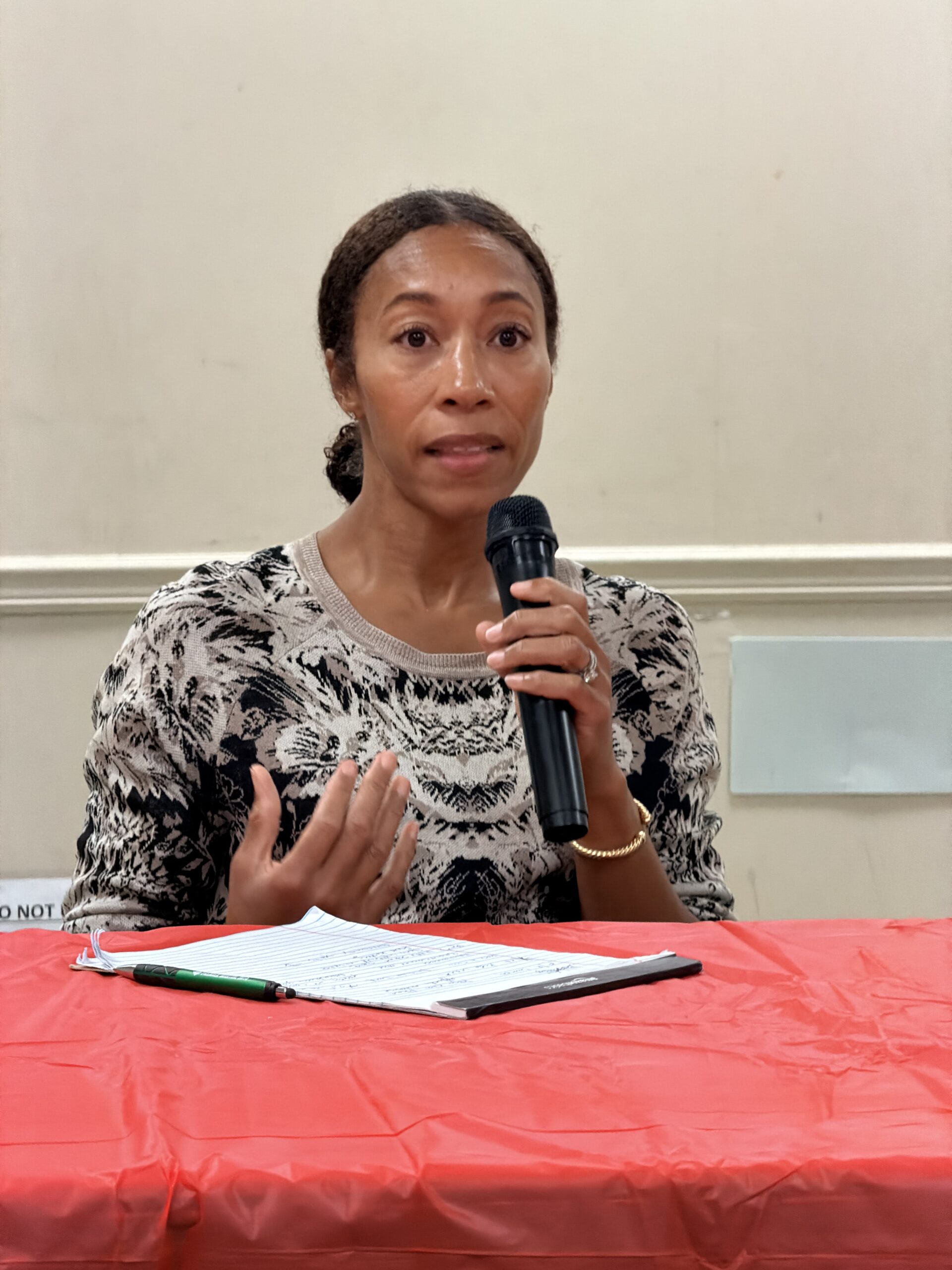
Trish Azeez
Trish Azeez: I think what is working, probably we look a little more diverse. So on the surface, classrooms might look like you have more Black and brown people in them. They might look like we have more economically disadvantaged kids in them and for me, it ends there. Now remember I’m not on the board, so I’m not privy to some information that might be out there. But what is not working? The goal of integration is to have equitable access to opportunity, right? And if we look at achievement numbers, right, if we look at the achievement data of special education kids of Black children, right, we’re just not closing that gap. We’re still looking at 50% almost of students who are below grade level in reading, almost 60% of children who are below grade level in math. I mean, to me that is not getting it done. So that is the first thing we need to look at.
But then we look at busing. We are busing for the sake of integrating the schools and we’re spending, what, 10 and a half million this year? Meanwhile kids aren’t getting to school on time. They’re not getting to school on time to have the breakfast. Their parents don’t know where their children are sometimes in the afternoon. And so I think we need to really consider how we are allocating the resources and what we’re doing it for. Are we doing it for better outcomes? Or are we doing it because we want the perception of diversity in our schools?
Kevin Diaz: So on the Triple I would say that it has reduced the socioeconomic difference within our schools that we have. If we’re looking at the free and reduced lunch program based on 2025, the numbers have gone down compared to where they were in 2019. So looking at some of those numbers, Seth Boyden, for example, was about 44% free and reduced lunch in 2019. And in 2025, that number has come down to about 22%. When you compare that to South Mountain in 2019, that was about three and a half percent and now that is up to about 6.2%. So the number has come down. It has changed a bit. The numbers do vary between all of the different schools. Again, it needs work still. When we talk about it, the work’s not done. Triple I needs to continue. There are some concerns about busing. There are concerns that we spend too much money on busing for Triple I. However, there’s been no real communication on the exact numbers that are spent on Triple I busing. I know that the budget for busing for the entire year is around 10 million, but general education is only about 3.1 million. And when we’re looking at that 3.1 million, that includes Triple I busing, but it also includes the South Mountain Shuttle. It also includes hazardous routes. It includes other things, not only Triple I.
So again, there is room for improvement. What would we do different? We would, I think, save money on busing if you were looking at bringing some of the bus routes back in-house. But I think Triple I is working, it is improving, but we have work to do still.
Will Meyer: So first of all, I just want to make the legal disclosure: Liz and I are on the board. Nothing we say represents the board. It’s just my opinion, her opinion.
This didn’t start yesterday, right? And it didn’t even start in 2019. Our district has dealt with segregation, de facto segregation and massive disparate placements in our schools for decades. And the Triple I is not the first. It is the latest in many different efforts to try to integrate our schools. The Marshall-Jefferson pairing, the zones at Seth Boyden and zones at Tuscan, zones at South Mountain. I was the last year, my son was the last year before Triple I, and we crossed all the way across town to go to South Mountain. That is a thing that our district has been focusing on for a while and all these prior attempts were not adequately working.
We have had lawsuits. There is a state law requiring that our classrooms look like our population and we were very much in violation of that. The Triple I has worked. It has met its objectives of integrating our schools. Is that the end? Absolutely not. There’s huge pieces we need to do on access, the opportunity gap and making sure that students of color, students of different socioeconomic backgrounds are achieving, because they’re not all there yet, but this is one piece that has worked and it would be foolish just to unwind it. Are there opportunities to improve it? Absolutely. Can we find ways of implementing this that will have less of a transportation impact? I believe we can. And we’re working right now to look at ways that could do that. But just unwinding it, and choosing to re-segregate our schools would be, I think, morally very problematic. I think we have to innovate within what we have, not try to unwind it.
Liz Callahan: I think Will did a good job of outlining some of the historical context that is important when we think about where we are today with our integration plan, what it means for our community. I think one thing we didn’t touch on is just the core principle, right? Are there operational and logistical challenges associated with Triple I? Absolutely. There’s no disputing that, and we can discuss those. As a core principle, I think integration is something that is important and our schools do, based on the work that we’ve done through Triple I, reflect the diversity of our community, even if we’re just looking at the metric of variance, which we routinely meet across our elementary schools. I think in terms of measuring success, Will alluded to some of the areas in terms of achievement gap, in terms of really looking at that and drilling down across a variety of domains, including our special education students. Our black and brown students are three times more likely to be referred to special education services.
So drilling down as we move forward, taking the work not just at the logistical pieces of Triple I, but really improving the classroom experience and putting the resources towards that is something that’s really important. I think we’ve also done some work around what are the ways that we can improve it. I would argue that moving to a proximity model is something that’s happened that should help to ease a little bit of some of those burdens of placement, continuing to look at isolated placements and those impacts. We also, the district developed Regulation 5120 that gives us a really nice framework to look at around annual data and reporting of impact analysis that I think should be the way that we as a board continue to look at it. It can’t be something that we’re looking at it through any other lens than the one that the regulation provides for us, and that should dictate exactly how we move and what we’re providing feedback to the community and communicating with the community around what those changes could look like as we move forward.
And I think there’s other things that we can and should be doing to improve communication around it as we are this many years into it so that new families to our community understand it at a higher level.
Question #2 (13:33 in the video): What is the current price tag of the Ritzer Field project? What are the pros and cons of putting artificial turf on Ritzer Field and what is your position on that?
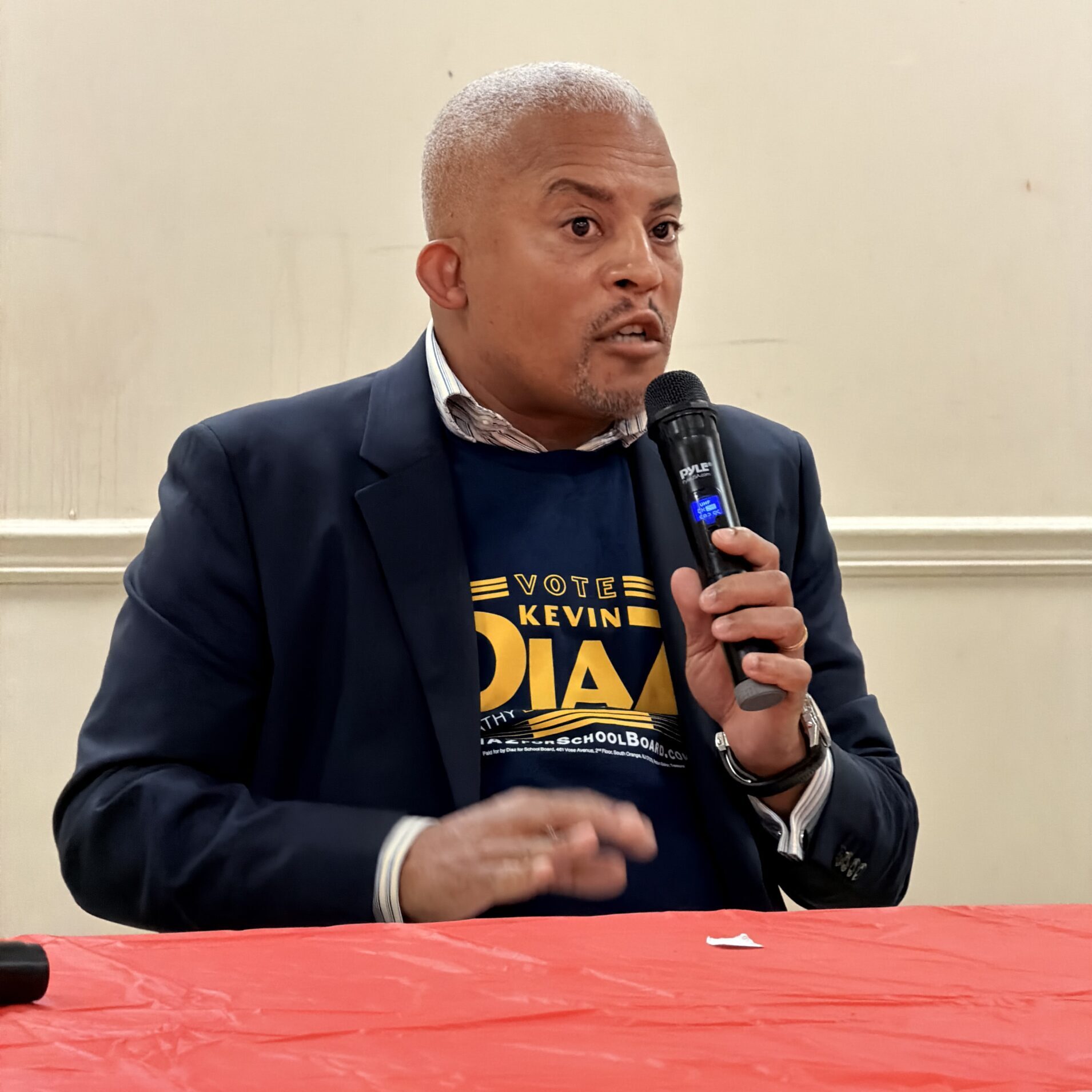
Kevin Diaz
Kevin Diaz: As far as my understanding, the current price tag is around $8 million on Ritzer Field. I oppose putting turf on Ritzer Field (feedback). And so does the mic (laughter). Some of the cons on obviously looking at Ritzer Field is making sure that there is a proper maintenance plan, there’s proper stormwater management plan, all of those things within the cost, making sure that those things are included in that total eight million dollars. If not, making sure that we have an accurate budget before bringing that to a vote. My thought is making sure that we look at natural grass options. South Orange, other towns have natural grass, they have playable fields and we need to figure out what they’re doing in order to maintain the fields over in South Orange, and where the girls are playing softball currently. What are they doing to maintain those fields? What can we do? What can we duplicate? Making sure that that is something that is obviously a cheaper model than going to turf that has to be replaced.
And when we’re talking about turf, we’re looking at, is it Ridgewood with their turf situation currently where it’s buckling and their field is out of commission as they try to repair that currently. So for me, I personally stand with looking at natural grass options, making sure that we do have a plan for that.
Will Meyer: So the last published estimate for the Ritzer field development had it at around, I think 7.8 million or so, and that’s with 20% state funding in debt servicing. Look, my record is clear. I have voted for a turf field option for Ritzer two different times now. And I did that as someone who, all else equal, would prefer that we have grass playing fields. But the situation we have is that we are not a district with a tremendous amount of space. We’re not a town with a tremendous amount of space. And so we’re in a situation where we have a lot of students with a lot of different activities that the district is supporting. Ritzer is a field. It is also a piece of district property and it serves our operations. And we have a lot of athletics and other recreational uses in addition to the needs that our town has.
There are a lot of fields. South Orange has a lot of fields and I’m on them more days than not in part of the year for baseball. But if you ever go over to Underhill Field, man, it is used constantly because there are certain things that you can do easily on turf that you can’t on other fields, and the community and our schools are really demanding it. And the district is saying, look, this is an important part of what we need to move forward. So I really do think that it is a thing that we need to look at, that it is an appropriate use of taxpayer funds and a relatively low impact on individual taxpayers. And this is part of a broader plan. This is not the only thing we need to be paying for, for sure.
There’s a lot of major infrastructure projects that we need to be working on, and we need to, regardless of what happens on that field, make sure that it is in good shape and it is playable, and we have to work on the major infrastructure issues that are facing our district. But, I think it’s a project that’s been sitting on the docket. It’s the only major project from the 2019 capital plan that was not developed. And I think it’s time that we get this done for the sake of the many of the district who use it. Thank you.
Liz Callahan: So the cost estimate that Will provided is accurate. We are still in discussion as a board weighing options around what this project can look like. I think one thing I think about in terms of this decision making is the amount of time that we have dedicated as a board, as a community to the discussions, to doing due diligence, to going back to the drawing board, to taking community concerns and ensuring that we’ve accounted for different studies to be conducted, going to our BOSE multiple times around this. And I think that all of this, in my opinion, has to happen in concert with prioritization around our very real infrastructure needs, right? As the parent of someone who is now at MMS, it is not lost on me how often we hear stories from MMS.
It is not lost on me that parents at CHS have, and students from CHS are consistently discussing the state of bathrooms. So while our buildings are old, as many of our houses probably are, we know that maintenance is needed and required to ensure that our facilities broadly stay safe and reflect the kinds of learning environments that we want for our kids. And the same is true of Ritzer. We need to identify what the next steps are going to be. We need to move this from discussion to action, and we need to make sure that all of our kids, including girls, have adequate playing space. I am often also on Underhill as both of my kids play flag football, and there are so many games that can honestly be hard to watch. And so I think about capacity, I think about space, I think about making sure that we have a balanced approach to the project while also moving the needle forward on not just Ritzer, but the broader conversation around our infrastructure so that we have places where kids can thrive academically and athletically.
Trish Azeez: So, the price we saw is roughly seven and a half million. Now, I don’t know what that price is per household, right? But I know for families of athletes around, we would say we need facilities for our children to play. You know, cons would be, yes, it could be an environmental issue, but listen, the analysis has already been done, right? The board has already voted on this and has already approved it. So the fact that it’ still a conversation is odd, but I think, listen, if we could have grass fields, we would do that. But I think that we’ve shown that we are not able to properly maintain our fields, and this becomes an equity issue, right? We have our girls’ softball team unable to play games, unable to host games. We have the, now we’re introducing middle school sports, and we don’t have. … I mean, I think it’s great, because I do think that we should have more access to for the middle school should have more access to athletics, but where are they gonna play? So we can’t introduce these new athletic programs without having the facilities to accommodate them.
Listen, I have two soccer players. My kids both play football, and these community sports are important because they feed right into the high school. So these are students that are gonna be representing Columbia. And we’ve played in Newark until nine o’clock at night because we don’t have available fields here. My son’s soccer team, he’s a Cougar, right, and they play in Orange. So our home field is a turf field in Orange. And so I think it’s clear that we absolutely do need these turf fields, and it’s for our students, it’s for equity, and it is giving our students a chance to develop outside of the classroom, and that becomes really important.
Question #3 (21:36): What are the district’s most urgent facility needs? What needs to happen to ensure that the most urgent facility work gets done in the summer of 2027?
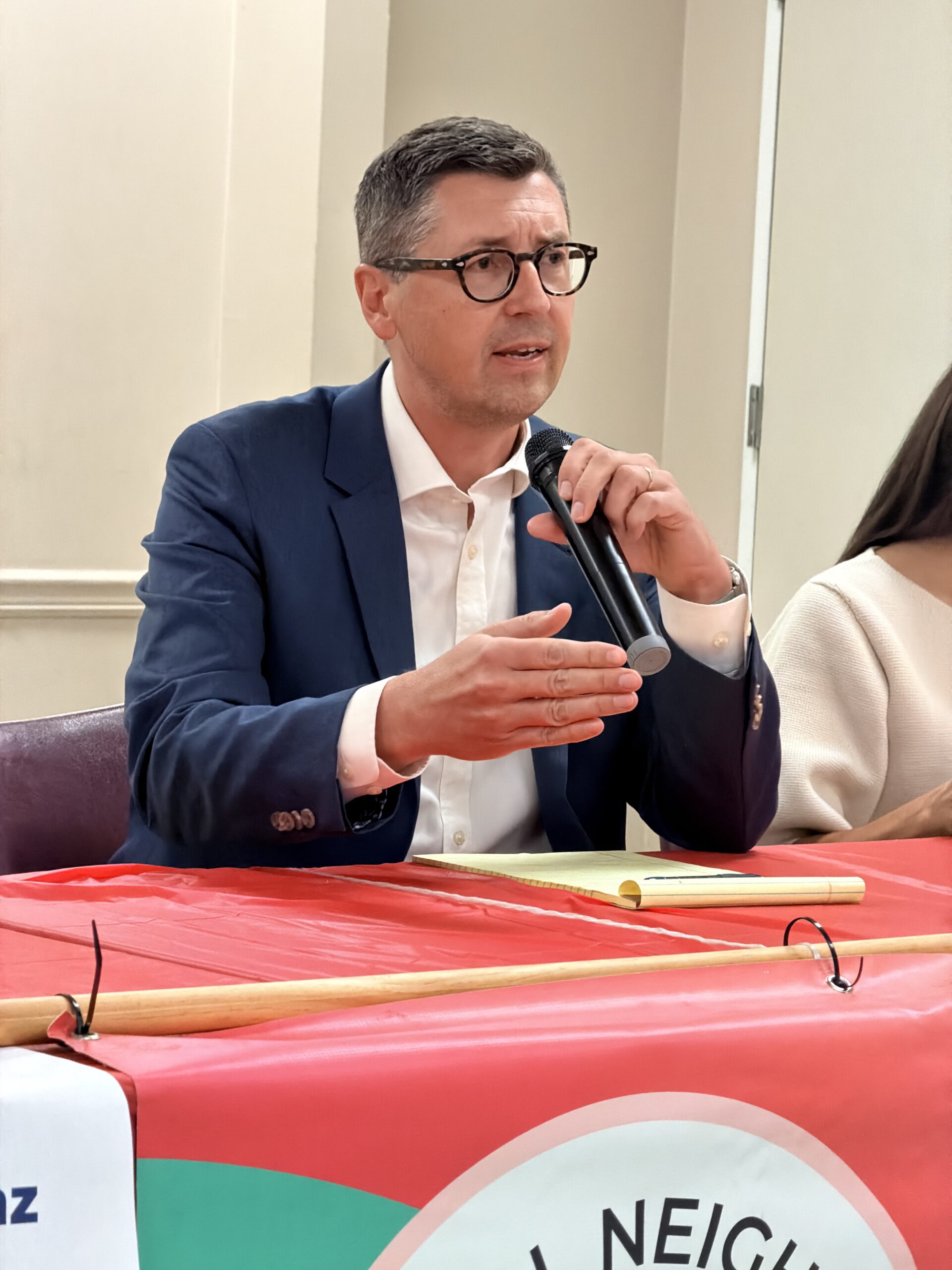
Will Meyer
Will Meyer: So we do have a lot of needs. And we just completed, of course, the 2019 facilities plan that it was originally, it went up to about $180 million. There were a couple more pieces that were tacked on, and there was a lot of very important work done. Some of it, a significant amount of it was upkeep of district facilities, stairwells that were entirely rotted out. And we also had a huge number of portable classrooms that were rotting out, as well that we needed to replace. So we had a huge amount of work to do that. But this is a district that has endured decades and decades of deferred maintenance. The kind of deferred maintenance that I’m hearing right now when we see reports in the paper that we don’t want to look at any additional taxation.
I think that’s a real problem because our schools are falling apart. We have major issues. We have the ceiling that fell in at MMS. We have boilers that are being replaced on an emergency basis right now. There are a number of issues that we’ve identified that the superintendent has identified, and that we’re hoping to go to the board of school estimate on. And what needs to happen is we need to have this package put together, secure the state aid that we’re gonna get from it, which will happen in a few months, and then bring it to our municipal leaders and have a partnership in committing the community funds necessary to getting our schools up to spec. There are accessibility issues that we need to work on right now. There are a number of just major infrastructure pieces. Maplewood Middle School, I would say, is the single biggest issue, but we have projects across the district. Getting a bond proposal approved quickly in the spring will allow us to do at least some of those perhaps in the summer of 2027 and then in the future going forward. But it’s gonna take some commitment for all of us anD the political will to make that happen.
Liz Callahan: I feel like I teased this in my last answer. But I think we are in a position where we have had years upon years of deferred maintenance, and we are at a little bit of an inflection point, in my opinion, right? As Will referenced, we are frequently in receipt of emails and of communication around bathrooms, around Maplewood Middle School specifically. Certainly CHS comes to mind, Seth Boyden’s playground. The list kind of continues, right? And so I think there’s a number of things that come to mind. In addition, we have also gotten a number of pieces around ADA compliance, which is non-negotiable in terms of the prioritization process. So yes, we completed the 2019 capital projects, which was amazing. It got rid of our portables, it added classrooms, and now we need to move on to this next phase.
And really the way that we do this most effectively is, as Will referenced, this is quite a group project, right? We have gotten feedback from the community. We are getting direction from the district who has engaged in a process to put together kind of a master list of all of the things that would be required to kind of get our schools where we want them to be. And now it’s incumbent on us to do that prioritization at a level of what is a package that we can bring to our municipal partners, because I do think there is an appetite from the community to ensure that the schools that we’re sending our kids to every day are schools that we’re proud to send our kids to every day, right? That classrooms are up to date, that the bathrooms are safe, well lit, that it’s accessible for our kids who need it to be and for our teachers who need it to be, for our parents who need it to be when they come and visit our schools.
All of those things are critically important and we’re no longer at a point where we can wait. We’re at a point where we need to work together to figure out what that looks like to give our kids and our community the schools that they deserve and to ensure that we do it, as noted, as quickly as possible. And we know that the longer we wait, the harder it gets to fix some of these entrenched problems in our facilities.
Trish Azeez: I think it’s clear if we walk through our schools that, we need to do better. When I moved here in 2016, my kids didn’t go into the district until around 2018, but I was that parent that went to the board and went down to the district and I wanted to tour the schools, right? And I remember walking through South Mountain thinking, where the hell am I? Like, this is not a school in our neighborhood. It was not reflective of the homes you see, of the families you meet, and honestly, we need to have our children in schools that they could be proud of. And it’s not just aesthetics, right? Where their air conditioners aren’t working, windows aren’t opening, toilets aren’t flushing.
You would walk through some of the schools and it’s like, listen, enough is enough, and we have to get it done. When it comes to what we’re prioritizing, of course you prioritize safety, you prioritize those issues that are gonna keep the kids in school, right? So if it’s boilers, if it’s a roof, we don’t want water dripping on our children’s heads, right? And so those are the things we’re gonna prioritize. , And listen, it’s just like your house, right? We, we need to take certain measures to make sure we are maintaining and keeping a safe home for our children to be in, and the same works with our schools.
Kevin Diaz: So I think I’ll piggyback on a lot of that. When we’re talking about the facilities issue, I think that there are a lot of urgent issues that need to happen within our schools. Again, we touched on bathrooms, we touched on elevators, drinking fountains, all of those things, ceilings falling in Maplewood Middle, that’s something that needs to be prioritized. We need to accelerate a plan to make sure that that can get done in the summer of 2027. From my understanding, again, I’m not on the board currently, but there is no plan in place. There’s nothing that’s going out for the ceilings. If we wait too long on getting something in place, the work can’t be done in the summer of 2027, which means it’s gonna get pushed for another year to 2028. So I think that needs to be accelerated. We need to make sure that we are looking and getting those urgent issues fixed immediately.
Question #4 (28:30): Which potential cuts are non-negotiable to keep and which would you consider? Librarians, special ed services such as dual teacher inclusion, courtesy busing, turf fields, teachers, electives such as CHS aviation, or increased class sizes.
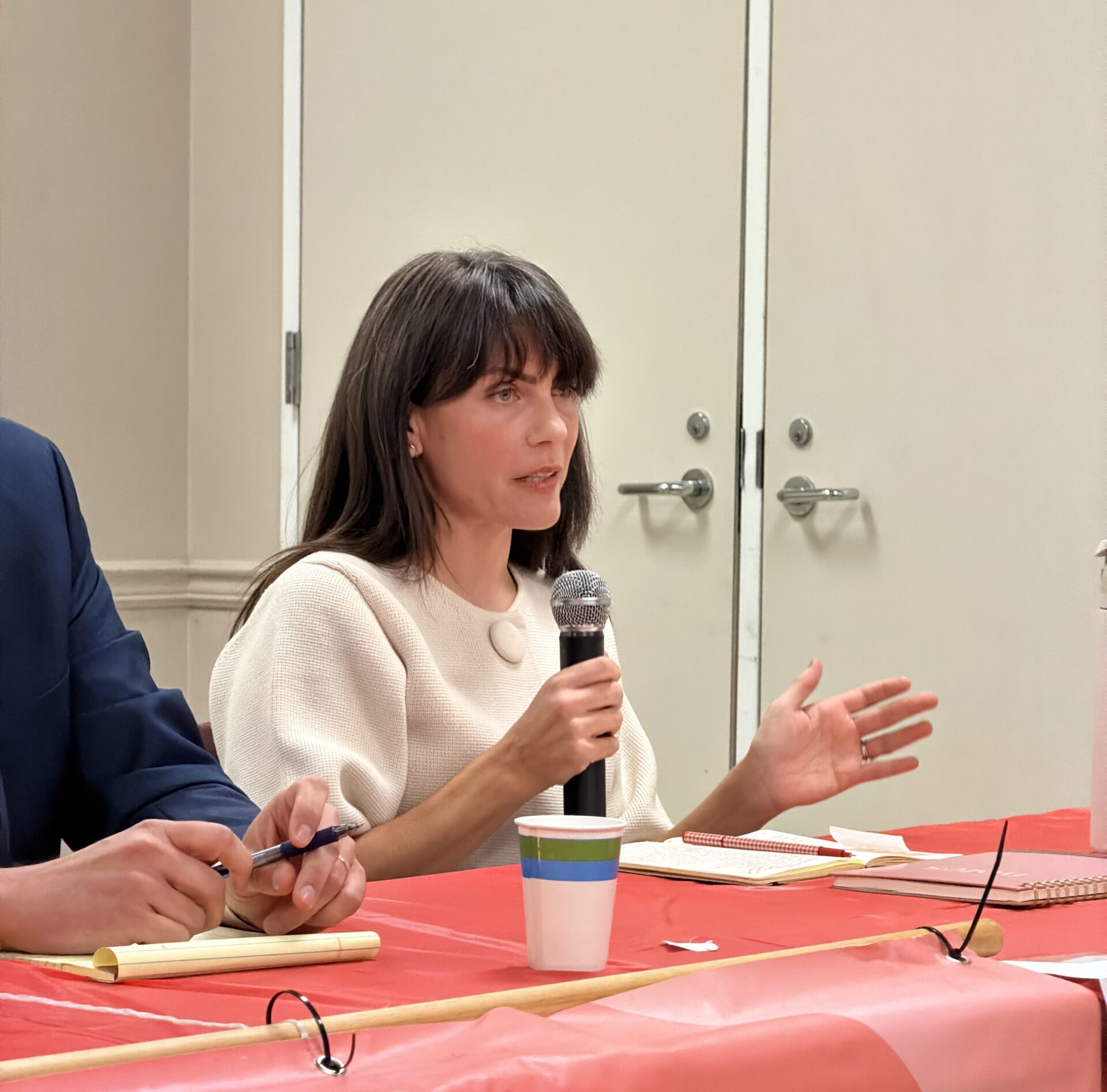
Liz Callahan
Liz Callahan: So I will be candid that questions like this for me not only as a board member, but as someone who works in schools and has for two decades, these are really hard for me to answer, because often as someone who provides an additional layer of needed support, but often contracted, I’m often that person, right? Yes, we really need this support, but hey, we can’t afford it anymore, even though I know that what we’re doing is indispensable to the kids that we’re providing this level of support for. And I would argue that there’s a case to be made for every single thing on that list, not dissimilar from that, right? The need for librarians, especially in a time where we are facing a literacy crisis, where we are facing that in combination with the rise of AI and digital literacy.
Inclusion is, in my opinion, is not something I would consider. I think our dual co-taught inclusion model is truly one of the gems of our district. It’s not something that many districts have and something that we’ve fought to protect in the past and try to continue to protect if that was brought up again.
In terms of increased class sizes, I think all of these things, right? Turf fields, teachers, electives, I would be hard pressed to pick one because I think a responsible board member looks at these and we do an impact analysis and we have discussions about what are the trade offs of every single one of these. I want to be able to make informed decisions and I feel like it would be irresponsible of me to sit here tonight as a sitting board member and to pick one of these things. The responsible thing to do is to say that I would get through our committee process on the recommendations of the SLT [Senior Leadership Team] and our superintendent, look at the options available to us in this really difficult financial posture that public schools find ourselves in, and make the most responsible decision based on the impact analysis provided.
Trish Azeez: I think that we just don’t pay enough attention to student outcomes. Like honestly, everything that we’re looking at, we need to be thinking about how does this affect student academic achievement? And not just academic achievement, but overall achievement. And so when we talk about special education at the high school level, if we look at the percentage of kids who are proficient in reading and math, that number is 6% for math, right? And so if I look at that and say, well, 6% of our special ed students at the high school level are at grade level in math, that is not a place that we can look at cutting costs. And so while we’re not talking about inclusion classes maybe in the elementary level, it compounds, right?
So what you see is that if the proficiency rate is 20% in grades K through five, then it’s gonna be 30% in the middle school. And then it’s going to be more so. We need to make sure that one, when we’re looking at cutting costs, we are thinking about outcomes for our students and special ed is one of the last places we’re going to do that. Teachers, it should be one of the last places we’re looking at to cut, increase class sizes, right? Teachers are already having a hard time intervening where kids need help, providing targeted support. The achievement data show that that is not a place that we can consider cutting.
One of the things you didn’t mention is transportation and I kind of missed an opportunity on this. Why not cut transportation, right? Some of our candidates here think that Triple I is working, but is it? Right? I propose let’s let our children walk to school, right? Let our children walk to the closest school and then let’s see how much of that 10 and a half million is attributable to Triple I busing and how about we put that into initiatives. Like if we’re looking for where we can find money, we can’t start in the places that affect student achievement.
Kevin Diaz: Of those items, when we’re talking about making cuts, I do not think we should be making any cuts to the teachers, especially to the special education department. Again, as we, I think we’ve all said already is that we need to make sure that we’re evaluating who’s being affected with any type of cut. All students are gonna be affected by teacher cuts. All students are being affected by librarian cuts. All students are being affected by arts cuts. We need to bring arts, the librarian, make sure we have those in place. Special education, again, we shouldn’t be reevaluating contracts to save a little bit of money, but not figuring out who’s going to be impacted. With the courtesy busing, again, sometimes looking at the parents that may have to get to work early, courtesy busing might be necessary.
Again, the only thing that I see that’s on this that could be cut would be the turf.
And when we’re talking about turf, we’re not saying we don’t want our kids to play sports. We want our kids to play sports. We want them to have a field to play on. We need to make sure that our district is responsible and they’re managing and maintaining a proper field. What we have right now, no maintenance being done on it. It’s a lawnmower, nothing else. As long as they’re maintaining a proper field, we can have our kids play sports and it’s equitable. Everyone can play on grass fields.
Will Meyer: So we have to look at a little bit of context here, right? We’re talking about cuts. We know, we’ve heard the superintendent say over and over that we are in the middle of a fiscal cliff here. And what that means is this: The inflation, the CPI has been rising each of the past three years in the New York/New Jersey area by two and a half to three and a half percent. The cost of health insurance on our district has gone up by 20 to 30%. Our teacher contracts, their salaries go up every year. In recent contract by about 4%. We can increase our budget by a maximum of 2%. This is really straightforward math here. You look at where the costs are going, you look at where our revenue is going. We are in trouble every single year.
And we are in trouble this past year and we created a budget. It’s the third painful budget I’ve had to be part of where we had to really cut. We call it, we say cutting the fat, but it’s cutting the muscle as well, right? We had to dig in. We had to cut in library. We renegotiated contracts in special education. It was painful. It’s not what people wanted. We had RIFs [reductions in force] of teachers. We had a reduced number of electives. We haven’t increased the class size on paper, but we are maxing out what the current policy says. And we are facing another multimillion dollar gap for the upcoming school year and the one beyond that. This is a Sophie’s Choice to say which of these categories should we cut and which don’t we? We are in the unfortunate position of having to do more with this every year.
Does that mean that we’re going to have to look at different creative ways of running a program that we think will not impact outcomes, but will create some efficiencies so that we can make payroll, keep the lights on, not shut down a building as towns around us have, fire 50 staff in the middle of the year? Those are things we don’t want to do. And the way to do that is with responsible cuts during the budget process and people will not like it. And any of the three of us that are up there, people are going to yell at us, but it’s going to have to happen.
Question #5 (37:04): The special education families in our district have long reported that their needs are not being adequately met by the district. Recently, parents have voiced their frustration. Individual education plans are not being followed. Inclusion classes are being held without special ed teachers, and communication with administration is inadequate and even non-existent. The children are suffering and their parents are asking for an answer from the administration. What specific actions will you take to improve the state of the special ed program in the district?
Trish Azeez: So I’ve spoken with many special education families, and I think two words always come to mind are unheard and fight, right? They have to fight for every service that their children are getting. And listen, I was in that boat and that’s why my son is homeschooled right now, right? He was not getting what he needed and I pulled him out. But I also acknowledge that I have the privilege to do that and not a lot of families may be able to do that. They may be able to make sure that their children are getting what they need. I think the first thing is communication, right? It is just unacceptable that we can vote to change a contract that’s going to impact paraprofessionals for these children. I mean, this is a basic need for a lot of these children and SEPAC [Special Education Parents Advisory Committee] wasn’t involved in the conversation.
I think oftentimes they are completely left out of the conversation and that is unacceptable because these are basic needs and when their basic needs aren’t being met, then the entire student body is going to suffer. I think that economics is about the allocation of limited resources. We do have limited resources, but how we spend our money is reflective of what we value. And I think that we’ve been sending the message that we don’t value some children, right? And maybe we’re not valuing them for what we perceive their capabilities to be or based on their performance, but every child in this district has value, and we have to be able to send that message. So like the issue with the paraprofessionals, I mean, that is what it says to families.
So we say that you’re going to get what you need and then we’re left 22 paras short at the beginning of the year. And families found that out right before school started. That is a problem, right? And so it starts with community engagement, engaging with groups and I think it ends with how are we allocating our resources and who matters to us.
Kevin Diaz: The children suffer. The parents are frustrated. Again, talking about the special education department, I’ve spoken to numerous parents prior to announcing my candidacy. And again, hearing the frustration on the parents, it’s maddening just to know that there is no communication, to know that a change like this that affects our most vulnerable students wasn’t discussed. Paraprofessionals are some of the people who know the children the most. They spend the most time with these kids and to disrupt that causes disruption within that child, causes a disruption when they get home and it just throws everything off. As far as what I would do differently, again, for me within the special education department, I think we would want to look to make sure that we have processes in place, making sure that the special education department, their families are treated as actual people and not as an afterthought.
Again, things are happening, they’re not informing them. It’s an afterthought. They’re letting them know after something has already happened. They need to be involved in the conversation while it’s happening because it affects them and their children. Outside of that, just going through the process of getting an IEP [Individualized Education Plan/Program], all of the process, making sure that the board can actually report numbers. How many appointments are being requested? How many are actually getting classified? How many are not getting it done in a timely fashion? How many parents are complaining? How many are going to legal action? We need numbers to know what’s happening, what’s working, what’s not working so that we can solve those issues. So if we don’t measure anything, we don’t know what we need to solve. So we need numbers and we need to figure out what’s actually working in special services and what’s not.
Will Meyer: Thank you. So this is an area near and dear to my heart. I live, breathe and sleep special education. I represent at any one time, more than 100 and over my career, certainly, in excess of a thousand special education families who are in disputes with their school district over their IEPs. And I go to national conferences with all the other lawyers and advocates representing parents and every single one of them have fights with their school district. And I honestly, I don’t know what it is that we cannot, in our whole nation, figure this out. It is a struggle in so many places and it’s because each kid has tremendously individualized needs and parents are so scared of what’s happening. Is the school listening? Is the school responding to our kids’ needs? And that’s a two piece, right?
Is it happening and are parents seeing it? We have a district culture that I think is not doing a good enough job at communicating with parents. We have a lot of great special education wins and over the past three years, we’ve added an emotional regulation classroom, we’ve added an ASD [Autism spectrum disorder] classroom, we’ve added a whole other child study team to decrease waits. We’ve brought a lot of kids back from out of district.
But each individual parent is saying, “What’s happening with my child’s services?” And I think we need to do a much better job of actually having that two-way communication. It’s actually part of the meeting we’re having next week in looking at all the communication struggles that came as a result of our paraprofessional issue, and say, “What are we going to do going forward so that parents do feel more in the loop and we have better two-way communication?” because the district has made strides on special education in a lot of ways, and it’s important that parents can see that and know their kids are being adequately served.
Liz Callahan: Thank you. So I’m glad that we do have to get to this conversation tonight. As Will said, when we ran three years ago, we ran in large part because we had this in common. We had a shared desire based on our professional experience to reinvest that experience and that knowledge in our community in a district where special education has a long history of deep challenges, not dissimilar from the ones that we are talking about today. As the chair of the special services committee, when I joined the board, it was an ad hoc committee, which we felt was even in a symbolic way, inappropriate because we have to focus, this is not a thing that ends, special education does not end. It is an integral part of our district and deserves the same stature as something like curriculum and instruction and something like facilities and finance.
As Will noted, we have had a number of successes. We have expanded the continuum in-district programming to meet the needs of our emotional regulation students, our ASD students. We’ve also improved the level of service, or training that schools are getting writ large in terms of Orton-Gillingham, in terms of collaborative problem solving, because I think where we often see that breakdown is we can have great specialized classrooms, but it really also comes down to the school culture and climate, right? Building inclusive schools requires training for school leaders, it requires training and buy-in from the board of education, from the district leadership. And I think as we move forward with the special education committee, as we move forward as a committee, that’s something that we have talked a lot about is moving beyond just the compliance issues, which of course are things we need to continue to focus on.
We were coming out of an audit, we had a corrective action plan. We have moved the needle, closed those out, but now is the time to really focus and shift our attention to strengthening the partnership with SEPAC, with the broader community. And really making sure our schools from the top down are focused on inclusion and making sure these families feel accepted.
Question #6 (46:23): Upon becoming superintendent, Mr. Bing outlined an ambitious plan for students to have pathways to careers and skilled trades. What is your vision and what would you plan to see coming through this?
Kevin Diaz: So I’m not 100% aware of what his plan was with that when he came on board, so I’m not going to speak on that one particularly. I’m going to pass.
Will Meyer: I think this is really important. We have nationwide this very ossified scheme at this point where you do your four years of high school, then you go on to your four years of college. It used to be four years of high school, you can get a job. No, now you do four years of college. Can’t get a job then either. Maybe a year or two of a master’s program, three years of law school. You know, farther and farther. And this is not the path for all of our kids. It’s not by far the most lucrative path after loans for all of our kids. It’s important, I think, in a 21st century system of education that we are certainly preparing our students to go to college, and have whatever additional post-secondary training they want, but to make sure they could actually get a job.
And we have tremendous career pathways that we’re developing right now. And this is not just things like automotive trades, although I think that I always passed that shop in my high school and wished I was in there. But we’re working on things like textiles, things like tech, woodworking. There’s a lot of pieces that we have that are giving practical skills. And that’s in addition, of course, to the opportunities that our students have to spend half a day at a vocational, at a voc tech. And even students who transfer and go into those programs, they shouldn’t have to transfer. We want to have the opportunity to do training. And that’s for our neurotypical kids as well as our neurodivergent kids. It goes into vocational training as well. I think it’s crucially important.
I have a very good friend in town who always sees me at every event and says, “When are we gonna have an adult vocational program to teach students how to work, like, in a cafe?” And we would love to see this happen. There’s a lot of things that we could do to better support our students for a non-college pathway, and I’m glad that Superintendent Bing has brought that to our district and that it is continuing.
Liz Callahan: I think Will made a couple of good points here in terms of providing multiple pathways. I think one of the most exciting things about being on the board, just to zoom out for a second, is I might not otherwise attend things like the CHS Hall of Fame, right? Maybe it wouldn’t be on my radar. I happened to go this year, and I’m reminded of a story. I don’t know who goes to Sabatino’s great pizza. I’m gonna give a shout out. But he told a really compelling story as a CHS graduate about how school was quite hard for him. And he didn’t necessarily see a traditional path forward. And I talked to a number of students and parents after that, and a lot of folks shared the sentiment that I walked away with.
It was really nice to have a model of what a different pathway could look like from a CHS graduate. Someone who came back to town with a different set of skills and did something slightly different, but is a demonstration nonetheless of an incredibly successful and happy life. And so I think when we have that lived example, someone who came out of CHS, it also makes me think about providing those options in real time for kids today. As Will noted, college is expensive, that’s one reason. And for some kids, school is really hard. Neurotypical or neurodiverse — school might be a hard place to be. It might not be something where you’ve kind of found your niche or your favorite subject. And these kind of programs also offer different pathways for engagement and belonging for kids who are maybe struggling. Maybe this is their entry point to why school feels exciting and feels fun and they see themselves in a different way because they’ve had access to this type of programming and provide opportunities beyond that as noted, pathways to jobs, pathways beyond high school.
And I also think there could be a nice dovetail with the 18 through 21 transition program that we’re working on at CHS as well. And so I think this is an incredible opportunity alongside, of course, ensuring that we stay the course and in terms of improving our academics at the high school at the same time.
Trish Azeez: I totally support expanding opportunities for students to develop their strengths outside of a traditional classroom, but I think as with any other initiative, we have to start asking questions. And so we have these, if I understand it, maybe nine pathways to different careers, but are they truly pathways? Or are they more electives? Because what I didn’t see was defined goals for these pathways. Are we trying to make sure that they are absolutely career ready and workforce ready? Are there going to be certifications? Who’s going to be teaching the programs? Because if we don’t define the goals, then how do we measure the outcome? And so when we are talking about budget constraints, not that I would ever want to cut the program, but we need to know that this is a place that’s worth our continued resources.
And so by that I mean we just need to have a plan for what are the students getting out of this? Is it simply exposure or is it a true career pathway where you’re going to leave with certifications and you have the competencies of industry, you’re being taught by someone who knows what they’re doing, and it’s a viable pathway. Also when we initiate these programs, we just have to have a measurable outcome. And so how are we deciding which pathways are true pathways? Are we surveying eighth graders? Are we trying to figure out who’s interested and are we then monitoring whether the pathway was finished? Did they complete two years or one year? And so I am all for it. I think it’s a wonderful opportunity, again, for students to explore who they are, discover their strengths, but like every other initiative, especially in budget constrained times, we need to make sure that we are measuring the impact of the programs.
Question #7 (53:09): What are the top three most pressing issues in our district?
Will Meyer: I knew we were going to get this. Top three is tough because we have a lot of competing districts and any three that I name are going to leave off the next eight that folks are very concerned about. And so I want to, I think that’s very tough to do. But, look, the number one issue with our district is paying for things. The system of funding schools in our state is broken and the financial support that is given to districts by the state is broken. We cannot raise enough money to run the district that anyone in this room wants, and that is a major problem. And look, they give us money and they have a formula. They say, “Well, you get this much, you get this much, you get this much.” So again, you know, you can fight amongst yourself.
And then they also say, “But we’re actually only going to fund it maybe 80% of that. So we’re gonna slice off the top for everyone and get going.” So I’m taking all my time on this, but the money is the issue and we have to not just fight amongst ourselves or in this room, we have to all go to Trenton. We have to say, “We need more money.”
Beyond that, getting our facilities in shape is really important, and we see that it’s very palpable. If you can’t open a classroom because of issues, that’s a binary thing. So we do need that investment in our facilities.
And beyond that, we still do have an achievement gap, or I should say an opportunity gap. ,We have a lot of students in our district who are extremely high flyers. We have a massive number of AP classes and honors classes for them, but we still have a lot of students who are struggling. And there are supports that we have in place. There’s access and equity supports, there are special education supports, but we need to do more. We need to continue investing in those populations that have been historically struggling and are still not where they need to be so that our graduation rates come up, our literacy and math rates come up, and we’re more successful overall.
Liz Callahan: I think any answer would be incomplete without also acknowledging the financial posture that public schools find themselves in. As someone who’s worked in public schools for two decades now, these are not new problems, but they are certainly worsening problems. This is not getting any better. And I think that this is where a community like ours can be such an asset. We are advocates, we are passionate, and turning our attention to the real structural and systemic challenges that are crippling our ability to run successful public schools is important and we need to be focused on that. Without which it will be impossible year over year, as Will mentioned, we are in a situation at this point where every single year, we will be making hard decisions, much like the ones Will and I, as members of FFT [the Facilities Finance and Technology Committee] and the board have had to make for the last three years.
There has been no easy budget season since I’ve become a board member. So every year we are facing an incredibly challenging menu of options that none of us want to make. Things that I think that we need to continue to focus on, as Will noted, our academic achievement is critical. We have made some gains. We’ve put some programming in, in terms of phonics, in terms of math programming.
We have built out our MTSS [Multi-Tiered System of Supports] structures. We have maintained our one-to-one co-teaching model of inclusion at an elementary, and all of those things are critically important in terms of creating inclusive schools where all kids can thrive. That dovetails with important improvements around special education. I would love to continue building out the amount of programming that we have to keep our kids in district to the degree possible, so that they can either be learning alongside their non-disabled peers or in classrooms that are designed to meet their specific needs. So investing there and maintaining and improving those services is an enormous part of what we do.
And then I think a third area of focus would be culture and climate, continually keeping an eye on our teachers, getting the supports that they need so that our kids are learning what they need, that they have a trusted adult in the building, and that we have really turned our attention and our eye in a time where so many populations are under attack to making sure that all of our students feel comfortable and safe in our buildings.
Trish Azeez: I think I agree with some of the places that we need to work on, but I think the priorities are different for me.
I mean, look, we’re a school, and if we look at academic achievement in our schools, we’re just not getting it there. The achievement gaps for Black students, special education students, for economically disadvantaged students are showing that we need to put more emphasis on interventions, on our curriculum, on making sure that we are getting to our most vulnerable students, figuring out what is happening. And what happens is if we can’t attack these problems in these early ages at the elementary level, then we’re going to get to the high school level and we’re going to be faced with kids who get labeled as lazy or as unmotivated when we are not paying enough attention to academic achievement early on.
I think that special services is key. We spend 13 million on out of district tuition. So what that says to me is we are not servicing our students the way we can. I bet many of those families would like to be here in the district where their kids can have more connection and more community and we’re not able to give them what they need here. So special services is I think a place that we really need to work and try to prove that we value these families, that we value these students and that their achievement matters as much as everyone else’s.
And, and I agree third that, that climate and culture is key. If I can be frank, I think when you look at the achievement gap, what we’re seeing there are opportunity gaps. And we are seeing that there are, there are groups that are just not being valued. And there are groups that do not feel like they are taking an active part in the community. So we need to be able to reach those groups, see what we can do, see how we can improve, and how we can make outcomes better.
Kevin Diaz: I will say that some of the top three would be obviously the budget process, making sure that the budget process is clear and it’s communicated in advance so that, that there is public buy-in on what’s happening, knowing if any of the changes are going to affect, students within special needs, for example.
I think the other top priority would be facilities. Our facilities process, we, again, need to accelerate that plan to make sure that the bathrooms are fixed, the water fountains do work, the elevators work. There’s a gym for Seth Boyden, making sure that we don’t have falling ceilings in Maplewood, , Maplewood Middle. Those are the most important thing. If we can’t send our kids to school because of bathrooms or they’re afraid to use the bathroom because they’re afraid to drink the water and all those other things, we’re going to have achievement gaps for that reason if they’re not focused, they’re not paying attention.
So we need to focus on the facilities issues first. Special education would be the next priority is to make sure that we are focused on our special education students, making sure that we are building a special education department where we can bring some of our out of district students back in house to stop paying the out of, , district tuitions. We need to find a way to as well work on the climate and, , bullying, , making sure that our LGBT, , you know, students are, you know, cared for. They’re not, you know, treated or bullied or, you know, fear, anything else. So we wanna make sure that they’re taken care of, making sure that they’re looked out, making sure that the culture and climate starts with the board, move down to the administration and onto the teachers and to the students. So it needs to start at the top.
We need to work on empathy, equity, and accountability.
Closing remarks:
Liz Callahan: Our community trusted Will and I to take these seats, to sit on this dais, and it’s not a responsibility that I think either of us have taken lightly. In fact, it’s been an honor. It’s been a challenge. But we’ve done work that I’m incredibly proud of in spite of challenges. We’ve had challenges in the fiscal side of the house. We have facilities challenges. We have had challenges in special education. But my experience has taught me that meaningful change requires patience and urgency. It requires that you move nimbly and you build systems that are sustainable so you can track improvement, but it’s going to take time and consistency and a willingness to learn and adjust course. I believe my institutional knowledge matters here. Consistency in leadership allows us to stay focused on initiatives and decisions that we’ve made. It allows us to be honest in our decision making, to be forthright when we’ve made mistakes and change course.
And I think that strengthening feedback loops with the board, with the community as we move forward is what will strengthen our schools during these difficult times. Thank you.
Will Meyer: First of all, thank you again to HNA, Mary, Mark. Thank you so much for running this. I’m so proud to have gotten to serve on the board for the past almost three years. I’m so proud to have gotten to serve with Liz Callahan on the board. If you’re going to vote for just one of us, please, for everyone’s sake. Look, I’ve got a list here of the different urgent issues that our district has, but you’ve heard them all tonight. I love our district. I love our schools. You all do. That’s the reason why you moved here. That’s the reason why we live here. And it’s incumbent on all of us. And I think everyone at the table is more or less in line with the issues that we need to fix and the ways we need to strengthen the district.
What I’m asking for tonight is your trust for three more years. I want to leverage the successes that I’ve had, and I also want to leverage my mistakes. Being on the board is a real exercise in, huh, well, we’ll do that differently next time. You can’t have three new people come in every single time and do that. You don’t get anywhere. So, I’m so glad we have new blood, we have a lot of interest and excitement. Experience also matters. I’m looking forward to making our district a place that everyone wants it to be with your help. Thank you.
Kevin Diaz: Thank you to the Hilton Neighborhood Association for having us. Thank you to you guys for being up here with us today. Again, we heard a lot of different things about what’s important and what’s going on within our school district where changes need to be made. …. I hope everyone out there heard some of the issues that need to be looked after. And again, for me, I think it’s about bringing equity, empathy, and accountability into our school district and into our board. Empathy starts with making sure that we know that every child matters, everyone matters within our school district. We have to listen. We have to understand. Equity is making sure that there is something available. Whatever’s available is available for all of our students within our district. We have to be able to ask the difficult questions. We have to be able to listen to the issues even when they’re difficult conversations. Accountability starts with our board, making sure that we are following the policies, procedures that we put in place, making sure that we’re holding ourselves accountable for everything that we’re putting into place.
I want to be on the board where I live to make sure that we have a school district that’s continuing to grow, to learn, and making sure that we’re making the school district better for each and every one of our children out there. Thank you.
Trish Azeez: Look, at the end of the day, we’re a school district. And our job is to provide high quality education for every child in the district. And to do that well requires a board that’s diverse, and I don’t mean just diverse in face, I mean diverse in thought and perspective and experience. And I hope to bring the perspective of a poor black girl from Philly whose education really helped build a very different life here in South Orange. And the perspective of a parent who has two children with very different learning needs. I have this advanced learner who always needs more challenge, and I have this neurodivergent kid who often needs more support. And I felt the frustration of having neither of their needs met here in the district.
I hope they bring the experience of a data-driven analyst who knows how to ask the hard questions, and evaluate evidence, to make strong recommendations. But I think most importantly is I bring the experience of a martial arts teacher. And seeing what can happen when we meet children where they are. Where we give them the support they need, we challenge them where they need it, and we expect excellence throughout the journey. I think that is where potential becomes achievement, and that’s what I hope we can get each child in our district.
Mary Boehner: Thank you. Thank you all. Got to hear a lot of different opinions on a lot of different subjects here. Good luck to all of you. I want to remind everyone that election day is November 3, and if anyone needs to register to vote, we have some voter registration forms in the back. And also, Hilton Neighborhood Association welcomes everyone, loves everyone, and if you want to join, there are also membership forms in the back. Just one quick reminder, Lightning Brook cleanup is Saturday, October 3. Our October monthly meeting is October 22, and congratulations again to our garden winners.