Warning: This story contains discussion of suicide and mental illness. If you are experiencing thoughts of self-harm or suicidal ideation, contact the mental health and suicide hotline at 988.
After temporarily taking Junot Diaz’s Pulitzer Prize-winning novel The Brief Wondrous Life of Oscar Wao out of the AP Lit curriculum this year, the South Orange-Maplewood School District is allowing families to opt their students in to read and study the book in class this spring.
The situation surrounding Oscar Wao and its presence in AP Lit classes in Columbia High School has in the last week become a community-wide discussion. In response to student protest, Superintendent of Schools Jason Bing scheduled multiple virtual meetings with the families of AP Lit students.
“I want to ensure that families have an opportunity to hear directly from me, ask questions, and engage in open dialogue,” Bing explained to students and families.
The first meeting between Bing and families was held on Monday, February 9, with both parents and students present.
“We were told to ‘consider the legacy we want to leave at Columbia’ when deciding whether or not we want to read this book,” said CHS Senior Alice Vitale. “I am proud to say that by pushing back and standing up for my right to read and explore difficult topics, I’m leaving the exact legacy that I want to leave.”
The “opt-in” model consists of parents signing a Google Form and confirming with a call home that they want their child to read the book. Families still have questions about when the directive halting instruction will be lifted and what the unit will look like for students whose families do not choose to opt-in, but students report that they have obtained the dialogue they were fighting for.
Bing, however, stressed that he feels that the students and community at large are not acknowledging the reality of the situation.
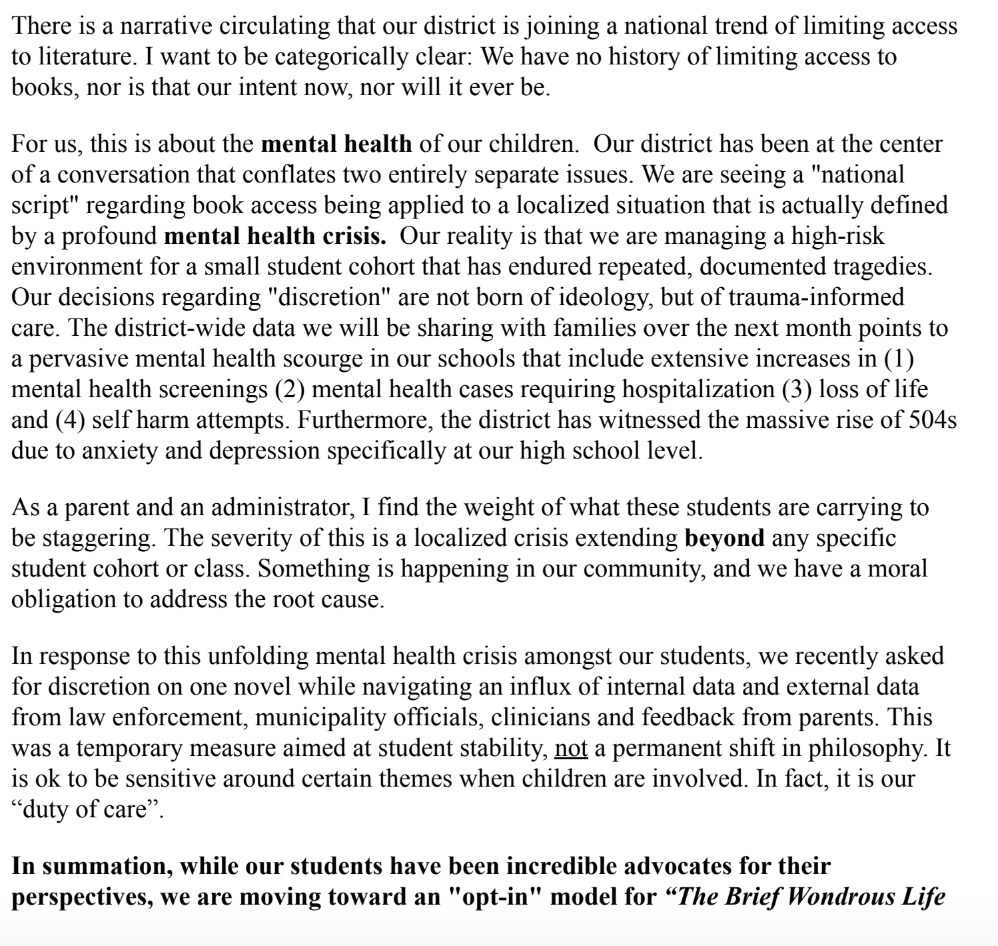
In an email to The Village Green, Bing wrote, “For us, this is about the mental health of our children. Our district has been at the center of a conversation that conflates two entirely separate issues. We are seeing a ‘national script’ regarding book access being applied to a localized situation that is actually defined by a profound mental health crisis.”
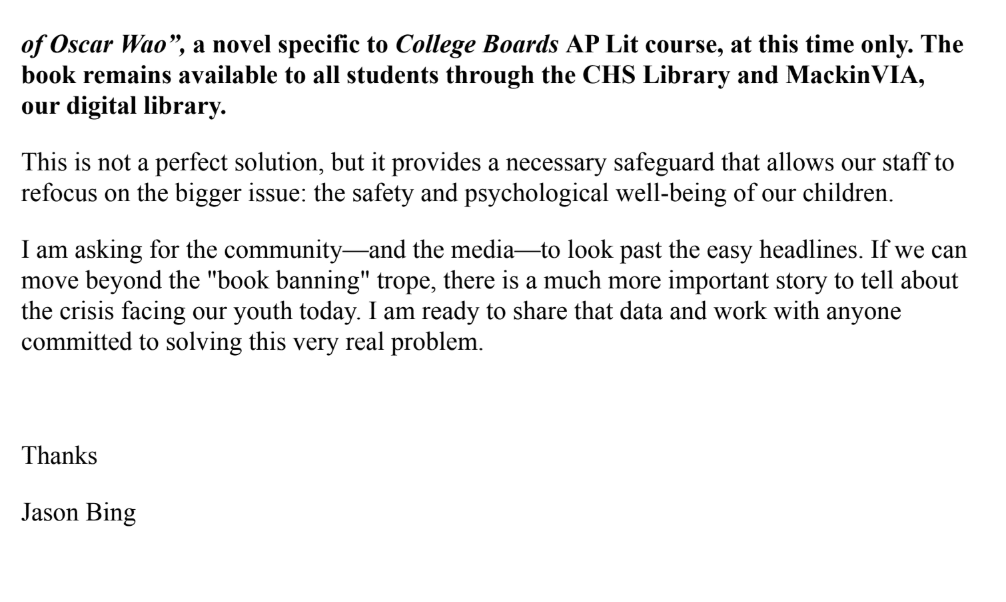
Bing said that there is thorough, district-wide data that he will be sharing in the next month that indicates a decline in mental health across the district, writing, “If we can move beyond the ‘book banning’ trope, there is a much more important story to tell about the crisis facing our youth today. I am ready to share that data and work with anyone committed to solving this very real problem.”
Bing continued, “The severity of this is a localized crisis extending beyond a specific student cohort or class. Something is happening in our community and we have a moral obligation to address the root cause.” He also wrote, “It is okay to be sensitive around certain themes when children are involved. In fact, it is our ‘duty of care.'”
AP Lit students are not unaware of the crisis that Bing has cited. As a class of only 12th graders, many have expressed concerns that actions the district plans to take might instead block students from understanding the mental health realities that await them outside the district.
“As graduating seniors on the cusp of independent living, it is inevitable that we face challenging topics,” said AP Lit student Genevieve Stefens. “Being shielded from these issues will not serve us well, especially at this formative point in our lives.”
Ella Levy is a 12th grade student at Columbia High School and is working with Village Green as part of a grant from the New Jersey Civic Information Consortium.
Read Bing’s full response to Village Green: