A 2017 story by Maplewood-based, Pulitzer Prize-winning writer Dan Barry is now the basis for a film being produced, in part, by BBC Films and the studio that created “Poor Things.”
The New York Times article “The Lost Children of Tuam”, authored by Barry, chronicled the journey of local Irish history enthusiast Catherine Corless — Barry calls her the real “hero of the story” — who uncovered the secret of as many as 800 children apparently buried in a Victorian-era sewage chamber on the property of the Bon Secours Mother and Baby Home in Tuam, County Galway.
After Corless’s work led to the discovery of the remains, buried between the 1920s and 1950s, the public rallied around the survivors of the home and sought justice for the victims and the buried children. Excavation of the mass grave began in Summer 2025.
Now a film inspired by Barry’s article is in production in Ireland, directed by Frank Berry (“Aisha,” “Michael Inside”) from a script by Rebecca Lenkiewicz (“The Salt Path,” “She Said”). Actor Liam Neeson is among the producers, along with Element Pictures (“Poor Things,” “Bugonia”), BBC Film, and Screen Ireland. Monica Dolan (“Sherwood,” “Mr Bates vs The Post Office”) will play Corless. The cast will also include Andrew Bennett (“God’s Creatures,” “The Quiet Girl”) and Ian McElhinney (“Game of Thrones,” “Derry Girls”).
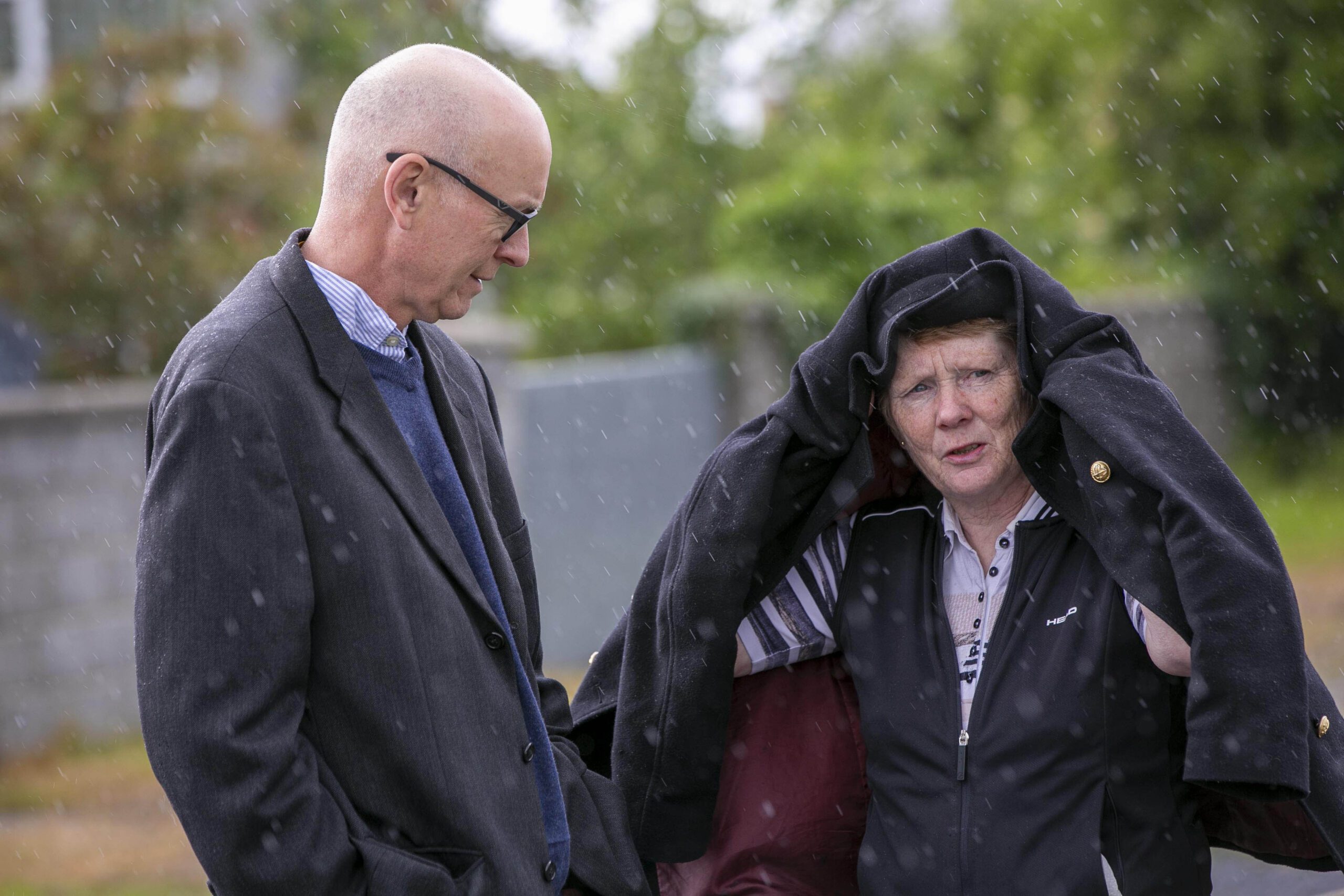
8/6/2017. Journalist, author, and feature writer for The New York Times, Dan Barry talks to historian Catherine Corless at the site of the former Tuam Mother and Baby Home. Photo Andy Newman.
“It is a great honor to me that a dedicated, professional and high profile film crew are creating this film, which follows my arduous journey from when I first discovered what really happened in Tuam and the struggle I faced to bring this truth to light against so many obstacles,” Corless told Variety. “It’s startling too, that I have observed the passion with which Frank Berry and his team are ensuring that the truth of what happened is paramount, and I am grateful, for that has been the essence of my long journey. It is said that a good film is immortal, and I have no doubt that ‘The Lost Children of Tuam’ will come under that spotlight.”
In an interview with Village Green, Barry was humble about his role in bringing the story to the screen, and much more interested in talking about the courage and persistence of Corless. He noted that neither he nor the Times broke the story and was sensitive to the fact that, even though he is an Irish American with close ties to Galway, “the chasm of presumption and misunderstanding between Irish America and Ireland is as deep as the Atlantic.”
Barry has stayed in touch with Corless, visiting her again just this fall: “I wrote the story in 2017. I spent three or four months or maybe more, researching it and then going to Ireland and then going back to Ireland and then writing a story. And I’ve gone back several times to the site and to visit Catherine.”
Barry said that Neeson had contacted him soon after the original story was published in 2017 (Barry also wrote a companion story in 2017 focused on Corless’s role as his touchstone, as well as a followup in 2023). “And we had lunch and he basically optioned the rights.” Barry stressed that having lunch with the likes of Liam Neeson is not a typical part of his schedule.
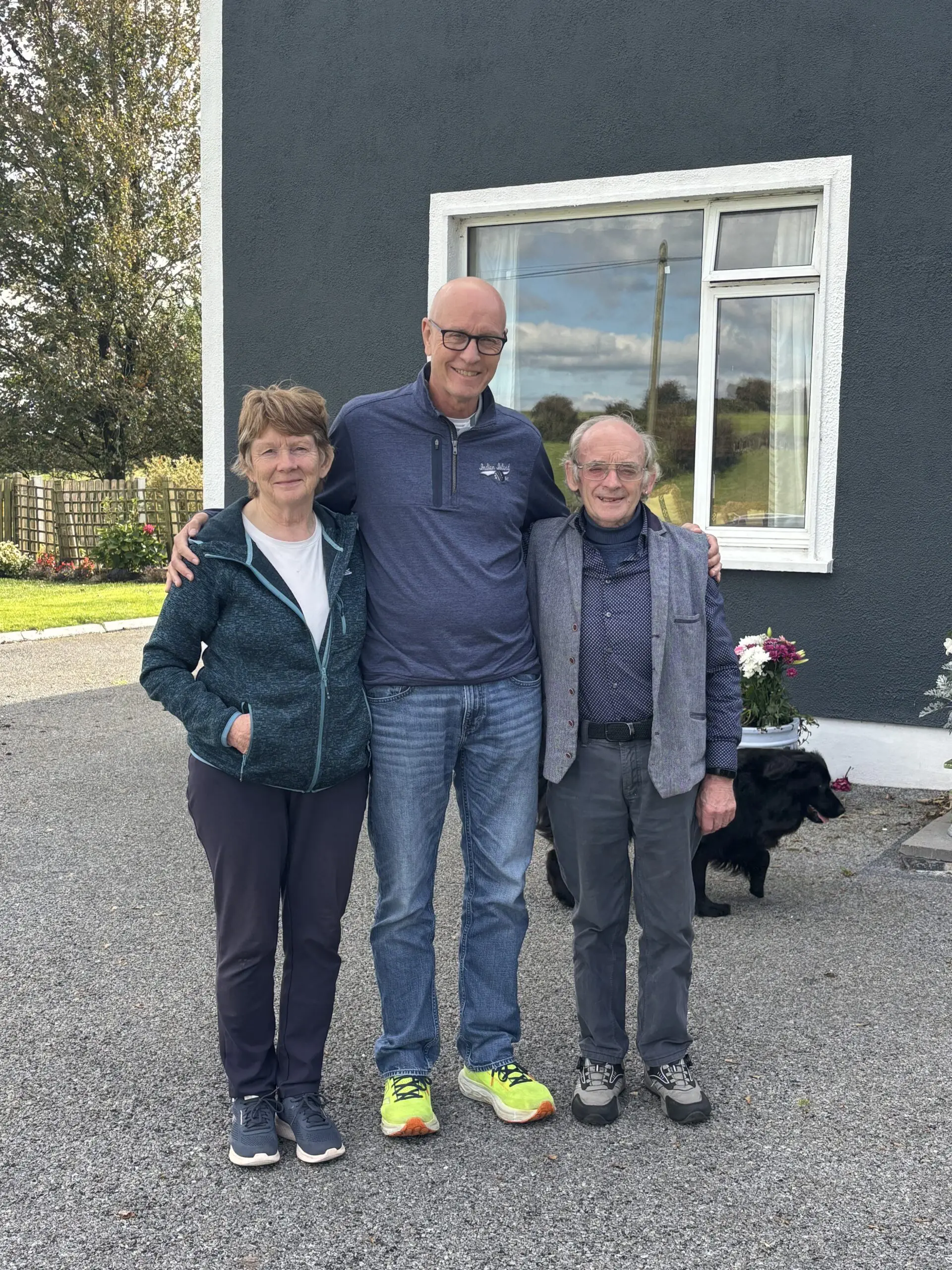
Barry with Catherine and Aidan Corless, 2025. Photo courtesy of Dan Barry.
Then years passed and nothing much happened.
“It’s a very laborious process to try and get the financing and to try and figure out who the actors would be and whether the actors attract more financing.” Neeson extended the option a couple more times.
Meanwhile, Barry kept in touch with Corless. “Whenever I would go back to visit my family in Galway, I would drive up to her place, which was about 45 minutes from where my mother was from, and have tea with her and sit at the same table where she did all her interviews with these survivors, and where she basically pieced together what happened. And we would commiserate over the years, thinking this is never going to happen.”
“But in her mind, she’s thinking about two things,” said Barry. “She’s thinking, the movie is the least of her concerns. Her concern remained on the excavation of the site and securing a proper burial for hundreds of children. So that was always her main drive.”
Barry remembers when Pope Francis came to Ireland “and she was invited to meet him, and she said, ‘Well, if I were to meet the Pope, would I be able to talk about the mother and baby homes?’ And she was told no. And so she said, “Well, then never mind.’ And so she turned down an invitation to meet with the Pope, and the night that she would’ve met the Pope, instead she joined a candlelight vigil at the site. That’s who she is. She’s really an extraordinary woman.”
Barry said he had the chance to visit the film set in September.
“Catherine lives in Galway, but they couldn’t shoot the film at her house. It was maybe too small, or it would’ve been too cumbersome. So they found an empty farmhouse in County Kildare, and Catherine gave them a bunch of her belongings, paintings, family photographs so they could recreate the house. So I drove up there, and it was pretty amazing. I watched from one room while they shot these scenes in the kitchen. And what I saw was an absolute recreation of what I had written in my story. One survivor comes up [played by McElhinney] and introduces himself, and he sits at the kitchen table where I had sat many times, and he tells his story, and it was very, very moving.”
Corless declined to make the trip with Barry to witness the filming.
“I said I can pick you up. We can go together. She doesn’t want to go. She’s so shy and so unassuming.”
“That’s part of her, to my mind, heroic nature,” said Barry. “She is extremely shy. She deals with panic attacks and depression and other things. And, you know, she’s not an academic. She was running a household and took up genealogy as kind of an avocation, and then decided she was going to do a feature story about the old building in town. And she had a math problem. And the math problem was, wait, there were some 800 kids who died here. And, well, where are they buried?”
“She was able to set aside her shyness and her discomfort in public places to fight the good fight. It’s pretty amazing. She’s very uncomfortable with the celebrity that’s come from all this. Only, she is determined to use the celebrity to further the cause to bring more attention to the burial site, to force the government to address this and to force the Catholic Church to make amends and to apologize. And so, she achieved all that.”
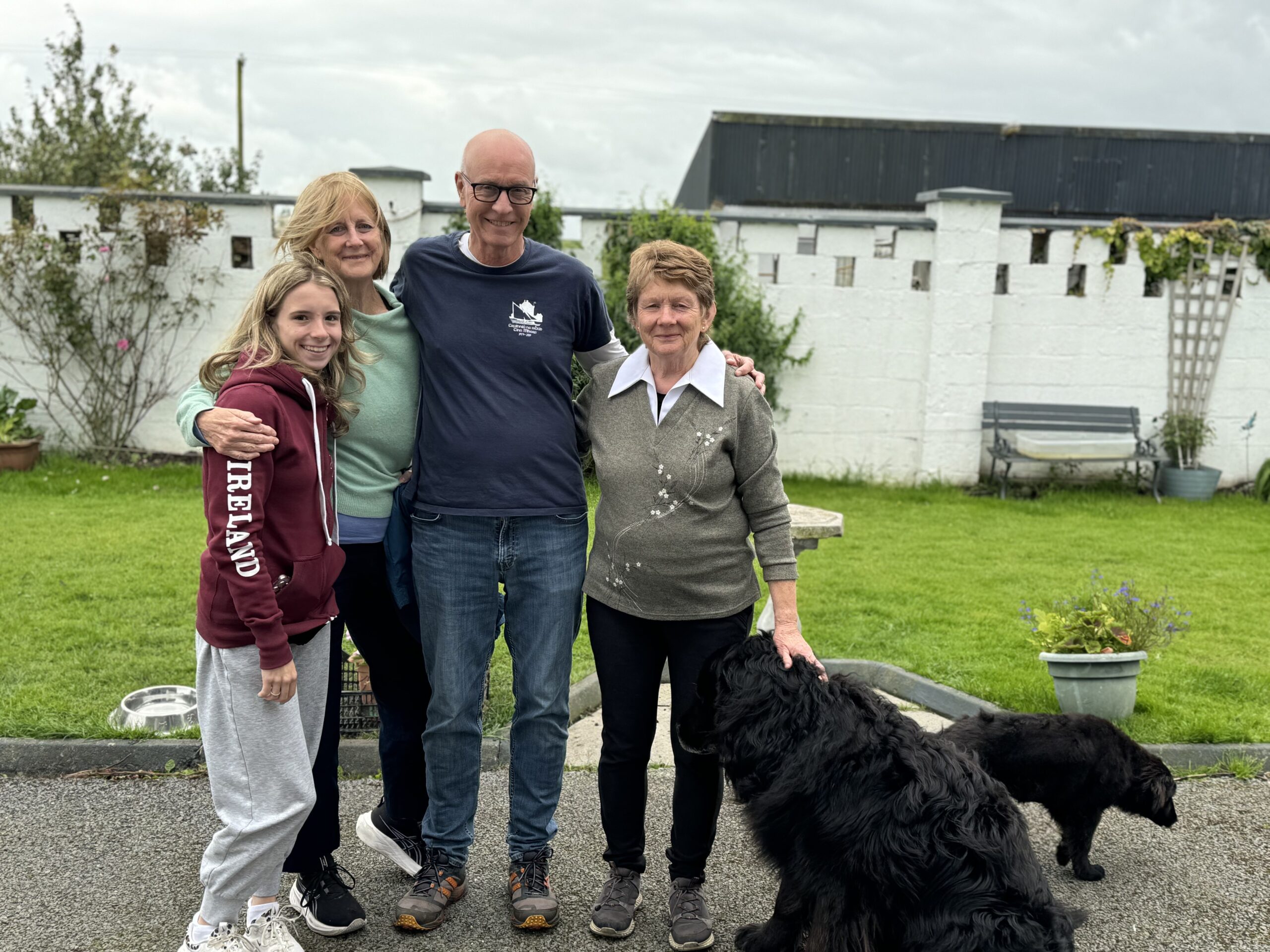
Barry’s daughter Grace, wife Mary Trinity, Barry, Corless and Corless’s dogs Shadow and Willa. Photo courtesy of Dan Barry.
Read Dan Barry’s reporting here: