On July 7, the Maplewood Township Committee passed two ordinances and discussed other actions aimed at protecting and aiding residents of the township who are immigrants.
Noting that the 2020 US Census identified 22.1% of Maplewood residents as foreign born, the Township Committee unanimously approved the Maplewood Immigrant Trust Act and a “Restricted Areas” ordinance (see attached below) protecting the privacy of local residents and clarifying local law enforcements obligations related to actions by U.S. Immigration and Customs Enforcements; discussed creating a legal fund to help immigrant families; and directed staff to provide outreach to Haitian-born residents facing loss of income and potential deportation due to loss of their Temporary Protected Status, or TPS.
Cynthia Galeota of the SOMA Action Immigration Committee thanked the governing body for their actions.
“This proposed law shows that the town of Maplewood is willing to stand up for immigrants who are being deliberately attacked and targeted and who have little political power,” said Galeota. “It is incumbent upon those of us who can intervene on their behalf to do so while this mass detention deportation agenda rages.”
Galeota noted that the ordinance cannot and does not interfere with federal immigration enforcement, “but the document itself exemplifies a kind of collective stubbornness with the town working to slow down ICE, to force them off town property, to force them to obtain judicial warrants, to put sand in their gears, and ultimately to force DHS [the U.S. Dept. of Homeland Security] and ICE to potentially work harder for every arrest.”
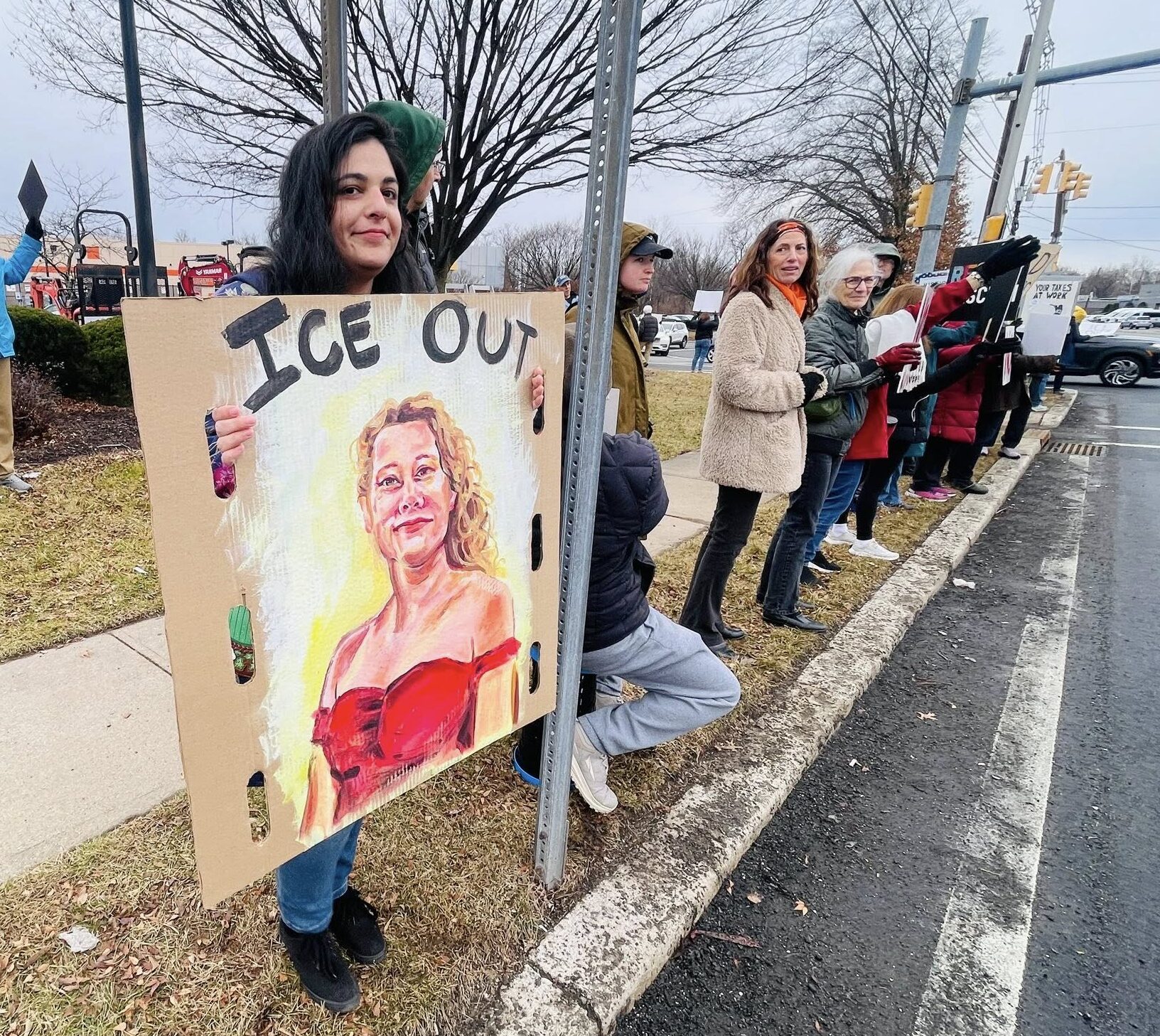
An anti-ICE protest organized by SOMA Action outside Home Depot in Union. January 10, 2026.
“In the past several months, there have been abductions of landscapers and construction workers on Springfield Avenue and in Maplewood’s residential streets, as well as surrounding towns,” reported Galeota. “Recently, ICE set a new enforcement arrest quota of 2,000 individuals daily, and in the last week of June, there were 10,000 arrests made in five days. Clearly, the speed and scale of the war on immigrants is accelerating across the nation. This administration wants to scare us to comply with their immoral and lawless removal of 12 million human beings from the United States. The fundamental question of these times must be, what do we owe one another? What more can we do to protect those who are the subject of the lawless assault by the federal government? The Maplewood Immigrant Trust act by virtue of its community protections and lawful opposition to the inhumane and unjust immigrant operation does just that.”
RELATED: Photos: Anti-ICE Protesters in Maplewood Stand With Immigrants
The ordinances were spearheaded by Township Committee member and former Mayor Dean Dafis.

Protest at Maplewood Town Hall. March 28, 2026. Photo by Max Fraidstern.
“I want to say first that the next step here … is to start training all of our township staff, including our law enforcement personnel, and then to establish an FAQ that we’re going to use for public outreach. And have a couple of town hall meetings where we can engage with the community so that they can understand our rights, their rights, law enforcement, what would Maplewood do in a scenario when they’re engaged with ICE or ICE engages with them. So that is forthcoming.”
Later Dafis reported that he is also working to establish an Immigration Legal Services Fund.
“What do we owe our neighbors right here, right now? What is the right thing to do?” asked Dafis. “How are we going to meet the moment? And especially after the Supreme Court decision, not just the increased ICE activity. This federal administration is doubling down on this lawlessness. They’re not holding back. They’ve set a quota. And since we last met two weeks ago here, there have been four incidents of ICE in our community alone.”
Noting that the Supreme Court’s decision to end Temporary Protected Status for many Haitian immigrants was impacting Maplewood’s sizable Haitian community, Dafis said, “We’re going to need to do something all that we can to connect people to immediate support.” Dafis said that the township could explore how the fund could work with the $20 million detention fund recently created by Gov. Mikie Sherrill. “How is that money being used? That money is supposed to go to the nonprofit legal services providers throughout the state who are engaged in immigration legal services support. We know that that money is good, but it’s not enough. We hear from Make the Road, we hear from the Alliance for Immigration Justice. These organizations are at capacity and there are so many cases and so many people who need to know their rights and who need immediate support. So I ask this governing body, whether or not this evening right here, right now, as we just passed our Immigrant Trust Act, do you support our attorney exploring how we can establish for Maplewood our own immigration legal services fund?”
Township Committee members indicated that there were interested in pursuing the creation of the fund.
“I was at Delaney Hall and this was the number one ask that the individuals on the ground who are working day in and day out to support the families of those in the facility,” said Deputy Mayor Malia Herman. “And they said over and over again, they need help with legal services. They were asking for the Governor to fully fund, and she did come through with a large amount. But I think there’s more that can be done and I’m very interested in hearing more of what we can do.”
During the monthly Board of Health meeting, Mayor Vic De Luca directed Health Officer Candice Davenport to reach out to the Haitian community to make them aware of services and programs that are available — spanning everything from food security to housing to county and state services.
“I know we have some employees who are Haitian. Can we reach out to those employees?” said De Luca, noting that the website and local media outlets “are probably not going to reach those folks.”
Herman said that information could be distributed through some local restaurants. Township Committee member Jane Collins-Colding talked about church groups. Finally, Davenport said that staff could canvas neighborhoods with information in Spanish and Creole.