On November 12, the South Orange/Maplewood Community Coalition on Race hosted “Now More Than Ever,” an event aimed at educating local residents about the long history of efforts to integrate the South Orange-Maplewood School District, culminating in the district’s Intentional Integration Initiative, or Triple I.
The Coalition recently posted video of the event to its YouTube channel. Watch it here:
Anita Gundanna, Chair of the Coalition’s Executive Committee led off the event, explaining the mission of the organization: “The Coalition was founded more than 25 years ago with a bold and intentional vision to build and sustain a community that is racially, culturally, and socially integrated and truly inclusive, where there is equity and equality for all. As a part of that mission, the coalition has been since its inception, committed to achieving fully integrated and equitable public schools. And at the heart of it all is the truth that every child, every young person, every family could and should feel a deep sense of belonging in our towns and in our schools.”
Gundanna said that the Coalition was acting in partnership “our towns, with our school district, with our interfaith clergy coalition, and with many community partners and elected officials” to sustain “the work of intentional integration. That doesn’t happen by accident, but that happens through ongoing commitment, collaboration, partnership, and advocacy.”
She noted that many partners and community leaders were present at the event and welcomed Superintendent of Schools Jason Bing; Assistant Superintendents Ann Bodnar, Zoila Correa, and Kerrie Waibel; Board of Education members Shayna Sackett-Gable, Liz Callahan, Deirdre Brown, Regina Eckert, and Bimal Kapadia; BOE members-elect Paul Stephan and Malini Nayar; South Orange Village Councilperson Bill Haskins; and former New Jersey Assemblywoman Mila Jasey.
Gundanna said that the CCR’s Schools Committee noticed that “many move here because our towns’ history of integration and because of our reputation for being a place that values it. But we’ve also heard from parents that they realize that they don’t fully know that history.”
CCR Executive Director Nancy Gagnier then presented a timeline of integration efforts, going back to the 1980s. The timeline was largely researched and put together by Schools Committee co-chair Jocelyn Ryan.
Read the slide presentation here:
Gagnier’s timeline began with the Marshall-Jefferson (now Delia Bolden School) pairing in 1982. “A time when the towns’ Black population, represented 4% in Maplewood and 10% in South Orange. At the time, the pairing was vehemently opposed, but then there was a change and it was passionately defended over the decades.”
“By the mid 1990s, the demographic changes are dramatic,” said Gagnier, recounting that “there were multiple attempts during the ’90s to redraw attendance zones to achieve racial balance in the elementary schools. And there were very bitter disputes about this. As someone who moved here in ’97, I can attest to those disputes. I was told not to raise certain issues with certain neighbors.”
“A new superintendent arrived in 1998 and worked with the community to create something more stable than redrawing attendance zones that resulted in making Seth Boyden a demonstration school. These elementary school reconfigurations improved but did not fully achieve elementary school integration,” said Gagnier. “Plus, we were still struggling with a serious racial achievement gap, Black students being disproportionately assigned to lower level classes, as well as experiencing disproportionate school disciplinary actions in the middle and high schools.”
Gagnier noted other efforts over the years including the Access & Equity policy passage in 2015, but then focused on 2018 and forward when “the Board of Education and governments in both towns committed to an integration plan, and the Intentional Integration Initiative was finally adopted by unanimous vote by the Board in 2020.” She noted that the Triple I had largely created racial balance — through socio-economic status [SES] placements — in grades K-8 in the school district.
Gagnier also sought to debunk some “myths” about the Triple I, including the idea that children were previously placed at their nearest school. “According to the superintendent at that time [in 2020], 35% of children in district were not attending their zone school.” She also noted that a relatively small percentage of the $10.5M in annual district transportation costs were due to Triple I placement transportation.
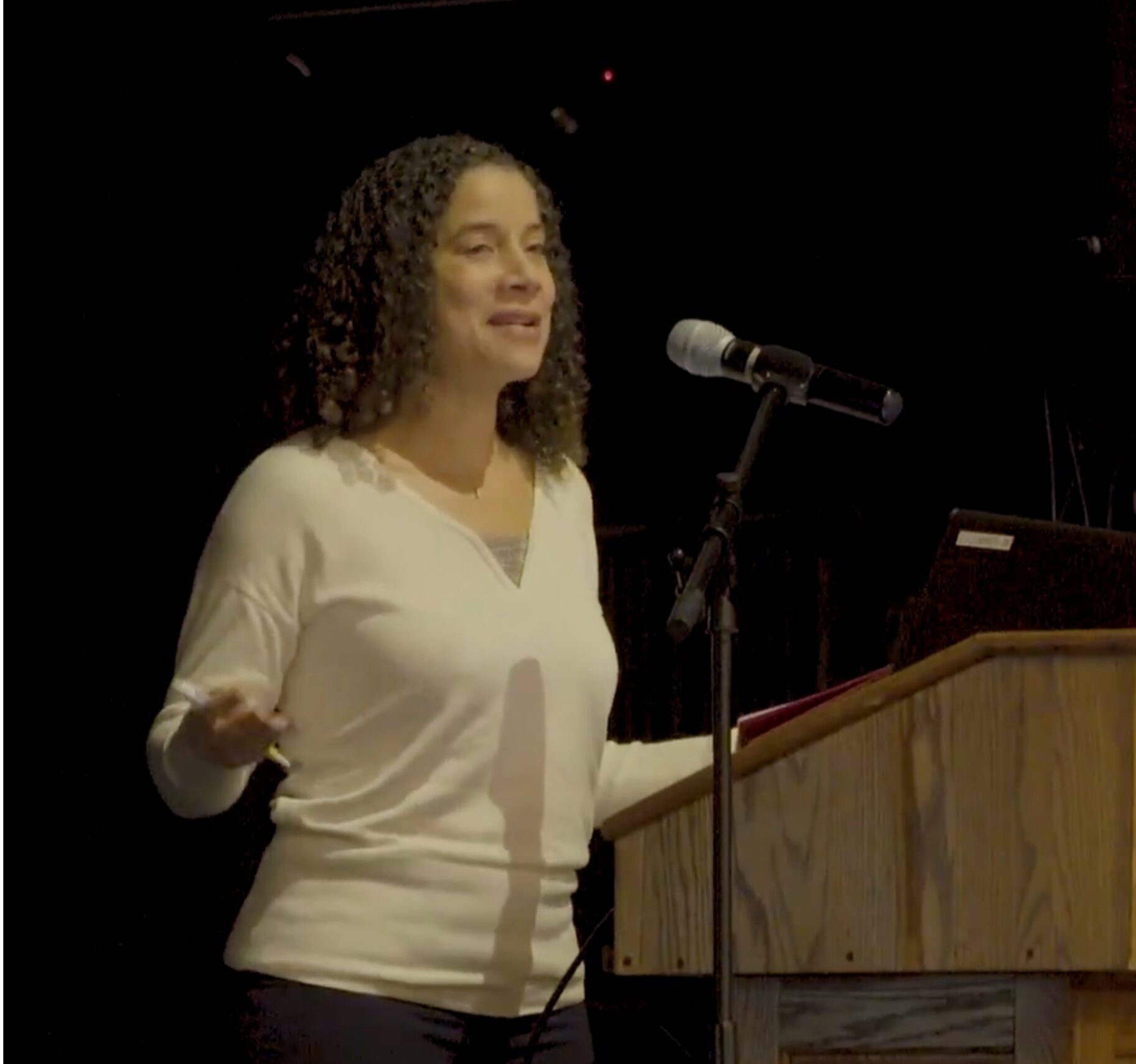
Rhena Jasey-Goodman
After showing a 20-minute video with testimony from current SOMSD students and recent graduates, Rhena Jasey-Goodman — Mila Jasey’s daughter — spoke from her experience as a student in the district (in the Marshall-Jefferson pairing), as an educator in the district (at Seth Boyden), and as a parent in an integrated school district in Montclair.
Jasey-Goodman noted that her experiences with diversity helped her when she got to college where many of her peers were uncomfortable with transgender and gay students. She wondered, “Doesn’t everybody have this experience in high school and the answer was no.” She added, “So I don’t take for granted, the value of having real authentic relationships with people who are different from me.” This point was also emphasized by Dr. Amy Stuart Wells in her presentation later in the evening, when she noted that colleges and employers continue to want students and employees who are comfortable with and can thrive in diverse environments.
Jasey-Goodman also spoke movingly of the differences between intention and impact and making sure that children — and teachers — have what they need in the classroom.
“Intentional integration is hard, messy and progress is not always linear. Students need to have windows and mirrors. They need to have a sense of belonging. We need to respond to inequities. We need to purposely address potential barriers and resource gaps.”
“And in order to do this, school leaders and teachers need the training, support, and resources to engage in intentional integration activities — because these things are not taught in most teacher preparation programs. And especially they weren’t taught 10 or 15 years ago when a lot of our teachers went through school. And so we need to be really deliberate about this — anti-racist behavior management strategies, how to identify inequities in schools, considering impact versus intent, and also providing parents with opportunities to learn about how they can help.”
“You’re all here learning about this, so that’s great, but we really need the support,” Jasey-Goodman added. “We can’t just expect teachers to know what to do. We need to give them the resources and support so that they can be as successful as possible.”
Jasey-Goodman also spoke about her experience as a parent in Montclair where the integration plan includes ranked choice and magnet schools.
“I was very skeptical of this whole magnet program they have in Montclair. … Each elementary school in Montclair has a magnet theme. So things like STEM, gifted & talented, environmental science, global studies. All parents then rank the schools by preference considering the magnet, the location, and the start time. There’s three different start times. So start time has a big role, as parents know. Then the algorithm considers your ranking as part of the placement process.”
She continued, “To decide on the rankings, parents actually get to tour the schools when their kids are in preschool. And I think this is really helpful because it helps demonstrate to the parents that all the schools are great. You really can’t go wrong and you do learn what makes each school unique, but they’re all strong schools. We ranked CHB, which stands for Charles H. Bullock because it remind reminded me of Seth Boyden.”
She noted that her kids don’t have classmates on their street.
“My daughters don’t have friends on the block that go to their school. In fact, all the kids on the block go to all different schools. And it’s great because they have their block friends and then they have their school friends, and then at their block friends’ birthday parties, they meet kids from other schools.”
“But I do want to acknowledge that I appreciate the role that ranking has on our feelings about the overall process,” said Jasey-Goodman. “Not all people get their first or second or third choice, but as a parent, you do feel like at least I had some say. So I do appreciate that and I want to name that.”
“But I also want to note that while we’re happy with the schools, they are not perfect,” said Jasey-Goodman. “All the schools are diverse, but every school has different percentages of race and ethnicity. They do not have nearly the same balances of race that you have here in South Orange and Maplewood. There are schools with very, very few Black students. They have Indian students, they have Asian students, they have Latino students. Then there are schools with a lot more Black students.”
“This element of choice I have seen does make an impact on the actual racial makeup of the schools. So there are trade offs,” said Jasey-Goodman.
She also said that integration was made successful at CHB because of parent involvement and shared responsibility. “Parents are very generous with their time and/or their money…. I haven’t experienced parents saying ‘What about my kid? What is my kid going to get out of this?'”
Jasey-Goodman closed by saying, “Integration is not just putting kids from all over the two towns in the same classroom. Intentional integration means that schools and leaders and teachers and parents all must be deliberate about how they approach it. So what are you doing proactively to make this work and to benefit all students? We need to continue to have intentional conversations around race like we are today. Identify and reflect on our own biases, and parents and students need to be part of the work.”
She added, “I encourage us to give each other grace and hold each other accountable. And I want to leave you with this quote from Ruby Bridges …’The first steps toward change are never easy. Keep your eyes on the prize and at all costs, stay united.'”