Editor’s Note: This article was originally written for The BluePrint, the student newspaper for Hagerty High School, a public school in Central Florida. Seminole County Public Schools board policy 5722 gives administrators the right to exercise prior restraint of school newspapers among other publications, and Florida state statutes define a person’s sex as a biological trait, stating that it is false to refer to them as a gender that conflicts with it. Due to the risk of such an article being associated with a public school, the story was denied publication. Instead of publishing the article, The BluePrint staff published an editorial about censorship titled “Our Take: Censorship is a Serious Threat to Liberty.”
The writer of the original piece, Lia Miller, is the niece of Maplewood resident Dana Miller and the editor-in-chief of The BluePrint. When Dana learned that The BluePrint had been censored on this topic, she turned to The Village Green for help. Village Green editors believe the First Amendment extends to students and wanted to give Lia a platform for her story.
The Reality for Transgender Students in Florida
John* wakes up at 5 a.m. each morning to walk his two dogs. He catches the bus to school, where he sits through three AP classes, contributes to class discussion and makes an effort to chat with his classmates. In the afternoon, he spends around two hours at band practice, then makes it home with enough time to finish schoolwork and maybe hang out with a friend. He likes to draw, write and go for hikes.
John belongs to a community whose existence sparks controversy. He does not drink, sell drugs or even drive after curfew — but the mention of his experiences elicits debate and negative attention more reliably than nearly any other topic.
John is transmasculine, meaning he was assigned female at birth, but now presents as male. “Transgender” applies as an umbrella term to any person whose gender does not align with their biological sex. According to the Yale School of Medicine, “sex” is determined by the characteristics one is born with, while “gender” is determined by a person’s psychology and social/cultural experiences. If these two do not match up, a person is transgender. So transgender women (or transfeminine people) were born with male biological characteristics but are female in gender, and transgender men were born with female biological characteristics but are male in gender. Some people may also identify as nonbinary, gender fluid or something similar, meaning they see themself as neither a woman nor man.
The transgender community has grown more visible among students, with 5% of youth identifying as transgender (although there’s evidence of transgender people as far back as 5000 BCE). However, they still face considerable legal and social opposition.
“My sisters know [that I’m trans, and] all my friends know,” John said. “More or less, my family doesn’t. […] My parents don’t really understand it, and it would be a lot of effort to try to explain it. And I’m not really sure how well they would take it if they actually did understand it.”
Important words to know:
- Transgender (or “trans”): A person whose biological sex differs from their gender identity.
- Trans man/transmasculine person: Someone who was assigned female at birth, but is male/masculine in gender.
- Trans woman/transfeminine person: Someone who was assigned male at birth, but is female/feminine in gender.
- Sex: A distinction between male and female based on biological characteristics.
- Gender: Someone’s place on the spectrum of masculine to feminine based on their social, cultural and psychological experiences.
- Nonbinary: A term for someone who identifies as neither a woman nor man.
- Gender fluid: A term for someone whose gender changes (typically between male and female) throughout periods of time.
- Dysphoria: A feeling of discomfort caused by a disconnect between one’s gender and their physical body.
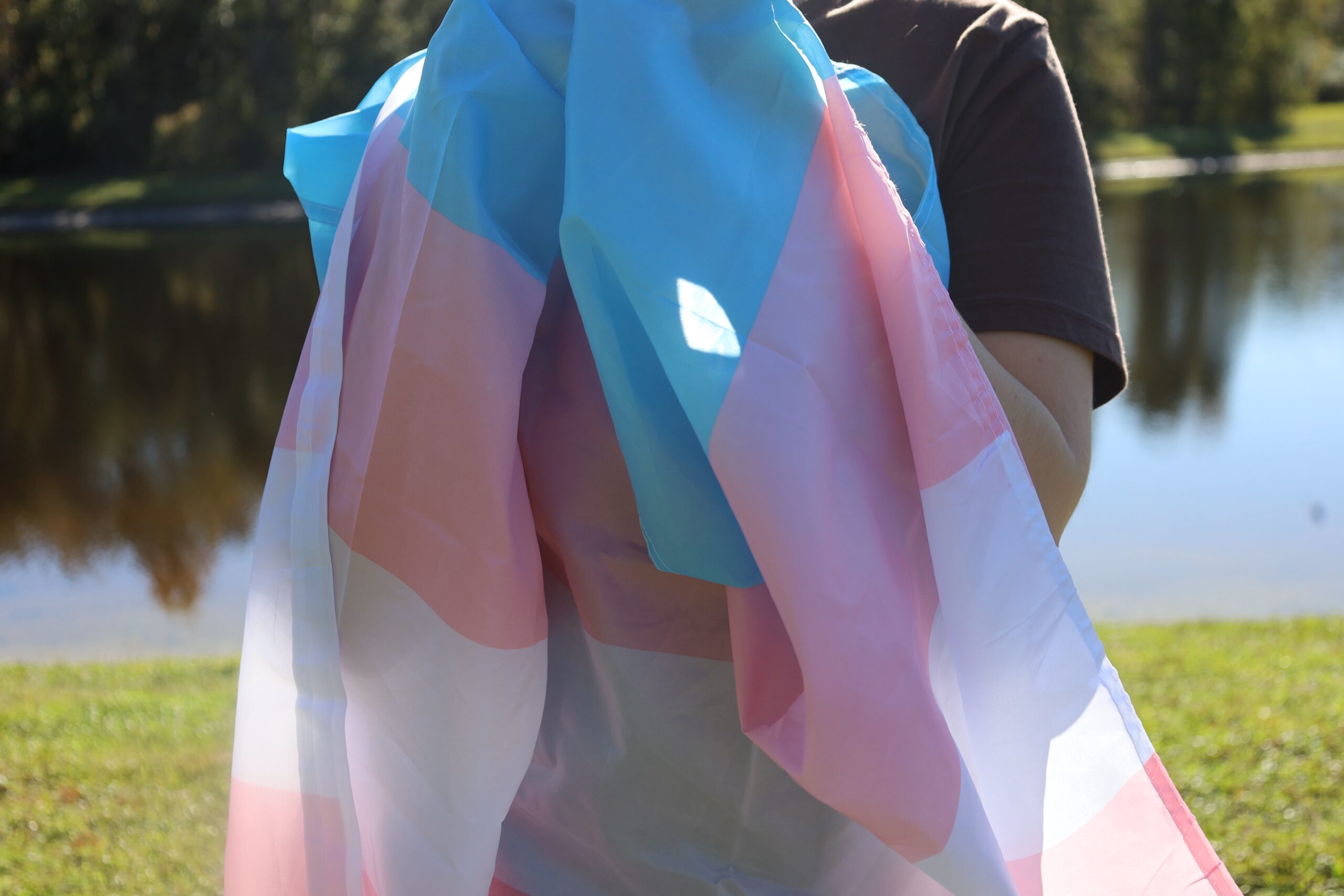
Photo illustration by Lia Miller
WHO AM I?
According to the Pew Research Center, 33% of transgender adults first felt that their assigned gender did not accurately describe them before the age of 10, and 81% considered the possibility by the age of 17. Often, this process begins with discomfort, or a desire to embrace a different gender presentation as a young child. However, at such young ages, transgender individuals often lack the exact words to describe their experiences.
“Gender wise, I definitely would have realized sooner if I knew what [being transgender] was,” John said. “Like when I was younger, I wanted to have short hair, [as early as] when I was four or five.”
Jane* began to distance herself from the typical masculine characteristics she observed as early as kindergarten, in part because of negative experiences with her father. However, she did not identify as transgender or begin to refer to herself with she/her pronouns until eighth grade.
“[My identity is] rather strongly based on an aversion to representing male characteristics,” Jane said. “So generalizations and ideas that typically apply to traditional males are things that I don’t want to apply to me. […] There are very, very few things that bother me, but one of which is being called a ‘man.’ That is kind of painful to hear, because it represents lots of generalizations that I don’t want to.”
Other students experience dysphoria at first, a state of extreme discomfort with one’s body that stems from differences between the way they perceive their gender and the way that they appear. Many describe it as something akin to “living in the wrong body.”
Jay* is gender fluid, meaning that he alternates between femininity and masculinity by the day or even hour. (This article refers to Jay with he/him pronouns, but it is important to note that gender fluid individuals often switch their preferred pronouns over time.) Having been assigned female at birth, Jay experienced profound dysphoria during periods when he saw himself as a boy.
“I found every time I wore a dress, I’d be uncomfortable [with] how I felt,” Jay said. “And I was confused. I was utterly confused. My mother would get really defensive on it, and I was just expressing wanting to wear a suit, [but] she would get really uncomfortable. But some days […] I’d be entirely comfortable with the dress. So I never understood what was going on until more recently.”
In middle and high school, students begin to interact with a larger group of individuals who may share their experiences, and many begin to recognize their identity as transgender. Even though they may already see themselves as a different gender, students tend to gain the exact vocabulary to describe themselves around this time, either through in-person interactions or social media.
The process may go slowly, and some students, including Andy,* make the transition slowly over time. Andy began to identify differently from his assigned gender at birth during his time in middle school.
“I was confused,” Andy said. “I didn’t feel necessarily like a girl. I went through a nonbinary phase, which shifted to kind of figuring out I go by he/him.”
While Andy only identified as nonbinary for a short while, for some it is a long-lasting label. Several identities fall under the nonbinary umbrella, as the term is used to describe anyone who neither identifies as strictly male or female. Jordan* alternates between feeling feminine and androgynous.
“I’ve been trying to figure myself out for a long time, and I am not generally a very confident person, so it took me forever just to get a haircut,” Jordan said. “As soon as I kind of clicked that together, it all just kind of felt a little bit easier.”
COMING OUT
Coming out to friends or family members can be nerve-wracking, and the process takes different forms for different individuals.
“I am not great with words, so I organized everything in a letter, which I handed to [my mother] one night,” Jake* said. “And then [I] ran to my room and started crying. But then she was super supportive and just wanted me to be happy.”
Jake has told his mother and friends about his gender, and openly embraces it on campus, going by his chosen name and wearing pins that specify his identity. Like many transgender students, he expects the process of coming out to the rest of his family to take time.
For this reason, transgender students often begin by telling those who they trust the most.
“I’m very careful with my selection of my friends, particularly in that case,” Jane* said. “But birds of a feather flock together and whatnot, so I naturally fell into a friend group that had similar experiences to me. So they are accepting and supportive, because that’s the kind of thing that they’ve been through before.”
Jane goes by her given name in school, a decision shared by several transgender students—though their reasons for doing so vary.
“I don’t mention anything, because I understand how difficult it can be for people to deal with that, which is why I haven’t filled out the name deviation form,” Jane said. “I don’t want my teachers—especially poor substitutes—seeing my name on the roster and then struggling with trying to call someone that they perceive as relatively masculine a very feminine name.”
And some students like Jordan receive mixed reactions from making their identity more apparent to most of the people they interact with.
“People make lots of negative comments towards me, to my face, around me, behind my back,” Jordan said. “And I get a lot of that in classes that are lower levels […] but in my higher level classes, it’s generally not a problem. […] I feel like the people who study more, the people who have to look into things more, like my AP classes and Dual Enrollment classes, they’re going to be looking into things more than the people who aren’t taking higher level classes. So if you look more into things, the more you see what you believe is right and wrong.”
Due to the increased visibility of trans students on campus, they can more easily find each other, and many enjoy befriending students also in the LGBTQ+ community. “I’ve been fine being different for a really long time,” Jake said. “But having people that are the same kind of different has helped me be more comfortable with that.”
In particular, Unity Alliance provides a space specifically for trans and LGBTQ+ students, while some form casual friend groups with others like them, or partake in hobbies and extracurriculars that attract a more diverse crowd.
“[Being around similar people] helped me feel more safe to explore myself and to look more into things,” Jordan said. “ I feel like anywhere else I would have gone, I would have been afraid to open up, and I would have been scared to dig into something that is not widely accepted.”
MAKING A CHANGE
Once they feel comfortable in their identity, trans students may make changes to their appearance to express their gender identity, or to ease feelings of dysphoria. This can include simple changes such as wearing clothes more commonly associated with their gender, or changing their hair and makeup look.
Of course, transgender individuals may dress any way that suits them, just as cisgender women sometimes wear shorts or pants, and cisgender men sometimes wear skirts or jewelry. However, far more often, transgender students switch up their style or adjust their physical appearance. For individuals assigned female at birth, a binder (a garment similar to a sports bra, which compresses the chest) provides a temporary way to make their appearance more masculine.
“[Wearing a binder] definitely feels more affirming,” Jake said. “I remember the first time I put one on. I was at the mall with my friends, and I felt so much more comfortable.”
However, wearing a binder for longer than the recommended time or not wearing it properly can result in bruising, scarring, difficulty breathing, injuries to the ribs and “pain,” according to John. Often, the recommended duration is only a few hours, which is shorter than a typical school day or work shift. However, going without a binder causes some to feel the same dysphoria that they felt before outwardly transitioning.
Jane often dresses in pink, a color typically associated with femininity, and has experimented with wearing skirts and feminine clothing to school. Especially for transfeminine people, responses to someone dressing closer to one’s gender identity can be extremely negative.
“I’m usually very identifiable by being completely decked out in pink,” Jane said. “And I’ve tried wearing skirts to school and such, but then I got yelled at and called a f—– and such.”
Choosing a new name also factors into the transition process. Some, like Jay, shorten their given names to make them more androgynous without giving up their given name entirely. John searched baby name websites and social media, and came up with a list of several options, eliminating them until he had settled on one with a similar origin to his given name. Andy sought out a name with a neutral connotation, and chose the one that suited him best.
“My dead name is very feminine, and I just didn’t really feel like I went by that,” Andy said. “So I chose […] a more unisex name.”
Making these outward changes has had a profoundly positive impact on the mental state of many transgender students.
“Dysphoria was horrible when I was younger, because I just didn’t know what was going on,” Jay said. “But finding out what I was really helped me feel more solid. […] Hearing one of my friends use my proper name brings so much joy to my heart that my normal name would never bring. My deadname would never bring me that same kind of joy.”
Though practically off the table for transgender teenagers, many hope to receive gender-affirming care in the future. For several years, teenagers, with parental permission, could start hormone therapy, taking either testosterone (for trans men) or estrogen (for trans women) in order to allow them to develop characteristics similar to those of the gender they identify with. The state of gender-affirming care in Florida is uncertain: A statewide ban on gender-affirming care for minors was passed in 2023, then struck down in 2024 by a ruling which was subsequently suspended later in the year. As of 2025, minors cannot receive this care. However, even when this was available, a study from Harvard found that fewer than 0.1% of transgender and nonbinary minors with private insurance received hormone therapy or puberty blockers.
Even so, the possibility remains on the mind of some students, with those like John factoring it into their long-term plans for the future. John, like other transgender students, expects the process to take time, as few institutions offer the care they have in mind.
“I’ve already, like, looked into the cost of [gender-affirming surgery],” John said. “By the time my name gets called, I would definitely have enough [money saved] for it. It’s also pretty hard to get approved for that stuff. That’s kind of a long time, honestly.”
STRUGGLES
The reality for many transgender students is far from perfect.
Simply knowing one’s gender does not dispel dysphoria, and many experience poor mental health due to the acute discomfort with their bodies and the knowledge of how they could have been different.
“A couple of years ago, I thought about taking a knife and cutting off my chest,” John said. “And then I actually, legitimately thought about how to do it. I wouldn’t try that now; I know it would cause nerve damage. But the thing is, if it didn’t, I might honestly consider it.”
According to a 2024 survey by the Trevor Project, 45% of transgender and nonbinary youth in Florida “seriously considered suicide in the past year,” 59% experienced symptoms of depression and 70% experienced symptoms of anxiety.
Additionally, many Florida laws and Seminole County policies exist restricting the rights of transgender individuals, especially on campus. The Safety in Private Spaces Act requires people to use the bathroom that aligns with their biological sex, resulting in a difficult situation for students and adults alike who appear more like their chosen gender than the one they were assigned at birth.
“I have so many friends who have to go all the way out to the genderless front office bathrooms just to use the bathroom,” Jordan said. “They don’t feel comfortable going into the men’s bathroom when they want to go into the women’s bathroom and they feel like a woman, and they look like a woman, and it sucks.”
Furthermore, the Parental Rights in Education Act, passed in 2022, prohibited teachers from discussing sexuality or gender identity in classrooms, and required educators to disclose any details they learned about a student’s sexual orientation or gender identity to the student’s parents. However, as of a settlement in 2024, teachers and students may again refer to these topics — though they cannot include them in the curriculum or as any part of instruction.
In addition to legal restrictions, transgender students can face social backlash from communities or even friends. Jay found that others in his religious group treated him differently once he came out to them.
“When I was first figuring out my identity, I was a lot more open about it than I should have been with people that didn’t deserve to know that,” Jay said. “Because of the groups I hung out in, a lot of guys definitely knew that I wasn’t exactly gender-conforming, nor heterosexual, and they did go out of their way to say rude things to me, tell me that [I] couldn’t be religious because I was that way, and that God wouldn’t love me.”
Even so, Jay remains true to his faith, while also accepting himself and his identity. “It’s definitely been hard, but I’ve come to terms with it,” Jay said. “Because I am Christian, I believe that there is nothing wrong with how I am, because I feel as though, if I was made this way, I was made this way. [God] made our minds.”
The topic of gender is often treated as taboo or “adult,” which makes it difficult for transgender individuals to be judged without bias.
“There’s definitely a lot of [society] not wanting people to know it’s important, not necessarily wanting you to present around younger children,” Jake said. “There’s just people that are going to be mean for no reason. Sometimes there’ll be slurs said to you.”
Misunderstanding also contributes to a lack of support for transgender students. “It hasn’t been easy,” Jay said. “I’ve been trying to help [my parents] learn the differences and understand that just because [people] look a certain way doesn’t mean that’s how they feel, and helping them learn not to be rude basically. I’ve been trying to teach them the right words to use.”
AN UNCERTAIN FUTURE
“I’m really nervous, because […] things are very negatively looked upon in the world of trans people,” Jordan said. “They’re largely discriminatory in our government right now, and so I am quite nervous about what is going to happen with me and my friends and anyone in our community.”
Transgender students, while taking practical steps to ensure their safety, also hope to make larger changes to the way that the world thinks of and refers to them.
“The worst part is trying to get people to change their perspective,” Jane said. “Because a lot of people are set in [their] first impressions. […] I’d say that the biggest struggle would be getting people to actually view them the way they want to be viewed, rather than just using a pronoun or a name. So instead of just managing to get somebody to use a different name and whatnot, it’s a lot harder to get people to actually see you for what you want [them] to see.”
The future is unpredictable, but transgender students harbor hope for what it may bring.
“I think we could all stand to learn a little bit more about the community, and not immediately just go, ‘This is something different. Why are we allowing this to exist?’” Jake said. Transgender students will still go to band practice and walk their dogs. For many, their gender identity is only a small piece of their whole identity.
Andy remains optimistic for his generation.
“I feel like this generation is a lot more open to exploring their gender identity,” Andy said. “I hope that they feel more comfortable thinking about how they really feel.”
*Names changed for anonymity