Tina Kelley is an award-winning journalist, author, poet, and Maplewood resident. She is the former editor of The Local, a digital news site operated by The New York Times covering Maplewood, Millburn and South Orange.
South Orange and Maplewood have capitalized on their reputation for being diverse and welcoming. The crosswalks in front of Maplewood’s town hall have been painted in rainbow stripes to honor LGBTQ+ residents, many kid sports teams are well integrated, the asphalt on the street connecting the two towns has proclaimed BLACK LIVES MATTER, and there’s a quiet area set aside during the annual Pride festival for neurodivergent people and others to decompress from any sensory overstimulation. If one were to poke fun of the place, they could point out that some elementary school teachers call it a Tug of Peace at field day, because war is wrong and disturbing.
Back in 1996, in response to concerns about white flight and the perceived decline of the school district the towns share, the local governments created the Community Coalition on Race to bolster not just the towns’ demographic mix, but to encourage the meaningful integration of residents in their daily lives. The Coalition, at one time hailed by a Rutgers dean as ”a state-of-the-art model for communities around the country,” further refined its vision statement ten years ago, aiming to create a community where people of different backgrounds can “interact, form friendships and participate fully” in the life of the towns.
That sounds straightforward enough. But in the United States, two thirds of white people have no friends who are Black, Hispanic, or Asian, according to a 2022 study by the Public Religion Research Institute. As Natalie Jackson, PRRI’s research director at the time, said, “If you wonder why we have groups in this country who just don’t understand each other, this is it. There’s no mixing.”
So how possible, practical, and even advisable is the promotion of boundary-busting friendships? Do residents go beyond slogans, and get to know each other so well they can find the forks in each other’s kitchens?
Through conversations with more than three dozen residents and experts, a picture of the prerequisites and possibilities of such relationships emerges.
Content warning: this is written by a white woman, a well-meaning one, often considered the most problematic kind. Almost everything I know about race and ethnicity I learned through non-white friends. I think such connections are crucial, but too often elusive.
With the recent removal of affirmative action and diversity, equity, and inclusion initiatives, colleges and workplaces — where Americans make most of their friends – may become more segregated, worsening the nation’s current levels of disconnection and misunderstanding around race and ethnicity. But social scientists tell us if people nurture diverse friendships, they develop concern about racial inequity and become more open, curious, understanding, and empathetic, according to PRRI.
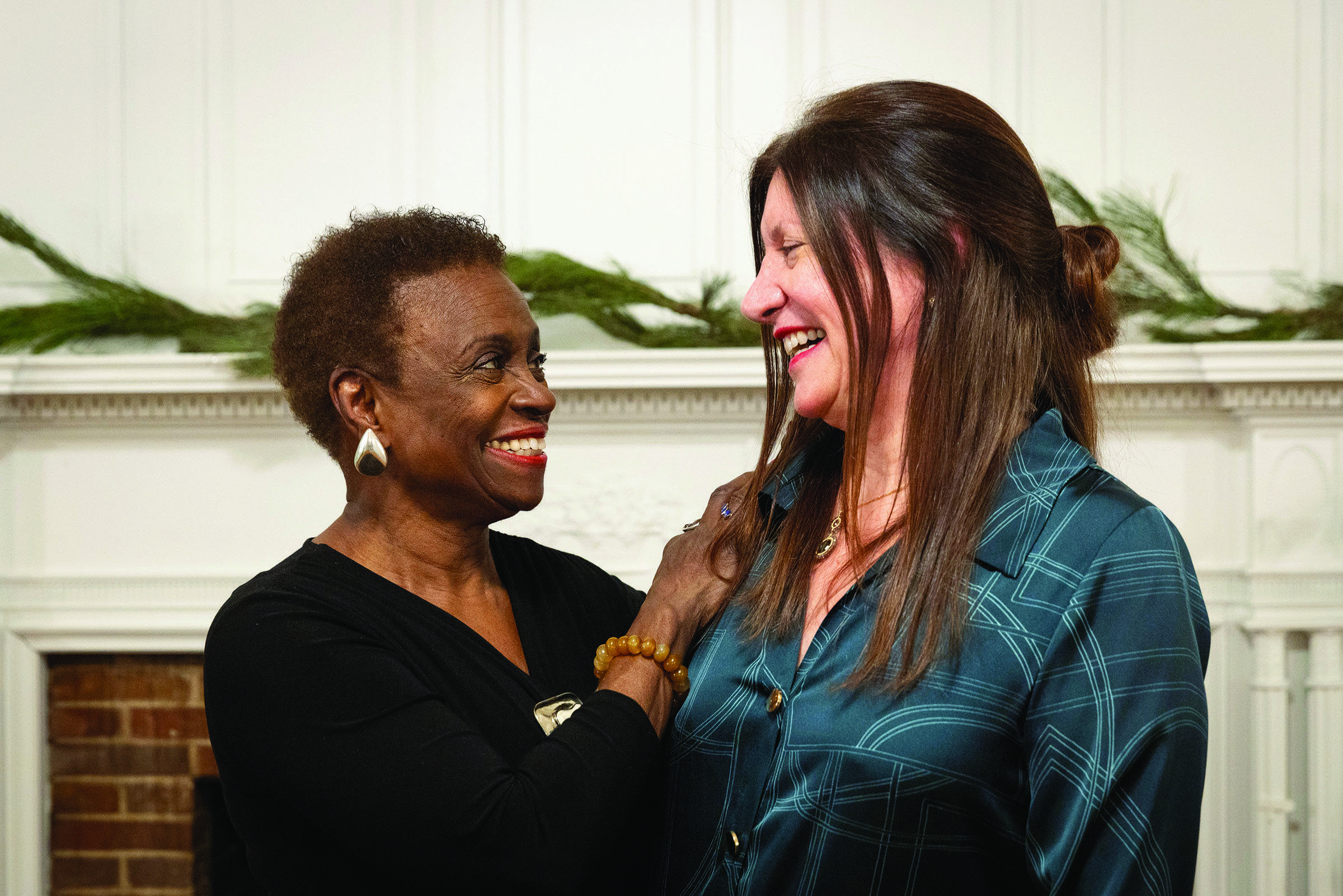
Audrey Rowe, left, with Nancy Gagnier, right, in December 2024, following the announcement of Rowe’s retirement as program director of the South Orange/Maplewood Community Coalition on Race. Photo by Mason Levison.
Friendship of Audrey Rowe and Nancy Gagnier
“We sometimes call social integration the last bastion or barrier,” said Audrey Rowe, the Coalition’s recently retired, long-time program director, as she and the Coalition’s executive director, Nancy Gagnier, 63, talked at HLS, a Springfield Ave. restaurant promising Health, Love, and Soul. “It can be the most difficult. People seem to expect that they’ll form relationships at work or school, but when it comes to who you’re going to invite to your house for dinner, that gets really personal. People on both sides, of all races, are a little bit more resistant.”
Even in New Jersey, which ties with Georgia for the sixth most diverse state in the nation, South Orange and Maplewood are rare in having such diverse demographic groups — their combined population of 44,168 is 54% white, 26% Black, 9% Hispanic, 6% two or more races, and 5% Asian. It’s even rarer in consciously taking steps to promote meaningful interactions among residents.
“We are a community that has committed to progressive values of racial equity and integration,” Gagnier said, “in a sea of racially isolated communities.”
Rowe, who is Black, has organized the group’s Conversations on Race, small-group discussions of topics like disinformation, and the racial wealth gap. About 110 people showed up for a talk last year on “Confronting the Backlash against DEI,” where people were assigned to tables well mixed by age, race, and ethnicity. Audience members heard from local and Coalition officials that the federal turn against diversity, equity, and inclusion threatened senior affordable housing and school programs, among other government functions.
She also ran Integration through the Arts, a program in which local artists lead weekly meetings, inviting residents to study opera, learn juggling, or practice improv or dance together.
“We can provide the opportunity to be in the room with someone you have a lot in common with, but you’d never know it because you may not ever meet,” said Rowe, just home from a trip to Los Angeles to watch her daughter, SZA, win more Grammies. She noted that members of a mural painting class last year were still getting together to go to an art exhibit.
“Things that are organized seem to be the things that ignite and sustain the relationship, organically,” Rowe said.
She and Gagnier, who is white, developed a strong bond of their own after Rowe helped train Gagnier in the director job.
“We were tied at the hip; we did everything together,” Gagnier said.
Rowe compared their friendship to a marriage.
“Without even going to her,” she said, “I’d say, ‘What would Nancy do?”
When they were working full-time in a two-person office they would go out to dinner, at Rowe’s beloved tacos and tequila joint, Red Cadillac, in Union. They’d sit together at Maplewoodstock and Giants of Jazz. Rowe attended Gagnier’s daughter’s bridal shower and was invited to the wedding.
But while friendships like theirs are what their organization envisions, Rowe admitted that it can take her and her friends of color a lot of effort to live in a white-dominated world, and she craves relaxation somewhere she doesn’t have to represent her race.
“If I’m exerting energy at work and school, when I come home I want to just be,” she said, exhaling broadly, “with nothing to prove, no stereotypes I have to counter, no worrying what it means if I’m late to something.” There are times, she conceded, when interacting with people who are very different “comes across as work.”
Also, humans in general want to be known, but are afraid to be known, she noted.
“We spend a lot of time with a little bit of a mask, and layering that with race and all these other assumptions and stereotypes makes it doubly difficult,” she said. “People are afraid of saying or doing the wrong thing, misreading what’s said or done, and it adds a lot of extra layers.”
Gagnier also found creating relationships across racial lines takes more than just buying a house in a diverse town. When she first moved to Maplewood she struggled to find integrated spaces. The mothers’ group she joined was very white, and they realized they had to be intentional in inviting moms of color to join.
“In places that do have the diversity, unless you have the intention and put in the work behind it, why wouldn’t people just keep doing what they’ve always done?” Gagnier said. “People are going to default to that, because it’s easier for them.”
Audrey’s and Nancy’s friendship began when they started working together at the Coalition in 2008, has outlasted numerous race-related flashpoints. Gagnier usually wrote the coalition’s statements on controversial issues, which must be approved by the Coalition’s board. She and Rowe would often talk the issues out first, finding themselves pretty much in step.
“What we vary on is tone, sometimes I’m much more aggressive, and Nancy is more looking long-term, so let’s massage it a little more,” Rowe said. “That’s the beauty of the partnership, and trust, and friendship. We not only work together but have such respect for each other as human beings.”
“We were tied at the hip, we did everything together,” Nancy said, adding that if she had doubts about the direction a statement was taking, Audrey was an “amazing soundboard.” “I’d say we don’t have time for this,” Audrey said.
“I’d say we’ve got to slow down,” for fear of offending someone, Nancy said. “That I’d say is the only tension.”
“Like, I’ve moved on…” Audrey said.
“…and I’m still losing sleep over it a year later.”
Rowe remains optimistic that progress will continue, given how the Coalition is about to start its third decade of work. “It’s an instant gratification society, but we’ve made slow progress,” she said. “We’re not going anywhere. We’re going to weather whatever storms come, and adjust to be relevant and address the issues.”
Some context about race and the towns
Some will argue that the current dearth of interracial and interethnic friendships is a white-people problem – caused in part by their self-segregating, reinforced by historically racist policies like redlining and shutting people of color out of the G.I. Bill and other opportunities for amassing generational wealth.
Nationally, the population is becoming more diverse. Less than half of Generation Z is white, and in the next 20 years most of the nation’s population will be made up of demographic groups formerly considered minorities.
But for many urban and suburban municipalities around the country, segregation is becoming worse. A 2021 study found that more than four out of five large metropolitan areas grew more segregated between 1990 and 2019, in part because of an increase in Asian and Latino populations, which tended to gravitate in concentrated areas. So even as the country becomes more diverse overall, it can be harder to find integrated neighborhoods and schools.
That can reduce the chances of white people creating more diverse networks.
“If you’re only surrounded by close friends who are also white, you’re less likely to support a more multiracial democracy, and less likely to think the legacy of slavery and discrimination still affects the lives of African Americans,” said Melissa Deckman, the chief executive officer of PRRI. “Having even one person who is not white in your friend network can really have a profound impact on your views.” For decades, social science has shown that knowing diverse people leads one to be more open, curious, understanding, and empathetic, she said.
To learn more, I reached out to a woman who had run a seminar by women of color just before the pandemic called “Allyship in the Racial Justice Movement.” Rhea Mokund-Beck, 49, a former trustee of the Coalition who describes herself as Black and mixed race, told a group of assembled white women that people of color can be wary of having white friends, because they tend to step on their toes, then ask why it hurts.
Especially after the last presidential election, when exit polls showed 53% of white women voted Republican, “The Black women I know have sort of just retreated into friendships and spaces that feel safe and affirming,” she said. “You put your hand on a hot stove and get burned, you don’t rush to do that again.”
Mokund-Beck is also a co-moderator of Maplewood Moms*, a raucous 9,800-member Facebook page for local parents, where many disagreements have racial undertones. (The * in the name recognizes “that not all members identify or associate with the terms, ‘Mama’ or ‘Mother.’”) Despite the frequent arguments she referees online, she thinks most of the women in town have cross-racial friendships that are quite intimate.
“Nothing is black and white, no pun intended,” she said, over a cup of tea at Jackie and Sons, on South Orange Ave.
“It’s not just about reunions and parties and good times,” she said of such relationships. “In order for them to be rich and real and lasting, they have to be quilted together, by transition and trouble and illness. For people who are in interracial relationships, that also means dealing with race. There’s no ignoring that. It’s one of the things that weaves the friendship.”
She noted that her own white friends tend to be from historically oppressed groups, including Jewish people and gay people, which makes sense to her: “We can talk about race and otherness quite openly.”
Another activist, Khadijah Costley White, 43, runs SOMA Justice, a non-profit addressing race and inequality, which, like the Coalition, has coordinated integrated social meetups. It created fellowship groups for adults wishing to expand their friend networks and has run a preschool book club featuring diverse offerings, alongside the Coalition’s integrated playgroups for toddlers.
But amid those efforts, White also sees the need for creating less integrated social settings.
“As a Black person in SOMA, generally, you’re pretty isolated at work,” said White, the first Black female tenured professor at the Rutgers University School of Communication and Information. “The folks who can afford it here are folks who are probably one of the only people of color in their office, so they’re already experiencing that level of isolation.” They often want to invest their time in social settings where they’re not “the only one.”
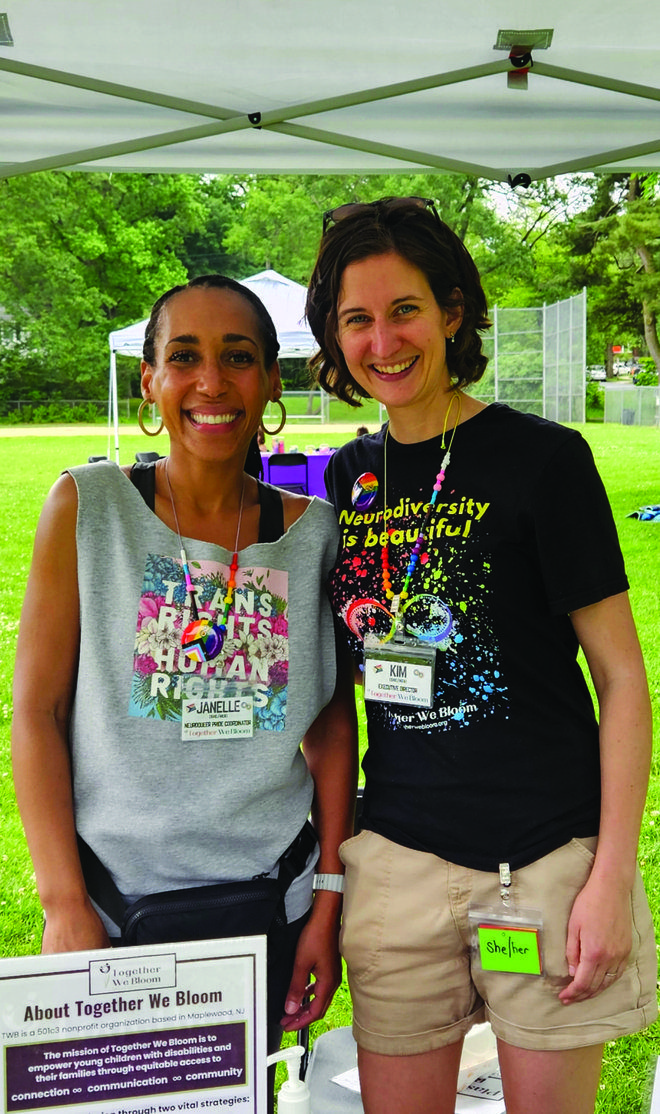
Janelle Gera, left, and Kim Takács representing their nonprofit organization, Together We Bloom, at the North Jersey Pride Festival in Maplewood on June 8, 2025.
Friendship of Janelle Gera and Kim Takács
Seeking friend pairs willing to talk, I asked for suggestions on the SOMA Justice Facebook group. Janelle Gera, 41, and Kim Takács, 36, volunteered. The two met at the baby sign language class Takács was teaching at Little Bee Learning Studio in Maplewood. Gera’s child, who doesn’t give away smiles easily, went over to Takács and plunked into her lap.
That gesture started the friendship, said Takács, who is white and says people have told her she “looks like a mom.”
The women found themselves both giggling at the same goofy things during the class, and their friendship grew via texts and voice messages.
Gera, who is Black, had signed up for all sorts of mom and baby activities, but she saw the white parents mostly sticking together, even at playdates billed as integrated.
“My impression was that white moms saw other white moms as a safe extension of their space, and I was less safe,” said Gera, who is 5’3 ½”. (Growing up with tall siblings, she’s proud of that extra half inch.) “I was less familiar, and just different.”
She knew that merely attending events with a mix of participants isn’t enough. “You have to try to speak to somebody who looks different from you,” she said.
Through their conversations, Gera came to admire Takács’s values, and how she doesn’t shrink from doing the hard, right thing, including around parenting. That meant accepting – without stress — the constant messes the little ones made. Gera said she gained from watching Takács tackle the kid chaos calmly.
Their friendship grew more intense during Covid lockdowns. Gera’s child was a terrible sleeper, and Gera would be on her phone late at night as a result. As new moms, they were trying to reconcile their recent and previous identities, learning how to meet other new mothers while they were still uncertain about what kind of mothers they were becoming. Takács was grateful that their conversations were deeper than those she’d had with other moms, where babies were often the only common focus.
“I think we talked every day in the start of the pandemic,” said Takács, who was new to town at the time. Gera smiled as Takács added, “Thank God, for so many reasons.”
They began working together to create Together We Bloom, a disability justice nonprofit that provides sliding-scale speech therapy to neurodiverse students. Takács, a speech language pathologist, is executive director, and Gera, who had done doctoral work in the critical philosophy of race, is a founding board member.
“I really got to experience the evolution of the idea, into something she was building, and has now built, and is doing this great work through,” Gera said. With the organization, Gera created a sensory room at St. Joseph’s Roman Catholic Church, for people who feel overstimulated during services.
“In having all those conversations, along the way there was also this dawning realization of where I sit in all of this,” said Gera, who had always known she was quirky and averse to small talk. “Kim really helped me by telling me about books she had read, and about her understanding of working with autistic children specifically.” In part through their conversations, Gera discovered she is autistic.
Since then, she has spoken to various grade levels at Bolden Elementary School about her neurodivergence. She was glad to help them understand that the chasm between neurotypical and neurodivergent people is much smaller than people think.
“It was an opportunity to stand there and say there are more of us who are weird and other than we recognize when we’re young. I don’t think I would’ve done it if it was something without Kim,” she said. “It could’ve been overwhelming with somebody I felt less comfortable with.”
Gera, who grew up in Montclair, another well-integrated suburb, had found it difficult to live in other more segregated cities and towns, recalling one former friend who, when Gera called her out for racially insensitive comments, defended herself and downplayed the issue rather than accepting Gera’s concerns and resolving to do better. Gera stepped away from the friendship.
With a different white and Jewish friend, Gera felt comfortable enough to express how her experience of oppression as a Black American gave her a view of the Israel-Hamas war that differed from that of her friend.
“I recognized I didn’t owe it to her, but recognized she’s a person who’s capable of hearing it, and empathizing, and understanding the point,” Gera said. “I know she will share those experiences with me, with any number of people who don’t relate with other Black people, or have the kinds of relationships where they would be able to have that intimate of a conversation,” she said. It’s a way of sharing her experiences in spaces that wouldn’t otherwise hear about them.
Takács, for her part, has noticed that SOMA’s vaunted diversity is a trait people can hide behind: “There are blind spots in the community we don’t recognize and acknowledge.” Few people understand the intersection of race and disability, for example, and so many families still want to hold on to all their white privilege, putting their children first and pushing for the best academic programs, not realizing that what’s best for the children might be a system where everyone has equal access.
“People say inclusion is so vital, oh but I don’t want my kid to walk to school or I don’t want to have to drive my kid to school,” she said. “They deeply believe in the inclusion of kids with disabilities, but don’t want to pay for any changes.”
She noted that the communities, more than most, foster friendships with people of different races, “yet there’s a ton of segregation in town, in the schools, in what gym you go to. You could live here and be mostly exposed to white people,” Takács said.
Gera and Takács call each other best friends, and four years ago, when Takács had her second child, she asked Gera to be his godmother.
“We speak of it as a chosen family,” Gera said of the two couples.
“All of us are so comfortable with each other, and with the kids and husbands, we could just kind of like do life together, in a really supportive way,” Takács said, recalling a weekend when Gera’s husband, Varun, was installing a bike rack on his car in Takács’ driveway, Gera and Takács went to the gym while the men watched the kids, then Varun and Takács headed to Home Depot, while the kids played outside all day.
Gera said she loves Takács’s proactive energy and ability to dig in, in an engaged way, in a variety of aspects of her life. “Let that be a contagious energy that hypes me up,” Gera said. “I don’t know if I have had a friend in my life that I’ve shared both of these versions of friendship with, the depth, and the regularity in which we’re engaging.” The women say their friendship took root because, even though Takács came from what she called a sheltered, private-school background, Gera is not her first Black friend.
“A lot of that work was done before me,” said Gera, who feels if people haven’t made diverse friends by their thirties, they’ve made a choice to live in a kind of bubble. “I’m looking to talk to somebody who’s made different kinds of decisions.”
Takács has tried to educate herself by listening to audiobooks, following people she can learn from on social media, and joining a book club of white residents inspired by SOMA Justice to study Me and White Supremacy: Combat Racism, Change the World, and Become a Good Ancestor.
While Gera has had to explain to Takács some aspects of her experience as a Black person in America, “I don’t think there’s ever been a time it felt like I can’t have this conversation with Kim because she’s a white woman.”
That said, Gera said it’s still important for there to be space for Black people to share complaints about how some white people treat them.
“None of us is under the illusion that Kim can magically put herself in the Black experience and know what it is, but can Kim empathize from a human space, about what it would be to have this body of experience?” Gera said.
Likewise, Takács said there are conversations about racism that she has with white friends that she doesn’t feel the need to bring to her friends of color. And when their group chat with three Black women and two white women discusses racist incidents — like when a Black mom was mistaken for a nanny at school — Takács said she feels comfortable offering support, but not advice.
While the two have found great joy and meaning in their friendship, they’re not comfortable saying other people necessarily should go out and make friends across races.
“It’s horrifying that two-thirds of white Americans are only friends with white Americans, but to say should, I think takes away from the fact that we as white people need to do the work, to be in a place where we’re not going to bring harm to that relationship,” Takács said. “To say oh those two-thirds should ‘go [befriend] Black people,’ that’s going to be harmful in and of itself without internal anti-racist work, and understanding the differences of the experiences of different races.”
She continued to educate herself after realizing, back around 2019, that her good intentions could harm people of color. When it was her turn to pick the topic to discuss at a staff meeting of speech pathologists, she chose anti-racism, not realizing that it would make her outnumbered Black colleagues feel singled out and uncomfortable. In retrospect, she said she should’ve had a meeting separately with her white co-workers to figure out how to work against racism, without making their coworkers feel uncomfortable.
“With privilege, unless we start to pay attention and examine it, we don’t notice it,” she said, explaining that for white people, one form of privilege is the lack of danger or annoyance, the lack of worrying about the police or being followed around a store by suspicious shopkeepers.
“There were so many pieces I wasn’t aware of until I started to actively learn about it. Unless you’re willing to go out and learn,” she said, “if you’re continually unaware of those moments of privilege and the absences of something, that’s when inadvertent harm can happen.” She believes that if she didn’t understand how systemic racism works, it would be harder for Gera to trust her, and their friendship would have been in danger of remaining on a surface level.
“Even if I wasn’t actively doing harm, there’s no way I could be a safe person for her to share moments with,” she said. “Janelle has taught me so much, just from listening to her experiences. I wouldn’t want her needing to do all this emotional labor to get me off the learning curve.”
Looking back at their typical weekends of hanging out together as families, Takacs said, “These aren’t huge life moments, but little life moments with someone you fully trust and love and care about in such a deep way,” Takács said – yes, she knows which drawer Gera keeps her forks in. Gera estimates the families get together three times a month, plus the moms meet up for work and for impromptu visits to parks with the kids.
“The fact that we have very shared values with our husbands, around so many different things, creates a lot of space for being generous with one another if there’s a misunderstanding,” Gera said. “If you trust someone’s values, you move through that.”
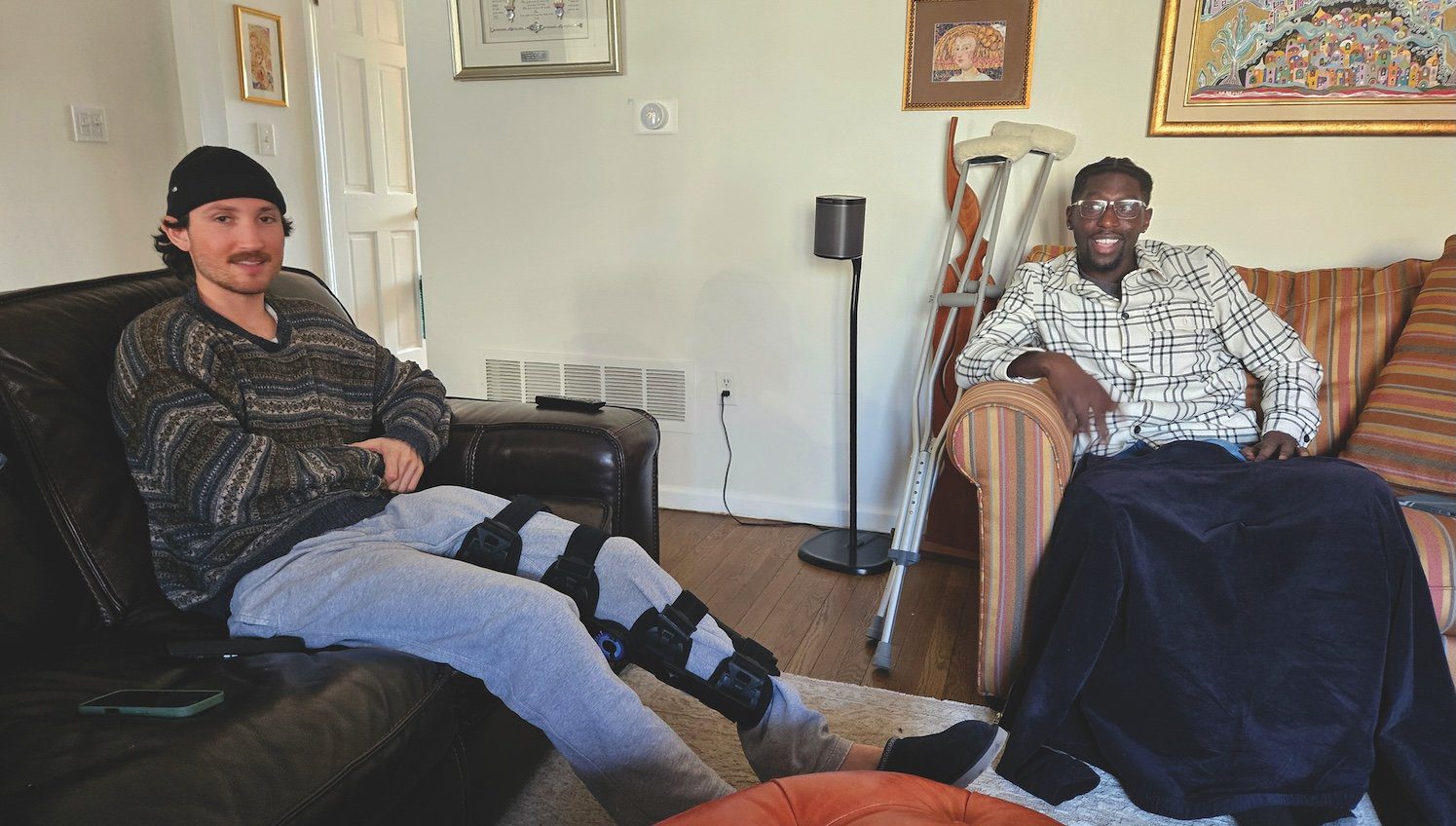
Avi Ramer, left, and Anthony Agu, right, at the home of Ramer’s mother in South Orange, New Jersey, on March 2, 2025. Photo by Tina Kelley.
Friendship of Anthony Agu and Avi Ramer
Demographic trends suggest that younger white people are more likely than older ones to build friendships across racial and ethnic lines. The PRRI study showed that while about a quarter of white Americans 65 and older have friend groups with some racial or ethnic diversity, almost a third of those ages 50 to 64 do. And 43 percent of white 18- to 29-year-olds, those in Generation Z, have at least some Black, Hispanic, or Asian friends.
As the population of Black and Hispanic Americans grows, segregated friend networks may decline going forward. The study found people of color are more likely than whites to have diverse friends – of Black Americans, only 46% have just Black friends; 37% of Hispanic Americans have just Hispanic friends.
“One in two Zoomers is not white, and that has a really profound impact on their politics and outlook,” said Melissa Deckman, the chief executive officer of PRRI, referring to members of Generation Z.
Two young graduates of the district’s Columbia High School say their friendship has given them insights they would not have had in segregated friend groups. Avi Ramer, 26, and Anthony Agu, 25, met in a math class where they were two tenth graders in a class full of accelerated eighth graders.
“We had to band together, and instantly became friends in class,” said Ramer, who is white. Ramer had come from a nearby Jewish academy he said was all white, but he wanted a more diverse high school; Agu had gone to nearby Irvington schools through sixth grade. Both were surprised how Columbia students tended to form homogenous friend groups.
Agu, who tends to pause to consider questions and number the points he’s making, said he mostly hung out with Black kids in high school, while Ramer said he had two social groups, white Jewish guys and friends of color. Ramer noticed that when he hung out with his Black friends, he tended to do more than hang out in basements playing video games.
“We’d go out, play basketball, go to the mall, or drive around aimlessly,” he said. “We’d be out in the world way more.”
When Agu, a first-generation Nigerian-American, would hang out with white friends, in their bedrooms, basements, or other spots, he recalled finding it unusual that they sometimes left their doors unlocked, arranged for frequent takeout deliveries, and had cleaning ladies. He was surprised by how many places his white friends had visited, and how many live professional sports games they had attended.
“I kind of got used to not expecting everybody to have the same life as me,” he said.
He enjoyed bonding with the parents of his white friends, and calls Ramer’s mother “Mom.” It was different with his Black friends, he said, as he didn’t visit their homes, in part due to his family’s hospitality traditions.
“When you come into my house I formally seat you, you can snap your fingers and I get you what you need,” Agu said. “I have food for you even if you’re here for only 15 or 20 minutes. This is routine. I’ve seen my parents do it.” Such hospitality is usually reserved for grownups.
At Columbia Ramer and Agu noticed other ways their experiences differed. When Ramer wanted to take a higher-level social studies class, he asked his school counselor, and it happened. When Agu wanted to level up, he and his counselor worked out a plan where if he got good grades in the next quarter, he’d move up a level. For some of his Black friends, however, it was more difficult.
“My friends went through war,” Agu said. “Like it was always ‘are you sure, have you considered doing another year at your current level, I don’t think you’re ready for it…’ There were no words of encouragement, it was more like blockages.”
When the Black friends compared notes later, they were extra upset, as they hadn’t realized at the time that they were experiencing what Pres. George W. Bush once called the “soft bigotry of low expectations.”
“They didn’t know exactly how to feel about it during the time,” Agu said, as he sat in Ramer’s mother’s townhouse in South Orange. Ramer was back from his job in Colorado, awaiting knee surgery after a ski injury. “Here was a person of authority saying, ‘don’t do this.’”
In their conversations they noticed many ways they were treated differently. At traffic stops, police were more likely to give Ramer a pass. When Ramer posted about this on social media, Black friends left comments saying “MBN” — it Must Be Nice to be treated so leniently.
Agu has found in his relationships that cross racial lines, he has had to learn to maneuver around challenges, if a friend’s grandfather or uncle came off as a little standoffish or racist, for example.
“Being able to confront it head on, the acknowledgement of the wrongdoings and taking the lessons from that situation,” he said, “it’s not an easy thing to do.”
Talking about such topics can add conflict to the usually lighthearted dynamics of a friendship.
“I think that takes a lot of love, heart, open-mindedness, and critical thinking skills, to be able to see something from an end you’re not familiar with,” Agu said. “It’s a science, and it’s an art to have tough conversations.”
The two friends had their longest conversation about race in 2020, after Minneapolis police officer Derek Chauvin killed George Floyd by kneeling on his neck for more than nine minutes. Hanging out at Ramer’s, the friends spent more than an hour talking. Agu had always known that parts of the world didn’t accept people who look like him, but his social media feed left no doubt.
“It was a constant reminder, day after day, of a new killing and a new life lost,” he said. “I felt put in a position, especially at that age, that I was not ready to consume all of that. And at the same time, I was forced to ask myself certain questions and understand certain realities of the world I’m living in. And it sucked.”
Ramer, Agu said, did “a great job” helping him process the tragedy.
“Obviously, I have Black friends,” Agu said. “But it’s a different dynamic.” He needed his Black friends to mourn with, and Ramer to vent at.
Ramer remembers his own social media feed at the time, when his Black friends were saying, in effect, “You don’t understand what it’s like for us to watch all these videos, of people who look like us. This could happen to me at the hands of people who are supposed to be protecting us,” he said. “That is something heavy that I’ll never understand.” Even though it couldn’t happen to him in the same way, he gained compassion for his friends.
Despite differences in their experiences, Agu found the discussion helpful.
“What I appreciated about it was just having a conversation with someone who didn’t look like me, but I was still receiving reassurance and empathy,” Agu said. “His empathy is actually through the roof.”
Both young men have thought about the pros and cons of interracial friendship.
Ramer said one of his white friends once asked him why he hung out with Black kids.
“I was like, ‘What do you mean? I enjoy hanging out with them.’ That was my response. He was like, ‘They’re weird.’ I said, ‘What do you mean? I’m weird.’” Ramer said his friendships with Agu and other people of other races have kept him from limiting himself.
“In a very simple sense, I’m experiencing the real world,” he said. “I don’t know if that’s weird to say.”
At the same time, he conceded he has experienced deeper, more painful emotions when his friends of color were hurting from the headlines.
Ramer said the Floyd murder hit him a lot harder than it would’ve if he hadn’t had close friends of color: “If you’re only friends with one specific community, you’re never going to feel pain unless that community is affected.”
Agu has reciprocated when he and Ramer had long discussions about the Israel-Hamas conflict, which Agu felt a need to stay informed about.
“At the end of the day it is a win, because you know more about the world, you don’t get stuck to your own ways and your own world,” Agu said. “Now you have two communities to care about and have empathy for. It sucks, when people’s feelings get hurt. But at the same time, their wins are also my wins.”
Agu also said going to Columbia prepared him well for his professional life as a business analyst, where his coworkers are also very diverse.
“It made me more open-minded to the world,” Agu said. “I had a better set of questions to learn about somebody, because I was thrown on that track many times.”
Ramer noted that there are challenges in interracial friendships, and he spoke of “having to work a little harder for the relationships” because friends don’t all come from the same culture or religion, so there’s some learning required to understand each other better at first. For example, he said his white friends were at ease recognizing the Judaica in his house, and their parents all sounded happy that their sons were hanging out together, he said.
Insights from advocates
As in many suburbs, some of the most contentious conflicts in South Orange and Maplewood center around schools. Many people move here expecting an excellent education, and the kind of attention their children need, when they need it. That can come into conflict with the equity-focused understanding that all students thrive most in a district that best meets everyone’s needs, including for high-quality special education and for integrated classrooms.
The district’s Intentional Integration Initiative — or Triple I — is working to address the racial segregation in the towns’ six elementary schools, where one was about 70% Black and two were about 70% white. The plan, introduced in 2021, has been largely successful in balancing the elementary schools, but faced backlash over transportation or the lack thereof, and the absence of a transfer portal, which district leaders said would negate the spirit of integration. The board of education ultimately approved a socioeconomic status (SES)-neutral transfer portal. And the administration is now beta testing zones, expanding the variance in its placement algorithm, and ending Triple I placements in the middle schools, — citing busing delays and costs.
The schools have long struggled with a significant achievement gap among races, a federal lawsuit over discriminatory practices in class assignment methods and discipline policies, and too few students of color in Advanced Placement classes.
“Right now there are still too many Black students who not only don’t get the support in the AP classes, and they don’t feel welcome in their AP classes,” said T.J. Whitaker, who has taught Literature of the African Diaspora and AP African American Studies at Columbia. “I’ve heard it described to me oftentimes after the first quarter, black students or students of color will opt out, having a footprint on their back, almost like ‘you don’t belong here.’”
“The veneer of diversity, the veneer of acceptance for all, is oftentimes exposed at the high school,” he said.
Whitaker, who sent his daughter through the district schools, sees friendships across race and ethnicity starting early in SOMA, some lasting through high school, even though the groupings of students in Columbia’s cafeteria look pretty homogeneous.
“I think that most of them at some point in middle school, if not early high school, those childhood relationships begin to either fracture or spread thin” as teens are increasingly influenced by popular culture and families, he said.
“They get to high school and the adult world becoming open to them, I think those who have the wherewithal to think differently through difficult concepts can see themselves through the racism, the white supremacy, the patriarchy. And if they don’t outright reject it, they question it as teenagers. But I think far too many drink the Kool-Aid.”
I wanted to hear from one of the founders of the Coalition: Robert Marchman, 68, a former Wall Street executive who is Black and saw the need for conversations around integration soon after he moved to Maplewood in 1991. He remembers being steered to less prestigious parts of town by his first real estate agent, then overhearing one white man on the train tell another that he was selling his house because the community was in “an irreversible downward spiral” due to Black people moving in.
“Because of our intentionality, we reversed that,” Marchman said.
Over the years the group trained real estate agents on equitable practices, created an integrated choir for adults, and advertised in 14 different Brooklyn newspapers, encouraging white families, artists, and others seeking an integrated community to move to town. The Coalition also helped people open their homes to events and to create neighborhood associations, “so people not only lived on the same block, but engaged,” Marchman said.
“We focused on getting people together to meet, talk, dialogue, have candid conversations, to counter head-on the irrational fears people were having,” he said. “A lot of that was based on a lack of engagement and lack of exposures. We worked on those, and those have been kind of the building blocks.”
While there’s of course no central local databank of friendships across demographic lines, Nancy Gagnier, the Coalition’s executive director, has seen such relationships become more prevalent, at least among the group’s board members.
“They have much more integrated friendships than I’ve ever seen,” Gagnier said. “Their families are friends, their kids are friends, they vacation together, and they work on projects together in the community. It’s been so inspirational to me.”
Religious leaders in town who have served on the Coalition board agree that conversations are central to creating that community where true friendships flourish.
Rev. Liz Testa, a pastor with the Reformed Church of America who lives in South Orange, was introduced to the area through one of the Coalition’s early bus tours welcoming New Yorkers, and she moved onto a block with adoptive families, Jewish families, Black families, and three clergy members. Later, a Sri Lankan family and a Buddhist family moved in. She enjoyed singing in the Coalition’s Two Towns in Harmony choir.
Testa, a Latin-Mediterranean American, describes what she calls the communities’ need for “equitable hospitality.”
“What I think is a tension point is here is, sometimes there’s an assumption that everybody’s on the same page, and everybody’s done the work,” she said. “I have been in some spaces where there have been white people, Anglo people, who show up and appear to be allies,” but don’t yet have the tools and make people of color feel less safe.
“There’s always space for the deep and the wide,” she said. “You go deeper with a core group of people and go wide to embrace people” who still have more to learn. It’s important to welcome those who think that they embody anti-racism and can jump right into the Coalition’s work, but may need to learn more deeply first.
“This is not a quick fix, and you can’t take anything for granted,” she said. “In the work of racial reconciliation, healing, and wholeness, pain is involved, so people would rather not get started. It’s too painful, there’s pride involved, and the ego is huge.”
But the work is necessary, she said: “We’re overriding a system that would keep us apart. It’s entrenched, and our society has a deep stake in it.”
Another pastor, Terry Richardson, 60, of the First Baptist Church of South Orange — once considered the only Black church in town, and now building a more diverse congregation — said the divisions people have built should never have been erected.
“What I like about Jesus is He really comes to break down those barriers,” he said. There must be a purpose to all the diversity in this life, he argues, or it wouldn’t exist.
To develop friendships across differences, so much depends on getting to know another person’s authentic voice and experience through listening carefully, he said.
“If I only listen through my experiences and narrative,” he said, “I’ll put up a wall, and lock it, then and there.”
The race-related conversations sponsored by the Coalition, now an independent nonprofit, have evolved well over the years, he said.
“We have to be intentional about it,” he said, over coffee in a shop across Valley St. from his sanctuary. “There’s no way for me to know you if we’re constantly separated.”
Recent demographic changes
After two decades of work maintaining and celebrating SOMA’s diversity and stopping white flight, the Coalition in 2016 published population trends in the towns suggesting it may have been almost too successful in its mission.
From 2000 to 2010 SOMA’s demographic mix was stable, and in the early 2010s, overall diversity and integration on the neighborhood level increased. But starting in 2007, the proportion of Black homebuyers started to decline. And average home values rose steeply – up 78% in South Orange to $1.1 million in the last eight years; the average home value in Maplewood was $938,000, up 72% from 2017, according to Zillow. Meanwhile, more people moving into the towns were white, Hispanic, or Asian. Between 2010 and 2020, the towns lost 10% of their Black population, and 5% of its Black-plus-other-races residents.
While the Coalition started off advertising the towns to white people to preserve SOMA’s diversity, it is now marketing the towns to Black and Hispanic future residents, and offering $15,000 Wealth Gap Equalizer Loans for families of color who are first-time home buyers.
Mokund-Beck worries that as wealthier white families buy into formerly affordable neighborhoods, the towns’ devotion to diversity may fade.
“I think we’re in that swing away from our reckoning with race,” Mokund-Beck said. “I think for the most part, white America thinks it’s done that already, and there are more pressing things to be reckoned with now.”
“Maybe we outlasted our time here in SOMA,” she said. “The SOMA we bought into is harder and hard to find, except in little pockets.”
Her friend Jan Oosting, who partnered with her to help persuade the school district to find a new name for Jefferson Elementary School, echoes that concern.
“We as white people see something diverse and good and rich, and take it over and colonize it,” she said. “We are our own worst enemies.” She wants to avoid the echo chambers that develop when communities are poorly integrated and lack the kind of friendships she has valued in SOMA.
“These relationships do actually cause you to question your own conscious and unconscious biases and challenge some of those assumptions you might have,” she said. “These relationships are not a burden, they’re a gift. Diversity in its purest form is a gift to all of us. It’s something that enriches us.”
Friendship of Jessica Mingusa and Rachel Henes
Mokund-Beck introduced me to Jessica Mingus, 46, who is Black, of multiracial descent, and Rachel Henes, 47, who is white, who met at a fellowship group sponsored by SOMA Justice for young mothers seeking new and diverse friends. They had a lot to talk about – their children, who were eventually diagnosed with special needs, how racism pervades special education, and how some of the Facebook conversations in town went off the rails (no, Maplewood Moms* will not help you find a mall Santa who doesn’t have a Spanish accent.)
After their first walk around and around DeHart Park, they proclaimed that they would work together, and they are building the Care Lab Collective, a business for parents of neurodivergent children who have experienced racism and ableism in the schools. With Together We bloom, the nonprofit Takács and Gera created with similar goals, they’re developing trainings for school and PTA leaders on how to create the most welcoming environments for neurodivergent students. They believe parents who find themselves fighting the school system need special mindfulness skills to defuse those fraught interactions. The practices can apply to relationships as well, Henes said.
“A main barrier to any kind of friendships across difference is unprocessed fight-or-flight nervous system energy,” said Henes, who accentuates her main points with her hands. Plus, when people are stressed or too busy, they often will seek out whoever appears the safest person, she said, “as opposed to having time and space to actually seek out people that you might feel most connected to.”
“To build authentic friendships cross-racially, as white people, if we’re not doing nervous system work, you’re going to be triggered by all the things inherent in that experience,” she said. “It all comes down to slowing down, and breathing.” People tense up and become more difficult to connect with if they’re worried about saying the wrong thing, she said. Ideally, they would notice their physical sensations, breathe, and sit with them.
Mingus has noticed that too often, people move to SOMA and feel they can check “support diversity” off their to-do list. Then they interact only with people just like themselves.
“How do we build real community, not the kind of community where the farther up the hill you get” — as the houses get more expensive — “the integration of the neighborhood goes down and the number of Black Lives Matter signs go up?”
Henes added, “If we’re a family that doesn’t have friends of color, are we talking to our kids about this – this is what structural racism looks like, this is our block of all white people,” she said. “Obviously being in the same community is important, but what are we doing with the diversity around us? Are we tending to it?”
Belonging would cut across all dimensions of difference, including LGBTQ status, disabilities, and socioeconomics.
“Everybody deserves to belong. No one has to earn belonging,” Mingus said. “We need community conversations that have the capacity to hold all the nuance and complexity of it. If not, we really don’t get to all the root causes that make us kind of stall in one place.”
The work can be “glacially slow,” she added. “The idea is like planting seeds for trees you’re not going to enjoy the shade of yourself. It’s ancestral work.”
And it comes down to daily choices. “It’s who we invited to the barbeque, who we have the playdate with, who your parent friends are,” Mingus said. “If your kids see you living a life that ignores diversity, you’ll be teaching them those values.”
Experts on friendship across barriers
Experts in the field of interracial friendship have valuable thoughts about what makes them more likely to grow and to thrive.
Both people need to be willing to tell the unfiltered truth, and both need to be willing to take a break when missteps happen, said Kimberlee Yolanda Williams, author of Dear White Woman, Please Come Home: Hand Me Your Bias, and I’ll Show You Our Connection.
“Just because you have good intentions and you want to build this friendship, it doesn’t mean who you’ve been conditioned to be will not show up,” she said.
History and culture have held some of her white friends back from knowing the appropriateness of their actions in the moment, for example, when one asked her, in a group discussion of DNA test kits, about her genetic ancestry, “like they didn’t know, that my ancestry is tied to slavery,” she said. “How can you so lightheartedly ask?”
As a leader of diversity, equity and inclusion trainings in Washington State, Williams teaches people that if they have been the perpetrator of a microaggression, to own it, apologize, and don’t circle back. When a friend apologizes extra times or tries to make sure the victim is ok, it is an attempt to assuage his or her guilt over the error.
“Your guilt belongs with the person you give your co-pay to, your counselor,” she said, “or your best friend or your dog or your cat.” Asking “are we good?” or requesting affirmation just adds to the wronged person’s burden.
She advises white people that sometimes, if trust needs to be established, it’s best to be upfront about why they are in place where people might not expect or welcome them, based on how they look. She gave the example of a white grandmother, coming into a Black hair salon with her biracial granddaughter, whose hair was knotted. The woman was humble in asking for instruction taking care of the girl’s long hair, which ended up needing to be cut. She explained why she was not looking to take anything from the community, but to be part of the work, and she was not expecting to be trusted, because of the history of how white people had behaved toward people in the salon in the past.
“That’s how relationships are formed. If we’re not willing to say out loud the things we know people are thinking, we’ll never get past the pretense, to get to the point of authenticity,” Williams said.
Similarly, when she’s presenting diversity trainings, she addresses upfront the misconceptions her audience may have.
“I tell them I’m here to help you build relationships on your team,” she said. “And you see people’s shoulders come down.”
Williams has found huge benefits to her interracial friendships.
“I’ve expanded my palate where music and food are concerned, and travel,” she said. “I’ve been a lot more adventurous because of my friendships with white folks, a lot less fearful. I’ve been a lot more open, and a lot more curious, instead of rigid.” And traveling with white friends has given her access to places she would not have felt comfortable by herself.
*
Melvin J. Gravely II, author of Dear White Friend: The Realities of Race, the Power of Relationships and Our Path to Equity, is unsure who’s responsible for the dearth of diversity in white Americans’ friend networks.
“I go back and forth as to whether it’s a white people problem,” he said. “I think we’ve still got some ways to go to be fully authentic and comfortable across racial lines, where conversation flows and the landmines are not so present, political and cultural landmines.”
If white people reach out, he said, “Many of us don’t say yes, we say, ‘I’m good, I’m good with my Black friends.’”
Gravely runs a construction company in Cincinnati, and its success hinges on his broad network of developers and investors across many political, racial, and cultural spheres.
“I’ll have people talk about abortion, politics, race,” he said, “and no I actually don’t agree with them. No one wants that at their dinner party. But I’m not going to sit there and say I agree, I’m not that guy.”
Race adds another set of complexities to discussions of controversial topics, he has found: “Usually, it’s the person of color who gives up who they are to assimilate into another group. If you’re unwilling to do that, that is the cost. I think about the cost a lot, in order to have access to the opportunities, in our case, to the civic infrastructure for me to grow a business.”
He knows the opportunity to be together gives people the chance to understand each other across silos, be they political, racial, or religious. But generally, people tend to congregate with others they have a lot in common with, and he doesn’t have that luxury.
“It wears me out, how to doublethink the way I say the next thing, how to be who I am and not be so offensive that I don’t get invited back,” he said. “That narrow passageway will wear you out, and your Black friends also think you’re too connected. I was considered too accommodating to white people, and that doesn’t feel so cool, so there are a lot of incentives not to do that.”
He wrote his book in part to help white people understand such challenges.
“If I were white, I don’t know how I’d know what it’s like to be Black,” he said. “How would I expect them to know something they didn’t get taught in school?”
He’s pleased that his book has made positive ripples, with one reader pausing the creation of a commercial real estate investment fund ensuring it included Black investors, and another starting a leadership development program for architects of color.
As for the conditions that help interracial friendships thrive, for Gravely it comes down to one trait:
“I happen to believe if you don’t have a bidirectional level of empathy, it’ll be hard,” he said. “If I’m going to judge you and check every word you use, and everything you say you have to be worried about how you say it with me, we’re going to have a really tough time…We’ve mutually got to have some empathy, some curiosity of perspective, about why do you feel the way you feel, while not judging.”
*
Paul Reck, a professor at Ramapo College, writes of his relationships with four Black godchildren in Straddling White and Black Worlds: How Interpersonal Interactions with Young Black People Forever Altered a White Man’s Understanding of Race. He’s concerned about the toll current levels of segregation pose to the development of young people, down to the classroom level. When he taught high school, he saw how tracks created by ability limited student interactions across races, and he saw administrators failing to provide activities outside class that would make it more likely for friendships to grow.
The same applies to the workplace.
“There needs to be more informal opportunities, somewhere for some kind of socializing, like bowling,” he said. “The first step, you have to come up with ways to establish meaningful spaces where people can get to know one another.” His college, for example, held retreats and workshops where people brainstormed and did activities where they shared personal experiences and made connections.
“They shared their humanity, and you can’t expect that to just happen in the workplace or in school by itself,” he said.
He’s also bothered by how whitewashed the education system is.
“We learn very little about people of color and the history of racism in this society, so we’re not developing a vicarious understanding,” he said. That lack of knowledge makes people avoid interactions where their ignorance would be exposed.
“What I emphasize is, it’s important to have a self-deprecating sense of humor, where you open yourself up to learning and making mistakes and doing better,” he said.
And for white people, there’s a critical need for empathetic listening, which can be challenging to teach.
“That’s definitely something that’s essential to breaking down the problematic dynamic we see, that dismissiveness of the experience of people of color, particularly of Blacks,” he said.
*
In his 2022 book, Stars and Shadows: The Politics of Interracial Friendship from Jefferson to Obama, Saladin Ambar harkens back to The Souls of Black Folk, the book W.E.B. Dubois wrote in 1903. Dubois wrote, “in a world where a social cigar or a cup of tea together means more than legislative halls and magazine articles and speeches—one can imagine the consequences of the almost utter absence of such social amenities between estranged races.”
The rarity of white people having relationships with individuals of color, Ambar said, “suggests maybe we haven’t really advanced all that much since that time.”
His book looks at interracial friendships that were part of a larger democratic project, like Mary McLeod Bethune and Eleanor Roosevelt, Ella Fitzgerald and Marilyn Monroe, and James Baldwin and Marlon Brando, who worked for racial justice in the course of their friendships.
Part of what made those friendships grow was the ability to disagree, he said, noting that a lack of arguments in a relationship could be a sign of repressed elements.
“Can we get along with the masks off, when we’re in loving disagreement? Friends can fight, can disagree and have a different perspective, and what I think is so important is authenticity and sincerity,” said Ambar, a scholar at the Eagleton Institute of Politics at Rutgers University.
“American democracy, a large multiracial democracy, is premised on the idea that diverse groups of people can come together to make decisions about each other in public, and we can’t do that if we don’t believe in the inherent quality of the other person,” he said.
Ambar notes a strong need for such friendships in the current political moment, which is “frought with rather reductionist ideas about who is more representative as American.”
“Politicians are going to politician,” he said. “The onus is on us to build meaningful relationships, and if we do it right, we can create a different kind of human relationship. That’s the kind of project I want to be part of. That’s a world I want to see, with empowerment among regular people.”
He believes it’s possible to create a country where friendships find fewer barriers across race and ethnicity. “I’m hopeful we can always choose to do something better than what has gone before, better than what we grew up with.”
This article was supported by a fellowship from New America. A shorter version of it appeared in The Progressive.